


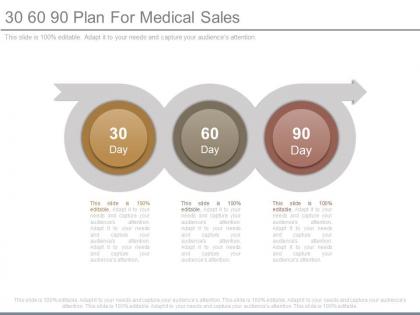
30 60 90 plan for medical sales powerpoint slides




Try Before you Buy Download Free Sample Product
 Impress Your
 Audience
 100%
100% Editable
 Save Hours
 of Time


Differences end with our 30 60 90 Plan For Medical Sales Powerpoint Slides. They assure folks gather round.
People who downloaded this PowerPoint presentation also viewed the following :
30 60 90 plan for medical sales powerpoint slides with all 7 slides:
Consolidate your gains with our 30 60 90 Plan For Medical Sales Powerpoint Slides. Gather in the praises your thoughts receive.
FAQs for 30 60 90 plan for medical
Key components include territory analysis, relationship mapping, product knowledge mastery, compliance training, and goal establishment for the first 30 days. During days 31-90, medical sales professionals focus on client meetings, needs assessments, competitive positioning, and pipeline development, with many finding that structured onboarding accelerates relationship building and revenue generation.
New medical sales representatives can align with company objectives by incorporating revenue targets, product knowledge mastery, territory analysis, and relationship building into their structured timeline. During the first 30 days, focus on understanding company protocols and market landscape, while days 60-90 emphasize client acquisition and sales pipeline development, ultimately delivering measurable results that support broader organizational growth and market penetration goals.
Initial 30-day strategies include comprehensive territory analysis, relationship building with key healthcare providers, product knowledge mastery, competitive landscape assessment, and establishing consistent prospecting routines. These foundational activities enable medical sales professionals to identify high-priority accounts, understand decision-maker hierarchies, and develop targeted messaging approaches, ultimately delivering faster relationship development and stronger positioning within their assigned territories.
Industry research enables medical sales reps to identify key market trends, competitor positioning, therapeutic gaps, and prescriber preferences when developing their strategic plans. Through comprehensive market analysis, reps can prioritize high-potential accounts, tailor messaging to clinical needs, and anticipate objections, while establishing credible relationships with healthcare providers who increasingly value data-driven insights.
Relationship-building with healthcare providers forms the foundation of medical sales success, involving trust establishment, credibility demonstration, understanding provider needs, and positioning yourself as a clinical resource rather than just a vendor. These relationships enable deeper product discussions, faster adoption cycles, and collaborative problem-solving, with many medical sales professionals finding that strong early connections ultimately deliver sustained territory growth and competitive advantage.
A 30-60-90 day plan enables medical sales professionals to systematically assess territory characteristics, competitor landscapes, and healthcare provider preferences while building strategic relationships with key decision-makers. This structured approach helps representatives identify high-potential accounts, understand regional compliance requirements, and adapt their sales strategies accordingly, ultimately delivering faster territory penetration and improved sales performance.
Key metrics include client acquisition rates, pipeline progression, revenue targets, product knowledge assessments, and relationship-building milestones across each timeframe. These measurements enable medical sales teams by tracking early engagement success, mid-term conversion rates, and long-term revenue generation, with many healthcare organizations finding that consistent metric monitoring ultimately delivers improved sales performance and stronger market penetration.
Medical sales reps can identify and prioritize key accounts by analyzing hospital volume data, physician prescribing patterns, current competitor presence, and potential revenue opportunities within their territory. Through systematic research of healthcare facilities, insurance networks, and specialist practices, reps can categorize prospects by conversion likelihood and strategic value, ultimately focusing initial efforts on high-impact accounts with established relationships and demonstrated needs.
Medical sales professionals can leverage CRM systems, territory mapping software, clinical research databases, competitive intelligence platforms, and presentation templates to optimize their 30-60-90 day plans. These tools streamline prospecting, enhance client relationships, and accelerate market penetration by providing data-driven insights, automating follow-ups, and delivering compelling value propositions, ultimately enabling faster territory development and stronger healthcare provider partnerships.
Feedback from management and peers enhances medical sales 30-60-90 plans by refining territory strategies, identifying overlooked physician relationships, adjusting product positioning approaches, and accelerating compliance understanding. This collaborative input enables sales representatives to pivot quickly from ineffective tactics, leverage proven relationship-building techniques, and ultimately deliver stronger market penetration and revenue results.
Common pitfalls include setting unrealistic targets, neglecting relationship-building with key stakeholders, insufficient product knowledge preparation, and lack of territory analysis. Medical sales professionals often underestimate compliance requirements and fail to establish consistent follow-up systems, with many finding that overly aggressive approaches damage long-term physician relationships and regulatory standing.
Ongoing education can be integrated through structured learning modules in the first 30 days covering product knowledge and compliance, peer shadowing and customer interaction training in the 60-day phase, and advanced selling techniques with specialty focus areas by day 90. This progressive approach enables representatives to build foundational expertise while developing practical skills, with many medical sales organizations finding that continuous learning integration ultimately delivers faster ramp-up times and stronger customer relationships.
Competitor analysis significantly shapes medical sales strategies by identifying market gaps, pricing benchmarks, product positioning opportunities, and relationship vulnerabilities within target healthcare accounts. Through comprehensive competitive intelligence, medical sales professionals can differentiate their value propositions, anticipate objections, and strategically time their outreach, ultimately enabling faster territory penetration and stronger customer relationships.
Medical sales progress measurement techniques include CRM analytics, call-to-conversion ratios, pipeline velocity tracking, physician engagement scores, and territory penetration analysis. These metrics enable sales representatives to identify underperforming strategies by the 30-day mark, adjust messaging and targeting approaches at 60 days, and optimize relationship-building tactics, ultimately delivering improved conversion rates and stronger healthcare provider partnerships.
Customer feedback becomes increasingly vital for long-term medical sales success, as it reveals prescriber preferences, patient outcomes, and competitive positioning that shapes strategic territory expansion and product positioning. Healthcare professionals' insights enable sales representatives to refine messaging, identify emerging market opportunities, and adapt approaches across different medical specialties, ultimately delivering stronger relationships and sustainable revenue growth in an increasingly competitive pharmaceutical landscape.
-
Easily Editable.
-
Understandable and informative presentation.