3d man puzzle planning objectives for process business ppt graphics icons

Rating:
100%
3d man puzzle planning objectives for process business ppt graphics icons
Slide 1 of 3
Favourites Favourites

Try Before you Buy Download Free Sample Product

Audience Impress Your
Audience
Editable 100%
Editable
Time Save Hours
of Time
The Biggest Sale is ending soon in
0
0
:
0
0
:
0
0
Rating:
100%
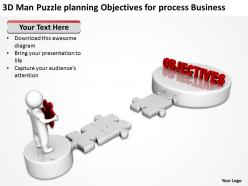
We are proud to present our 3d man puzzle planning objectives for process business ppt graphics icons. This PPT Theme contains image of 3d man with word obejective. Download this Business PowerPoint template for Marketing, Sales, Finance, Growth and Development presentation.

People who downloaded this PowerPoint presentation also viewed the following :

FAQs for 3d man puzzle planning objectives for process business

The primary objectives include enhancing spatial reasoning skills, promoting collaborative problem-solving, developing critical thinking abilities, improving hand-eye coordination, and fostering creative visualization techniques. These interactive learning tools streamline educational engagement by combining tactile experiences with cognitive challenges, ultimately delivering improved retention rates and deeper conceptual understanding, with many educators finding that students demonstrate significantly enhanced three-dimensional thinking capabilities.

3D man puzzles enhance cognitive skills by developing spatial reasoning, critical thinking, visual processing, memory retention, and hand-eye coordination through interactive manipulation and assembly challenges. These puzzles strengthen problem-solving abilities by requiring children to analyze complex structures, plan sequential steps, and adapt strategies when initial approaches fail, ultimately building persistence and logical reasoning skills that translate to improved academic performance and creative thinking in educational settings.

Creativity drives 3D man puzzle development through innovative design concepts, unique spatial challenges, complex interlocking mechanisms, and engaging visual narratives that captivate users. These creative elements enhance problem-solving experiences by delivering multi-dimensional thinking challenges, improved cognitive engagement, and strategic learning outcomes, with many educational institutions and corporate training programs finding that creative puzzle design ultimately strengthens analytical skills and collaborative teamwork.

3D man puzzles can be integrated into occupational therapy programs through fine motor skill development, cognitive rehabilitation, spatial awareness training, problem-solving enhancement, and hand-eye coordination improvement. These therapeutic tools enable occupational therapists to address multiple rehabilitation goals simultaneously, with many healthcare facilities finding that puzzle-based interventions streamline patient engagement while delivering measurable improvements in dexterity, cognitive function, and overall therapeutic outcomes.

Educators can effectively assess students' understanding through 3D man puzzles by observing problem-solving processes, evaluating spatial reasoning skills, measuring collaboration effectiveness, and analyzing completion strategies during hands-on activities. These assessment methods enable teachers to gauge comprehension levels, identify learning gaps, and track cognitive development across subjects like mathematics, engineering, and science, ultimately delivering personalized feedback and enhanced educational outcomes.

High-quality hardwood, precision-cut acrylic, reinforced cardboard, and food-grade silicone deliver optimal durability and engagement for 3D man puzzles. These materials enable intricate detail retention, repeated assembly cycles, and tactile satisfaction, with educational institutions and corporate training programs finding that strategic material combinations enhance learning outcomes while minimizing replacement costs, ultimately delivering lasting value.

3D man puzzles enhance teamwork and collaboration by requiring students to communicate effectively, share different perspectives, delegate tasks based on individual strengths, and work toward common problem-solving goals. Through these interactive activities, educational institutions foster critical thinking, patience, and collective decision-making skills, with many classrooms finding that students develop stronger interpersonal relationships and improved collaborative abilities that translate into better group project outcomes.

Adapting 3D man puzzles for different age groups involves adjusting piece complexity, size variations, thematic content, instruction clarity, and completion timeframes to match developmental stages. Educational institutions and toy manufacturers increasingly customize these puzzles by simplifying geometric shapes for younger children while introducing intricate mechanical components for adults, ultimately delivering age-appropriate cognitive challenges that enhance problem-solving skills across diverse learning environments.

3D man puzzles enhance spatial awareness by requiring users to visualize three-dimensional relationships, rotate objects mentally, and understand proportional scaling, while simultaneously developing fine motor skills through precise manipulation, careful placement, and coordinated hand movements. These cognitive and physical benefits translate directly into improved problem-solving abilities, enhanced design thinking, and better manual dexterity, with educators and therapists finding that regular puzzle engagement significantly strengthens both spatial reasoning and motor control coordination.

Cultural considerations for 3D man puzzles include diverse representation in skin tones, clothing styles, body types, cultural symbols, and avoiding stereotypes or culturally insensitive imagery. Organizations developing these puzzles increasingly recognize that inclusive design enhances global market appeal, fosters workplace diversity conversations, and ensures educational materials resonate across different cultural backgrounds, ultimately delivering broader engagement and competitive advantage.

Technology enables interactive 3D man puzzle experiences through augmented reality applications, virtual reality platforms, motion tracking systems, gesture recognition software, and cloud-based collaborative tools. These technologies streamline puzzle engagement by delivering immersive visualization, real-time manipulation capabilities, and multi-user collaboration features, with many educational institutions and corporate training programs finding that interactive 3D puzzles enhance learning outcomes and strategic problem-solving skills.

3D man puzzles enhance STEM learning by developing spatial reasoning, problem-solving skills, critical thinking, and mathematical concepts through hands-on manipulation and visual processing. These interactive tools streamline complex abstract concepts into tangible experiences, with many educators finding that students in engineering, architecture, and mathematics programs demonstrate improved comprehension and retention, ultimately delivering enhanced analytical capabilities and sustained engagement in technical subjects.

**INPUT**: What are the psychological benefits of solving 3D man puzzles for adults? **OUTPUT**: Solving 3D man puzzles delivers significant psychological benefits including enhanced spatial reasoning, improved problem-solving skills, stress reduction, increased focus, and boosted cognitive flexibility. These activities enable professionals to strengthen critical thinking capabilities while providing mental relaxation, with many organizations incorporating puzzle-solving into team-building and strategic planning sessions to enhance collaborative decision-making and creative problem-solving approaches.

3D man puzzles enhance corporate training by developing problem-solving skills, strategic thinking, and collaborative decision-making through hands-on visual challenges. These interactive tools streamline team-building exercises in organizations like consulting firms and manufacturing companies, where groups must work together to solve complex spatial problems, ultimately delivering improved communication, enhanced analytical thinking, and stronger workplace cohesion.

Innovations like augmented reality overlays, modular component systems, interactive digital companions, adaptive difficulty algorithms, and collaborative multi-user platforms could significantly enhance 3D man puzzle educational value. These technologies streamline learning by providing real-time feedback, personalized challenges, and immersive experiences, with educational institutions and corporate training programs finding that such strategic combinations deliver improved engagement and measurable learning outcomes.

Ratings and Reviews

100% of 100
Write a review
Most Relevant Reviews
  1. 100%

    by Charley Bailey

    Content of slide is easy to understand and edit.
  2. 100%

    by Chung Bennett

    Commendable slides with attractive designs. Extremely pleased with the fact that they are easy to modify. Great work!

2 Item(s)

per page: