

4 elements of audit observation report




Try Before you Buy Download Free Sample Product
 Impress Your
 Audience
 100%
100% Editable
 Save Hours
 of Time


Epitomize honesty with our 4 Elements Of Audit Observation Report. Be forthright in your analysis of achievement.
People who downloaded this PowerPoint presentation also viewed the following :
Content of this Powerpoint Presentation
Description:
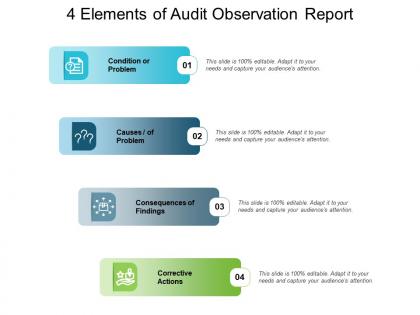
This image presents a slide from a presentation detailing the four key elements of an audit observation report.
1. Condition or Problem:
The first element represents the issue or discrepancy identified during the audit. It emphasizes the importance of clearly stating what was found to be out of order, non-compliant, or problematic.
2. Causes / of Problem:
The text here contains a typographical error ("/" instead of "of") and it refers to the second element, which involves discussing the underlying reasons or factors that led to the identified condition or problem.
3. Consequences of Findings:
This element focuses on the implications or potential impact that the findings could have on the organization, ranging from financial losses to reputational damage.
4. Corrective Actions:
The final element is dedicated to the solutions or steps that should be taken to address the identified issues and prevent their recurrence.
Use Cases:
The slide can be utilized across various industries for internal or external audit reporting. Here are seven industries and specific use cases:
1. Finance:
Use: Reporting internal financial audits
Presenter: Internal Auditor
Audience: Finance Department
2. Healthcare:
Use: Presenting compliance audit findings
Presenter: Compliance Officer
Audience: Hospital Management
3. Manufacturing:
Use: Quality control audit reports
Presenter: Quality Assurance Manager
Audience: Operations Team
4. Information Technology:
Use: IT systems security audit findings
Presenter: IT Audit Specialist
Audience: IT Department
5. Education:
Use: Reporting academic program audits
Presenter: Academic Auditor
Audience: University Administration
6. Retail:
Use: Inventory and process audit presentations
Presenter: Inventory Auditor
Audience: Store Management
7. Government:
Use: Discussing public sector audit results
Presenter: Government Auditor
Audience: Public Administration Officials
4 elements of audit observation report with all 5 slides:
Be forthright in your analysis of achievement with our 4 Elements Of Audit Observation Report. You will epitomize honesty.




FAQs for 4 elements of
Key components include audit objectives, methodology, detailed findings, evidence documentation, risk assessments, management responses, and actionable recommendations. These elements work together by establishing context, presenting factual observations, and providing clear remediation paths, with many organizations finding that comprehensive reports enhance accountability, streamline corrective actions, and ultimately deliver improved compliance outcomes.
Audit issue severity is determined by assessing potential impact on operations, financial implications, regulatory compliance requirements, and likelihood of occurrence. Auditors evaluate whether issues could lead to significant financial losses, operational disruptions, or regulatory violations, with many organizations using standardized risk matrices that combine impact severity with probability, ultimately enabling prioritized remediation efforts and efficient resource allocation.
Clear headings, consistent fonts, bullet points, numbered sequences, and strategic white space enhance audit observation report readability significantly. These formatting elements streamline complex findings by organizing information hierarchically, highlighting critical issues, and enabling quick navigation, with many auditing firms finding that well-structured reports accelerate management responses and improve compliance outcomes.
Audit Observation Reports should be reviewed monthly or quarterly depending on risk levels and regulatory requirements, with updates triggered by significant operational changes, new findings, or compliance developments. Organizations in highly regulated sectors like banking and healthcare often implement continuous monitoring systems, enabling real-time updates and faster remediation, ultimately enhancing audit effectiveness and regulatory compliance.
Management responses in an Audit Observation Report demonstrate accountability, transparency, and commitment to addressing identified deficiencies through corrective action plans, timelines, and resource allocation. These responses enable organizations to transform audit findings into strategic improvements, with many companies finding that comprehensive management responses strengthen stakeholder confidence, enhance operational controls, and ultimately deliver measurable risk reduction and process optimization.
Visuals and charts transform complex audit findings into digestible insights by highlighting trends, comparisons, and risk patterns that stakeholders can quickly grasp. Through dashboards, heat maps, and infographics, organizations streamline communication across departments, enhance management comprehension of critical issues, and accelerate decision-making processes, ultimately delivering faster remediation and improved audit outcomes.
Follow-up plays a crucial role in audit effectiveness by ensuring identified issues are addressed, corrective actions are implemented, and systemic improvements take hold across the organization. Through structured follow-up processes, organizations can track remediation progress, verify compliance improvements, and prevent recurring issues, with many finding that consistent follow-up transforms audit observations into measurable operational enhancements and stronger internal controls.
Organizations ensure timely implementation by establishing clear accountability frameworks, setting specific deadlines for each recommendation, and assigning dedicated owners to track progress. Through regular follow-up meetings and automated tracking systems, management can monitor completion rates, address implementation barriers, and maintain momentum, with many companies finding that integrated dashboards ultimately deliver faster resolution and enhanced operational compliance.
Common pitfalls include vague findings without specific evidence, failing to prioritize risks by significance, inadequate root cause analysis, and presenting observations without actionable recommendations. These issues undermine report effectiveness by creating confusion for management teams, delaying corrective actions, and reducing audit credibility, with many organizations finding that structured templates and clear risk classifications ultimately streamline remediation processes and enhance operational transparency.
Technology streamlines audit observation documentation through automated data collection, digital workflows, real-time collaboration platforms, AI-powered anomaly detection, and cloud-based reporting systems. These solutions enhance accuracy by eliminating manual entry errors, accelerating review cycles, and enabling seamless stakeholder access, with many organizations finding that digital audit platforms reduce documentation time while improving compliance transparency and audit trail integrity.
Internal audit observation reports focus on operational improvements, compliance gaps, and risk management recommendations for management's strategic decision-making within the organization. External audit observation reports emphasize financial statement accuracy, regulatory compliance, and material weaknesses for stakeholders like investors and regulators, with many organizations finding that combining both perspectives delivers comprehensive risk oversight and enhanced operational transparency.
Confidential information in audit observation reports should be handled through restricted distribution lists, secure document management systems, password protection, and clear confidentiality markings on all materials. Organizations typically implement role-based access controls, encrypted storage solutions, and non-disclosure agreements for audit teams, while ensuring sensitive findings are anonymized where possible, ultimately protecting stakeholder privacy and maintaining regulatory compliance across industries.
Effective communication strategies include visual dashboards with clear metrics, executive summaries highlighting key risks and financial impacts, storytelling through real-world scenarios, and structured presentations using plain language rather than audit jargon. These approaches enhance stakeholder understanding by translating technical findings into business implications, prioritizing actionable recommendations, and facilitating meaningful discussions, ultimately enabling faster decision-making and stronger organizational buy-in.
Regulatory requirements significantly influence audit observation report structure by mandating specific sections, standardized risk classifications, compliance tracking mechanisms, and detailed remediation timelines. These frameworks ensure consistency across organizations while enabling regulatory bodies to efficiently assess institutional compliance, with banks and financial services finding that structured reports streamline regulatory reviews and ultimately enhance stakeholder confidence through transparent, systematic documentation.
Best practices for objective audit observation reporting include maintaining independence from auditees, using standardized criteria and methodologies, supporting findings with verifiable evidence, implementing peer reviews, and separating fact-gathering from interpretation phases. These approaches enhance credibility by eliminating personal bias, ensuring consistent evaluation standards, and promoting transparency, with many organizations finding that structured documentation processes and multiple reviewer validation ultimately deliver more reliable audit outcomes and stakeholder confidence.
No Reviews