


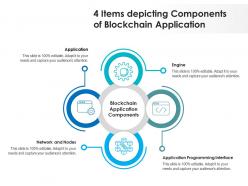
4 items depicting components of blockchain application





Try Before you Buy Download Free Sample Product
 Impress Your
Audience
 100%
Editable
 Save Hours
of Time


Our 4 Items Depicting Components Of Blockchain Application are topically designed to provide an attractive backdrop to any subject. Use them to look like a presentation pro.
People who downloaded this PowerPoint presentation also viewed the following :
4 items depicting components of blockchain application with all 2 slides:
Use our 4 Items Depicting Components Of Blockchain Application to effectively help you save your valuable time. They are readymade to fit into any presentation structure.
FAQs for 4 items depicting components
Key blockchain architecture components include nodes, blocks, hash functions, consensus mechanisms, smart contracts, and cryptographic keys. These technologies work together by enabling distributed verification, ensuring transaction immutability, and automating processes, with many financial institutions and supply chain organizations finding that this architecture delivers enhanced security, operational transparency, and reduced intermediary costs.
Consensus algorithms significantly influence blockchain performance by determining transaction speed, energy consumption, and network scalability, while establishing security through validation mechanisms and attack resistance. Proof-of-Work delivers robust security but slower processing, while Proof-of-Stake enables faster transactions with lower energy costs, with many financial institutions finding that algorithm choice directly impacts operational efficiency and user adoption rates.
Smart contracts serve as self-executing digital agreements that automatically enforce terms and conditions without intermediaries, functioning through predetermined code that triggers actions when specific conditions are met. These programmable contracts streamline operations across industries like finance, supply chain, and real estate by reducing processing times, minimizing costs, and eliminating manual oversight, ultimately delivering greater transparency and operational efficiency.
Public blockchains offer complete transparency and decentralization for applications like cryptocurrencies and supply chain tracking, while private blockchains provide controlled access for internal enterprise operations like banking and healthcare records. Consortium blockchains combine both approaches, enabling strategic partnerships between selected organizations in sectors like trade finance and insurance, ultimately delivering enhanced security and operational efficiency while maintaining necessary regulatory compliance.
Peer-to-peer networks eliminate central authorities by distributing blockchain data across multiple nodes, enabling direct transactions between participants without intermediaries. This decentralized architecture enhances security, reduces single points of failure, and increases transparency, with many financial institutions and supply chain organizations finding that P2P networks deliver greater operational resilience and cost efficiency.
Blockchain applications implement cryptographic hashing, digital signatures, consensus mechanisms, immutable ledgers, and multi-factor authentication to protect data integrity. These security measures work by encrypting transactions, validating network participants, and creating tamper-proof records, with financial institutions and healthcare organizations finding that decentralized verification ultimately delivers enhanced transparency and significantly reduces fraud risks.
Blockchain scalability significantly impacts real-world adoption by determining transaction throughput, processing speed, and network costs across various applications. While high-traffic sectors like retail payments, supply chain management, and financial services require thousands of transactions per second, many organizations find that emerging solutions like layer-2 protocols and sharding enable broader implementation, ultimately delivering faster services and competitive advantage.
**INPUT**: What programming languages are commonly used for developing blockchain applications, and why? **OUTPUT**: Common blockchain programming languages include Solidity, JavaScript, Python, Go, and Rust, each offering specific advantages for different blockchain platforms and applications. Solidity dominates Ethereum development, while Python streamlines backend integration, JavaScript enables web interfaces, and Go delivers high-performance solutions, with many organizations finding that language choice ultimately depends on their specific blockchain platform, scalability requirements, and existing technical infrastructure. [Word count: 60 words]
Blockchain enhances identity verification by creating immutable digital identities, eliminating intermediaries, and enabling real-time authentication across platforms. Financial institutions use blockchain for secure KYC processes, healthcare systems verify patient credentials instantly, and government agencies streamline citizen services, ultimately delivering faster verification, reduced fraud, and enhanced user privacy while maintaining regulatory compliance.
Interoperability challenges include varying consensus mechanisms, different cryptographic standards, incompatible data formats, protocol differences, and scalability limitations across blockchain networks. These technical barriers create fragmented ecosystems where financial institutions, supply chain companies, and healthcare organizations struggle to integrate systems seamlessly, ultimately limiting cross-platform functionality and requiring strategic middleware solutions for effective blockchain adoption.
Tokenization converts real-world assets into digital tokens on blockchain networks, enabling fractional ownership, enhanced liquidity, and automated transactions through smart contracts. Financial institutions and real estate companies increasingly leverage tokenization for asset management, investment opportunities, and cross-border transactions, ultimately delivering improved market accessibility, reduced intermediation costs, and streamlined regulatory compliance processes.
Regulatory compliance significantly influences blockchain development through data privacy requirements, financial reporting standards, audit trails, and cross-border transaction protocols. While compliance can slow initial deployment, it ultimately enhances trust and adoption, with financial services and healthcare sectors finding that regulatory-compliant blockchain solutions deliver greater institutional acceptance and long-term scalability.
Blockchain integration with IoT and AI creates powerful synergies through smart contracts automating device interactions, AI algorithms analyzing distributed ledger data, and decentralized networks securing IoT communications. Financial services, supply chain management, and healthcare organizations leverage these strategic combinations to enhance transparency, streamline operations, and deliver real-time insights, ultimately providing competitive advantages in increasingly connected business environments.
Best practices for managing data privacy in blockchain applications include implementing zero-knowledge proofs, utilizing private or consortium blockchains, applying data encryption techniques, minimizing on-chain personal data storage, and establishing clear consent mechanisms. These approaches enable organizations to leverage blockchain's transparency and security benefits while maintaining regulatory compliance, with many financial services and healthcare institutions finding that strategic combination of off-chain storage and cryptographic protocols delivers enhanced privacy protection without compromising operational efficiency.
Oracles function as secure bridges connecting blockchain networks to external data sources, APIs, and real-world information that smart contracts require for execution. Through cryptographic verification and consensus mechanisms, oracles enable smart contracts in sectors like insurance, supply chain, and financial services to access real-time data, automate complex agreements, and execute transactions based on external conditions, ultimately delivering transparency and operational efficiency.
-
Great quality slides in rapid time.
-
Design layout is very impressive.
-
Awesome presentation, really professional and easy to edit.
-
Excellent template with unique design.
-
Editable templates with innovative design and color combination.
-
Awesome use of colors and designs in product templates.
-
Informative design.