

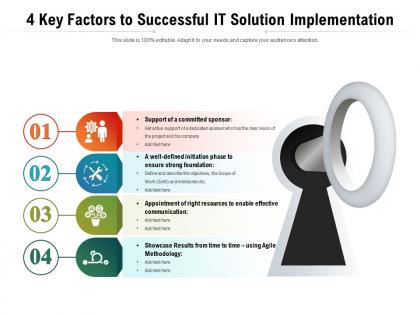
4 key factors to successful it solution implementation




Try Before you Buy Download Free Sample Product
 Impress Your
 Audience
 100%
100% Editable
 Save Hours
 of Time


Our 4 Key Factors To Successful IT Solution Implementation are topically designed to provide an attractive backdrop to any subject. Use them to look like a presentation pro.
People who downloaded this PowerPoint presentation also viewed the following :
4 key factors to successful it solution implementation with all 2 slides:
Use our 4 Key Factors To Successful IT Solution Implementation to effectively help you save your valuable time. They are readymade to fit into any presentation structure.
FAQs for 4 key factors to successful
IT solution implementation includes planning and assessment, system design and configuration, data migration and integration, testing and validation, and deployment with user training. These stages streamline operations by establishing clear timelines, allocating dedicated resources, and maintaining stakeholder communication throughout, with many organizations finding that phased rollouts minimize disruption while delivering faster operational efficiency.
Assessing organizational needs involves analyzing current infrastructure, identifying operational gaps, evaluating user requirements, reviewing security protocols, and understanding budget constraints. Through comprehensive audits and stakeholder interviews, IT consultants can map existing workflows, pinpoint inefficiencies, and determine scalability requirements, ultimately delivering tailored solutions that enhance productivity and competitive advantage.
Stakeholder engagement plays a critical role in IT solution implementation by ensuring alignment between business objectives and technical capabilities, facilitating user adoption, and minimizing resistance to change. Through regular communication, training programs, and feedback integration, organizations streamline implementation processes, reduce project risks, and ultimately deliver enhanced operational efficiency, with many finding that engaged stakeholders accelerate successful deployment.
Determining the right IT solution requires analyzing business requirements, evaluating existing infrastructure, assessing scalability needs, and considering budget constraints alongside implementation timelines. Organizations increasingly conduct proof-of-concept testing with multiple vendors, with many companies finding that solutions addressing both immediate pain points and long-term growth deliver the strongest competitive advantage.
Common IT solution implementation challenges include inadequate planning, resistance to change, budget overruns, integration complexities, and insufficient user training. These obstacles can be mitigated through comprehensive project management, stakeholder engagement strategies, phased rollout approaches, and robust testing protocols, with many organizations finding that early user involvement and continuous communication ultimately deliver smoother transitions and higher adoption rates.
Organizations ensure IT solution alignment with business strategy by establishing clear strategic objectives, conducting comprehensive needs assessments, engaging cross-functional stakeholders, and implementing governance frameworks that monitor progress. Through strategic planning sessions and regular reviews, companies in sectors like manufacturing and healthcare streamline operations, enhance customer experiences, and accelerate decision-making, ultimately delivering competitive advantage and measurable ROI.
Key metrics include system uptime and performance benchmarks, user adoption rates, cost reduction achieved, process efficiency improvements, and customer satisfaction scores. These indicators help organizations measure both technical performance and business impact, with many companies finding that tracking ROI, reduced manual processes, and faster service delivery provides comprehensive insights into implementation success and competitive advantage.
IT change management best practices include stakeholder engagement, comprehensive training programs, phased rollouts, clear communication strategies, and continuous feedback loops. These approaches streamline transitions by minimizing resistance, ensuring user adoption, and maintaining operational continuity, with many organizations finding that structured change management reduces implementation risks while accelerating time-to-value and competitive advantage.
User training and support significantly impact IT solution effectiveness by enhancing user adoption, reducing implementation errors, and maximizing system utilization across organizations. Through comprehensive training programs, companies streamline workflow transitions, minimize resistance to change, and accelerate productivity gains, with many businesses finding that well-supported users deliver faster ROI and sustained competitive advantage.
Data migration considerations include data quality assessment, mapping compatibility between old and new systems, establishing backup protocols, timing coordination, and user training requirements. These processes streamline implementation by minimizing downtime, ensuring accuracy, and maintaining business continuity, with many organizations finding that thorough migration planning ultimately delivers faster system adoption and reduced operational disruption.
Agile methodologies enhance IT solution implementation by promoting iterative development, continuous feedback, and adaptive planning throughout the project lifecycle. These approaches enable organizations to deliver functional components faster, respond quickly to changing requirements, and minimize risks through regular testing and stakeholder collaboration, ultimately reducing implementation timelines while improving solution quality and user satisfaction.
Vendor management encompasses contract negotiation, performance monitoring, relationship coordination, risk mitigation, and quality assurance throughout IT solution implementation. These practices streamline project delivery by establishing clear expectations, maintaining consistent communication, and ensuring accountability, with many organizations finding that strategic vendor partnerships reduce implementation timelines, minimize cost overruns, and ultimately deliver more successful technology deployments.
Security and compliance requirements significantly shape IT solution architecture by mandating data encryption, access controls, audit trails, and regulatory adherence from the design phase. These requirements, while adding complexity, ultimately enhance organizational resilience and customer trust, with sectors like healthcare, finance, and government finding that proactive compliance integration reduces implementation costs and accelerates deployment timelines.
Post-implementation reviews in IT solution projects deliver enhanced project learning, improved future planning capabilities, stakeholder satisfaction assessment, risk identification protocols, and performance optimization insights. These systematic evaluations enable organizations to refine deployment strategies, minimize recurring issues, and maximize return on investment, with many enterprises finding that structured reviews reduce future project timelines by 20-30% while enhancing operational efficiency.
Organizations foster continuous improvement by establishing regular feedback loops, creating cross-functional teams for ongoing optimization, implementing performance metrics tracking, and encouraging employee suggestions for system enhancements. Through structured review processes and user training programs, companies in healthcare, finance, and retail streamline operations while maintaining system effectiveness, ultimately delivering sustained operational efficiency and competitive advantage.
No Reviews