


4 pillars strategy to improve leadership management




Try Before you Buy Download Free Sample Product
 Impress Your
 Audience
 100%
100% Editable
 Save Hours
 of Time


Our 4 Pillars Strategy To Improve Leadership Management are explicit and effective. They combine clarity and concise expression.
People who downloaded this PowerPoint presentation also viewed the following :
Content of this Powerpoint Presentation
Description:
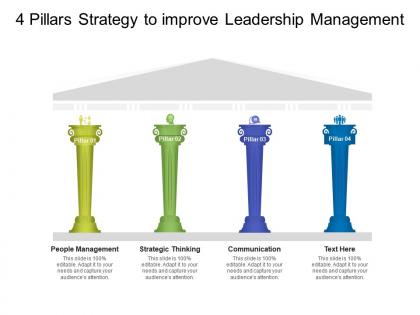
This image presents a slide titled "4 Pillars Strategy to improve Leadership Management", indicating that it is a strategic framework aimed at enhancing leadership qualities within an organization or group setting. The slide visually represents four columns or 'pillars,' each corresponding to a key area of leadership development. The text entries on each pillar suggest what these areas are and that the slide itself is customizable for the presenter's needs.
Pillar 01 is labeled "People Management," emphasizing the importance of managing and leading people effectively as a fundamental aspect of leadership. Pillar 02 reads "Strategic Thinking," which points out the necessity for leaders to develop and maintain a clear strategic vision and the ability to plan accordingly. Pillar 03 is named "Communication," highlighting that effective communication skills are essential for leadership as they enable the clear transmission of vision, strategy, and values. Pillar 04 lacks specific text and simply states "Text Here," meaning it's a placeholder for the presenter to insert another critical leadership area or concept they believe is relevant to their framework or audience.
Use Cases:
Given the nature of the content, these slides could be relevant to the following industries:
1. Corporate:
Use: Facilitating leadership development and team-building in professional settings.
Presenter: Human Resources Manager or Training Coordinator (internal expertise).
Audience: Employees and managerial staff (all levels).
2. Education:
Use: Cultivating leadership skills and qualities in students and aspiring professionals.
Presenter: Academic Instructor or Career Counselor (external or internal expertise).
Audience: Students and individuals seeking leadership development.
3. Healthcare:
Use: Equipping healthcare managers with effective leadership strategies for improved patient care and team dynamics.
Presenter: Hospital Administrator or Training Specialist (internal expertise).
Audience: Medical staff and hospital management teams (department leaders, supervisors).
4. Military:
Use: Instructing military personnel on leadership principles and tactical decision-making within military training programs.
Presenter: Military Officer or Training Commander (experienced leaders).
Audience: Cadets and military personnel (various ranks and specialties).
5. Non-Profit:
Use: Strengthening leadership competencies for effective resource management and impact within non-profit organizations.
Presenter: Non-Profit Organization Leader or Development Officer (experienced individuals).
Audience: Team leaders and organizational staff (executives, department heads, volunteers).
6. Government:
Use: Enhancing leadership skills and ethical decision-making for civil servants and public sector managers.
Presenter: Government Training Facilitator or Public Administration Expert (policy specialists, leadership consultants).
Audience: Civil servants and public sector managers (department heads, policy officers, administrative staff).
7. Technology:
Use: Developing leadership skills for project management, innovation, and team collaboration within tech companies.
Presenter: Chief Technology Officer or Agile Coach (industry leaders, experienced technologists).
Audience: Technical team leads and project managers
4 pillars strategy to improve leadership management with all 2 slides:
Give your audience a fulfilling experience. They will find our 4 Pillars Strategy To Improve Leadership Management elevating.
FAQs for 4 pillars strategy to
Look, being adaptable is everything now - things change way too fast to stick to old playbooks. Listen more than you talk, that's my biggest advice. People can tell when you're actually hearing them versus just waiting for your turn to speak. Remote work made this even more critical since you can't rely on those casual hallway conversations anymore. Don't micromanage either, it'll backfire every time. When plans fall apart (and they will), watch how you react - that's where you really learn about yourself. Empathy isn't just nice to have anymore, it's essential. Your team needs to feel valued, not just productive. Practice getting comfortable with uncertainty because honestly? That's just leadership now.
Track the stuff that actually moves the needle - internal promotions, whether your high-performers are sticking around, leadership scores trending up. Survey people about what they're actually using from training (not just if they "liked" it). Honestly, most companies just assume these programs work without ever checking. Also look at business metrics in whatever areas you focused on - retention, sales, whatever. The key thing is setting up those quarterly check-ins to see what's working and what isn't. Sounds boring but the feedback loop is where most programs completely drop the ball.
Look, emotional intelligence is what actually makes leaders worth following. Most "smart" managers totally bomb at this - they can't even read their own emotions, let alone their team's. Here's the thing though: once you get good at pausing before reacting to stressful stuff, everything changes. Your team starts trusting you more because they see you're not just flying off the handle. I always tell people to ask themselves "what's my team feeling right now?" before making decisions. Sounds cheesy but it works. You'll build way better relationships and honestly, people perform better when they feel understood.
You know what actually works? Get your junior people to mentor the senior folks on new tech and fresh ideas - sounds backwards but it's genius. Those 15-minute weekly leadership challenges hit different too, way better than sitting through some 4-hour training that everyone forgets by lunch. Have team members rotate into leading projects they've never touched before. Honestly, peer coaching circles are where the magic happens - people actually listen when it's not their boss talking at them. Pick whatever feels right for your team first, then build from there. Don't try to do it all at once or you'll burn everyone out.
Match them with mentors 2-3 levels up, not just their direct boss. Monthly check-ins work better than weekly (people get busy). I'd add quarterly goal reviews too. Honestly, most programs die because nobody's actually running them - people forget or get swamped. You need someone coordinating behind the scenes. Don't just pair whoever's available either. Match on career goals and whether they'll actually click personality-wise. Give both sides structure: what to discuss, time expectations, how feedback should work. Otherwise it turns into awkward coffee chats about the weather.
Honestly, culture is everything when it comes to leadership development. Your training programs will totally bomb if people don't feel safe trying new things or giving honest feedback. I've watched companies blow serious money on fancy coaching programs that went nowhere because - surprise - the culture still freaked out over mistakes. Short sentences work better sometimes. When you've got psychological safety and people actually want to learn, that's when leaders naturally start growing. Oh, and here's the thing nobody talks about enough: you really need to figure out what your culture actually rewards before you design any training. Otherwise you're just throwing money at a problem that won't budge.
Honestly, tech has made leadership development so much easier than it used to be. You can find online courses that actually fit your crazy schedule, plus those VR simulations let you practice tough conversations without looking like an idiot in real life. AI feedback on communication is surprisingly decent too. Mobile apps will track your goals and send daily tips - some are actually pretty good, though others are total garbage. Video calls mean you can get mentored by leaders anywhere, which is wild when you think about it. Best part? Everything adapts to what you specifically suck at and how fast you learn. Just pick one tool that tackles your biggest leadership weakness first.
Make D&I central to the whole curriculum, not just some random workshop they sit through once. Bias training helps, but focus on practical stuff - decision-making frameworks, real scenarios they'll actually encounter. Honestly? The programs that work best mix up who's doing the teaching and mentoring. Your cohorts need diversity too so people learn from each other naturally. I'd track metrics on inclusive behaviors to see what's sticking. Give them tools they can use right away - like how to run better meetings or give fair feedback. It's gotta be practical, not theoretical BS.
Honestly, I'd start simple with maybe 3-4 metrics instead of going crazy trying to measure everything. Track the obvious stuff first - promotion rates for people in your program, whether they're actually sticking around (retention is huge), and how their teams are performing. 360 feedback scores are pretty telling too. The softer stuff is trickier but matters just as much. Pulse surveys can help you capture things like confidence levels and decision-making quality, though that's always a bit subjective. Oh, and definitely look at engagement scores for the teams they're leading - that usually tells you if someone's actually developing as a leader or just going through the motions. You can always layer on more metrics once you get a baseline going.
Start by being curious yourself when stuff goes sideways - ask "what'd we learn?" instead of pointing fingers. Share your own screwups and what came out of them (trust me, this works way better than pretending you're perfect). Celebrate the process, not just wins. Your team needs to see you actually experimenting, not just talking about it. Most leaders I know say they want growth but then lose it at the first mistake! Ask people what they want to get better at, then help them do it. Oh, and make sure they feel safe speaking up about problems.
Honestly, the hardest part is getting people to actually connect - like, really connect. You miss all those random hallway conversations that build relationships naturally. Time zones are a nightmare too. Body language gets lost over video calls, which makes coaching sessions feel flat sometimes. Oh, and don't get me started on keeping people engaged when they're at home with kids screaming in the background! What's worked for me: tons of breakout rooms, structured peer stuff, and virtual office hours where people can just pop in. Short bursts work better than long sessions.
Look, first figure out what leadership skills you'll actually need in 2-3 years based on your strategy. Digital stuff? Expansion plans? Whatever's coming down the pipe. Then see where your current leaders stack up against those future needs - that's your gap. Don't just throw generic training at people. Build programs around those specific gaps and get your senior folks involved in designing it (otherwise they'll just roll their eyes). Oh, and track real business results, not how many people showed up to workshops. That completion rate stuff is pretty useless honestly.
Your team basically mirrors your leadership approach - how you lead shapes everything from their communication to actual results. Autocratic gets you fast decisions but kills creativity. Democratic styles? Great for buy-in and fresh ideas, though decisions drag when you're in a crunch. Laissez-faire works if your people are self-starters, but anyone struggling gets left in the dust. I'm biased toward transformational leaders honestly - they actually inspire growth while crushing goals. The real trick is switching up your style based on what's happening and who you're working with.
Honestly, start with mentoring - pair your experienced people with high-potential folks. Throw emerging leaders into challenging projects that'll make them uncomfortable (that's where the magic happens). Oh, and psychological safety is huge - people need to feel like they can screw up without getting their heads chopped off. I'd also rotate potential leaders through different departments early on. Give them real decision-making power, not just busy work. Regular feedback helps too. The key thing? Don't wait to identify your future leaders - start that process now and let them experiment.
Dude, non-traditional leaders are fascinating because they can't fall back on old-school playbooks. They experiment constantly instead of waiting for perfect solutions. Their teams are super diverse, which naturally challenges groupthink. Customer obsession is huge for them too - probably because they had to fight for every early user. The pivot game is strong since they learned quickly that stubbornness kills startups. Gaming companies do this really well, actually. What I find cool is how they mix being genuine with staying flexible. Creates environments where people aren't scared to fail. Food truck owners have surprisingly good insights on this stuff.
No Reviews