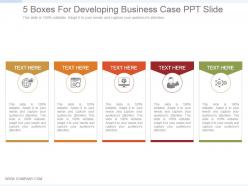
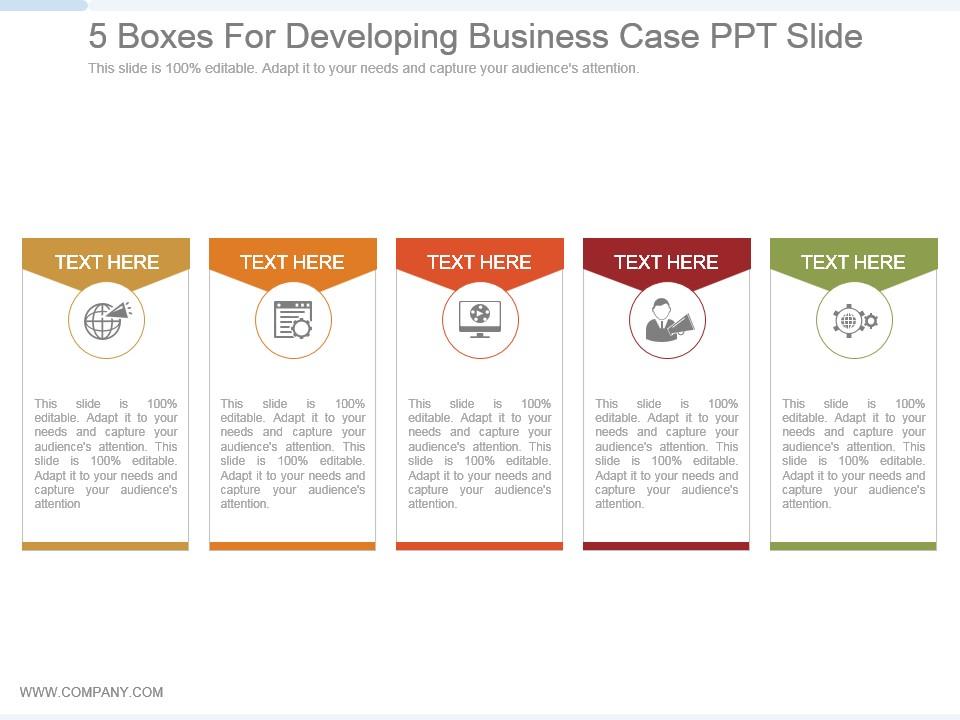
5 boxes for developing business case ppt slide
Try Before you Buy Download Free Sample Product
Audience
Editable
of Time
Gain the advantage again with our 5 Boxes For Developing Business Case Ppt Slide. They allow you to fight back hard.
People who downloaded this PowerPoint presentation also viewed the following :
5 boxes for developing business case ppt slide with all 5 slides:
Age is no bar for our 5 Boxes For Developing Business Case Ppt Slide. They enthuse across generations.
FAQs for 5 boxes for developing business
Essential components of a successful business case include executive summary, problem statement, proposed solution, financial analysis, risk assessment, and implementation timeline. These elements work together by clearly defining the business need, quantifying expected returns, and addressing potential challenges, with many organizations finding that comprehensive cases with detailed cost-benefit analyses and stakeholder impact assessments ultimately secure faster approval and stronger executive support.
Data analysis enhances business case credibility by providing quantifiable evidence, identifying market trends, validating assumptions through historical performance, and demonstrating measurable ROI projections. Through predictive analytics and benchmarking, organizations can substantiate their proposals with concrete metrics, risk assessments, and competitive insights, ultimately delivering compelling evidence-based arguments that stakeholders trust when making strategic investment decisions.
Stakeholder engagement ensures business cases address diverse perspectives, secure necessary buy-in, and identify potential risks or opportunities early in development. Through collaborative workshops, interviews, and feedback sessions, organizations can validate assumptions, refine project scope, and build consensus among decision-makers, ultimately delivering stronger proposals with broader organizational support and higher approval rates.
Identifying risks in business cases involves conducting thorough market analysis, financial modeling, competitive assessment, operational reviews, and stakeholder evaluations to uncover potential challenges. Through systematic risk matrices and scenario planning, organizations can quantify impact probabilities, develop mitigation strategies, and create contingency plans, with many finding that proactive risk analysis strengthens decision-making and enhances project success rates.
Business case presentations require clear executive summaries, quantified financial impacts, risk assessments, implementation timelines, and compelling visual data storytelling. Successful presentations focus on strategic alignment with organizational goals, emphasize competitive advantages and ROI projections, while addressing potential concerns upfront, with many executives finding that concise, outcome-focused narratives drive faster approval decisions.
ROI for proposed initiatives is calculated by comparing projected financial benefits against total implementation costs, typically expressed as a percentage or ratio over a specific timeframe. Organizations determine this through detailed cost-benefit analysis, including direct savings, revenue increases, and efficiency gains, with many businesses using multiple ROI scenarios to account for risk variables and ensure strategic alignment.
Business case development tools include Microsoft Project, Smartsheet, Business Case Pro, Rational Plan, and integrated platforms like Monday.com or Asana with financial modeling capabilities. These solutions streamline the process by automating financial calculations, enabling collaborative editing, and providing standardized templates, with many organizations finding that dedicated business case software reduces development time while improving accuracy and stakeholder buy-in.
Aligning business cases with organizational strategy involves connecting proposed initiatives to strategic objectives, demonstrating measurable outcomes that support long-term goals, and showing clear ROI pathways. Through strategic mapping and stakeholder alignment, organizations streamline resource allocation, enhance decision-making processes, and ensure initiatives deliver competitive advantage, with many finding that well-aligned cases accelerate approval timelines significantly.
Project prioritization techniques include cost-benefit analysis, risk assessment matrices, strategic alignment scoring, resource availability evaluation, and ROI calculations. These methods enable organizations to systematically compare competing initiatives by weighing financial returns, strategic value, and implementation feasibility, with many companies finding that combining multiple prioritization frameworks delivers more objective decision-making and optimal resource allocation.
Case studies can be effectively incorporated into a business case by serving as compelling proof points, providing real-world validation of proposed solutions, demonstrating measurable ROI from similar implementations, and addressing stakeholder concerns through documented success stories. Strategic placement throughout executive summaries, risk mitigation sections, and financial projections enhances credibility, with many organizations finding that industry-specific case studies significantly strengthen proposal acceptance rates and accelerate decision-making processes.
Common pitfalls in business case development include overly optimistic projections, insufficient stakeholder analysis, weak risk assessment, inadequate competitive analysis, and unclear success metrics. These oversights often undermine credibility with decision-makers, especially in financial services and healthcare sectors, where thorough validation and realistic assumptions are essential for securing funding and strategic approval.
Visual aids and templates improve business case clarity by standardizing information presentation, highlighting key metrics through charts and graphs, and creating logical flow that guides stakeholders through complex data. These tools streamline decision-making processes by making financial projections, risk assessments, and strategic recommendations more accessible, with many organizations finding that visual presentations significantly reduce approval times and enhance executive comprehension.
Industry trends significantly influence business case development by shaping market demands, competitive positioning, regulatory requirements, technological capabilities, and customer expectations. These trends enable organizations to identify emerging opportunities, anticipate potential risks, and align strategic initiatives with market evolution, with many companies finding that trend-aware business cases deliver stronger stakeholder buy-in and sustainable competitive advantage.
Stakeholder feedback should be systematically integrated through structured review cycles, requirement validation sessions, and risk assessment updates throughout business case development. This collaborative approach enables organizations to refine assumptions, address concerns, and strengthen strategic alignment, with many finding that early stakeholder engagement ultimately delivers more robust proposals and faster approval processes.
Key metrics for evaluating business case success include return on investment (ROI), net present value (NPV), payback period, cost-benefit ratios, and operational efficiency indicators. These financial and performance measures enable organizations to track tangible outcomes like revenue growth, cost reduction, and productivity gains, while many companies find that combining quantitative metrics with qualitative assessments delivers comprehensive insights into strategic value and competitive positioning.
-
Very unique and reliable designs.
-
Enough space for editing and adding your own content.