5 c analysis identify internal factors micro macro environmental analysis
Try Before you Buy Download Free Sample Product
Audience
Editable
of Time
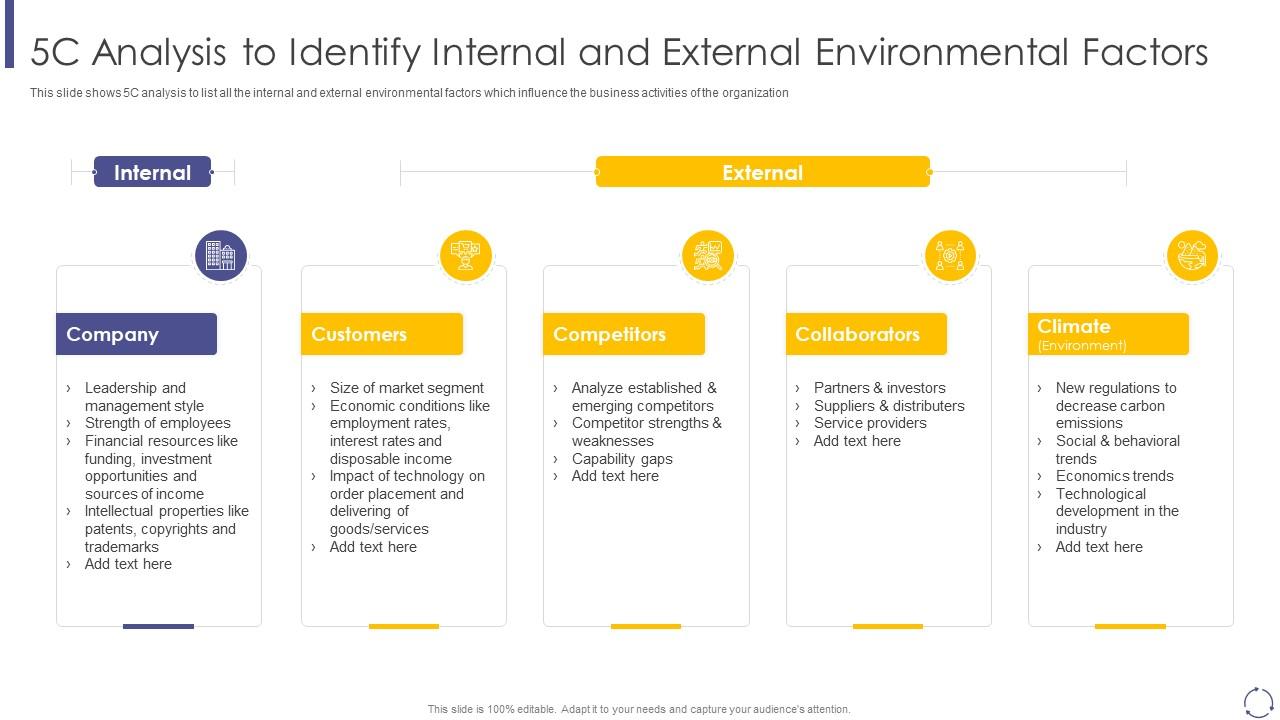
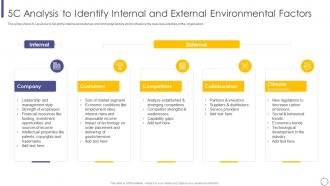
This slide shows 5C analysis to list all the internal and external environmental factors which influence the business activities of the organization
People who downloaded this PowerPoint presentation also viewed the following :
5 c analysis identify internal factors micro macro environmental analysis with all 6 slides:
Use our 5 C Analysis Identify Internal Factors Micro Macro Environmental Analysis to effectively help you save your valuable time. They are readymade to fit into any presentation structure.
FAQs for 5 c analysis identify internal factors micro
The 5C analysis framework comprises Company (internal strengths and weaknesses), Customers (target market needs and behaviors), Competitors (market positioning and strategies), Collaborators (suppliers and partners), and Context (external environmental factors). These components interconnect strategically, with company capabilities aligning to customer demands while differentiating from competitors, leveraging collaborator relationships, and adapting to contextual changes, ultimately delivering comprehensive market insights for competitive advantage.
Businesses can effectively gather data for the 5Cs through internal audits and financial analysis for Company insights, customer surveys and behavioral analytics for Customer understanding, competitive intelligence and market research for Competitor analysis, stakeholder interviews for Collaborator assessment, and industry reports for Context evaluation. These comprehensive approaches enable organizations to streamline strategic planning by delivering actionable insights across all categories, ultimately enhancing decision-making and competitive positioning in increasingly complex markets.
The 5C analysis differs from SWOT and PESTEL by providing a comprehensive, customer-centric framework that examines company, customers, competitors, collaborators, and climate simultaneously, while SWOT focuses on internal strengths/weaknesses and external opportunities/threats, and PESTEL analyzes macro-environmental factors. This integrated approach enables organizations to develop more holistic strategic insights by connecting market dynamics directly to customer needs and competitive positioning, ultimately delivering more actionable intelligence for strategic decision-making.
Companies leverage 5C analysis insights for product development by identifying market gaps through customer needs assessment, competitive benchmarking, and contextual opportunity analysis. Through systematic evaluation of customer preferences, competitor weaknesses, and market trends, organizations can innovate targeted solutions, enhance existing offerings, and develop differentiated products that address unmet demands, ultimately delivering competitive advantage and accelerated market penetration.
Market research serves as the foundational data source for 5C analysis, particularly enabling comprehensive customer analysis through demographics, psychographics, buying behaviors, and satisfaction metrics. Through surveys, focus groups, and analytics platforms, businesses can identify customer segments, preferences, and pain points, while competitor research reveals market positioning strategies, ultimately delivering actionable insights that enhance product development and competitive advantage in increasingly dynamic markets.
Small businesses can adapt the 5C analysis by focusing on local market dynamics, leveraging free digital tools for competitor research, and emphasizing customer feedback through direct engagement rather than expensive surveys. This streamlined approach enables resource-conscious organizations to gain strategic insights while building competitive advantage through agility, personalized service, and niche market positioning that larger competitors often cannot match.
Organizations face challenges including data collection complexity, resource allocation constraints, competitive intelligence gaps, and maintaining objectivity across all five components during 5C analysis. These obstacles can be overcome by establishing cross-functional teams, leveraging market research tools, creating standardized assessment frameworks, and implementing regular review cycles, with many companies finding that systematic approaches ultimately deliver more accurate strategic insights and competitive positioning.
Economic downturns and regulatory shifts significantly alter 5C analysis outcomes by reshaping customer purchasing power, intensifying competitive dynamics, affecting supplier relationships, and modifying distribution channel viability. These external changes force companies to reassess their strategic positioning, with many organizations finding that previous assumptions about market conditions, customer behavior, and competitive advantages require substantial revision, ultimately driving more agile and responsive business strategies.
Common pitfalls include relying on outdated data, oversimplifying competitor analysis, neglecting emerging market trends, insufficient customer segmentation, and failing to integrate cross-functional insights. These challenges can undermine strategic accuracy, with many organizations finding that regular data updates, comprehensive stakeholder input, and dynamic reassessment ultimately deliver more robust decision-making and sustainable competitive advantage.
Technology and analytics enhance 5C analysis accuracy through automated data collection, real-time market monitoring, predictive modeling, and comprehensive competitive intelligence platforms. Through AI-powered tools and advanced analytics, organizations streamline customer segmentation, competitor benchmarking, and market trend analysis, while delivering deeper strategic insights and faster decision-making capabilities, ultimately enabling more precise strategic positioning.
5C analysis proves particularly effective in retail, healthcare, financial services, technology, and manufacturing industries because these sectors face complex competitive landscapes, rapid market changes, and diverse customer segments. These industries benefit from 5C's comprehensive framework by enabling strategic positioning against competitors, understanding evolving customer needs, and leveraging company strengths, ultimately delivering enhanced market responsiveness and sustainable competitive advantage.
Businesses should prioritize 5C analysis insights by addressing immediate competitive threats, leveraging company strengths in high-opportunity customer segments, and adapting to critical contextual changes first. This strategic sequencing enables organizations to maximize market positioning while minimizing vulnerabilities, with many companies finding that focusing on customer-competitor gaps delivers the fastest competitive advantage and revenue growth.
Competitor analysis within the 5C model reveals market gaps, pricing strategies, and differentiation opportunities that directly inform strategic positioning decisions. By understanding competitive strengths, weaknesses, and market positioning, companies can identify underserved segments, develop unique value propositions, and craft positioning strategies that capitalize on competitor vulnerabilities while leveraging their own capabilities for sustainable competitive advantage.
Companies ensure their 5C analysis remains relevant by conducting quarterly reviews, integrating real-time market intelligence platforms, and establishing cross-functional teams to monitor competitive shifts, customer behavior changes, and regulatory developments. This dynamic approach enables organizations to quickly adapt strategies, pivot resource allocation, and capitalize on emerging opportunities, with many retail and technology companies finding that continuous 5C monitoring delivers significant competitive advantages in volatile markets.
Organizations can measure 5C analysis strategy effectiveness through customer acquisition costs, market share growth, competitive positioning scores, brand awareness metrics, and operational efficiency ratios. These KPIs enable companies to track how well their strategic initiatives respond to customer needs, capitalize on market opportunities, and counter competitive threats, with many finding that integrated dashboards combining financial performance with customer satisfaction data ultimately deliver comprehensive insights into strategic success and sustainable competitive advantage.
-
Understandable and informative presentation.
-
Really like the color and design of the presentation.