

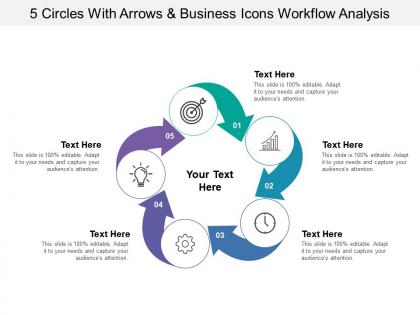
5 circles with arrows and business icons workflow analysis




Try Before you Buy Download Free Sample Product
 Impress Your
 Audience
 100%
100% Editable
 Save Hours
 of Time


Eliminate ignorance with our 5 Circles With Arrows And Business Icons Workflow Analysis. Don't allow bigotry to develop.
People who downloaded this PowerPoint presentation also viewed the following :
5 circles with arrows and business icons workflow analysis with all 5 slides:
Influence the forum with our 5 Circles With Arrows And Business Icons Workflow Analysis. Enlighten them about better alternatives.


FAQs for 5 circles with arrows and business
Key steps in conducting effective workflow analysis include mapping current processes, identifying bottlenecks and inefficiencies, documenting task sequences, analyzing resource allocation, and measuring performance metrics. These systematic approaches streamline operations by revealing redundancies, optimizing task distribution, and enhancing productivity, with many organizations finding that structured workflow analysis delivers significantly improved operational efficiency and reduced costs.
Workflow analysis improves team collaboration and productivity by identifying bottlenecks, streamlining communication channels, and establishing clear role dependencies across processes. Through detailed process mapping, organizations eliminate redundancies, reduce handoff delays, and create transparent accountability structures, with many teams finding that systematic workflow optimization delivers faster project completion and enhanced cross-functional coordination.
Workflow success metrics include cycle time, throughput rates, error frequencies, resource utilization, and customer satisfaction scores. These measurements enable organizations to identify bottlenecks, optimize resource allocation, and enhance operational efficiency, with many companies finding that tracking these indicators delivers faster processing times, reduced costs, and improved service quality across departments.
Technology significantly enhances workflow efficiency by automating repetitive tasks, enabling real-time collaboration, and providing data-driven insights for optimization. Through cloud platforms, AI-powered analytics, and integrated software systems, organizations streamline operations, reduce processing times, and minimize human error, with many companies finding that strategic technology adoption delivers faster project completion and improved resource allocation.
Common pitfalls include analyzing workflows in isolation without considering interdependencies, relying solely on current employee perspectives, and failing to measure baseline performance metrics before implementing changes. Organizations should avoid rushing the analysis phase, overlooking technology integration opportunities, and neglecting stakeholder buy-in, as these oversights often lead to incomplete solutions that ultimately hinder operational efficiency rather than enhance it.
Visual tools like flowcharts enhance workflow analysis by providing clear process visualization, identifying bottlenecks and inefficiencies, and facilitating stakeholder communication through intuitive diagrams. These visual representations enable teams to quickly pinpoint improvement opportunities, streamline complex procedures, and ensure consistent understanding across departments, ultimately delivering faster implementation and reduced operational costs.
Employee feedback serves as a critical data source in workflow analysis, providing insights into bottlenecks, inefficiencies, resource constraints, and process improvement opportunities that may not be visible through observation alone. This frontline perspective enables organizations to identify practical solutions, streamline operations, and enhance productivity, with many companies finding that incorporating employee suggestions significantly accelerates implementation and delivers measurable operational improvements.
Industry standards significantly influence workflow analysis methodologies by establishing consistent frameworks, measurement criteria, and best practices across organizations. Standards like ISO 9001, Six Sigma, and LEAN manufacturing provide structured approaches that streamline process evaluation, ensure regulatory compliance, and enable benchmarking, with many companies finding that standardized methodologies deliver improved operational efficiency and competitive advantage.
Continuous improvement in workflow analysis ensures processes remain efficient, adaptable, and competitive by identifying bottlenecks, eliminating redundancies, and optimizing resource allocation through regular assessment cycles. This iterative approach enables organizations across manufacturing, healthcare, and financial services to reduce operational costs, accelerate delivery times, and enhance customer satisfaction, ultimately delivering sustained competitive advantage in increasingly dynamic markets.
Workflow analysis aligns with strategic business goals by mapping current processes against desired outcomes, identifying efficiency gaps, and prioritizing improvements that directly support organizational objectives. Through systematic evaluation, companies streamline operations, reduce costs, and enhance customer experiences, with many organizations finding that strategic workflow optimization delivers measurable competitive advantages and accelerated goal achievement.
Workflow documentation best practices include creating visual process maps, defining clear roles and responsibilities, capturing decision points and exceptions, documenting timing and dependencies, and maintaining version control. These methods enhance transparency by standardizing processes, identifying bottlenecks, and enabling continuous improvement, with many organizations finding that comprehensive documentation ultimately streamlines training and ensures consistent operational efficiency.
Small businesses can effectively implement workflow analysis by starting with simple process mapping, identifying bottlenecks through employee feedback, and using affordable digital tools like basic project management software. These approaches enable streamlined operations, reduced redundancies, and improved resource allocation, with many small enterprises finding that systematic workflow evaluation ultimately delivers faster customer service and significant cost savings.
Effective workflow analysis software includes process mapping tools like Visio and Lucidchart, analytics platforms such as Tableau and Power BI, project management systems like Asana and Monday.com, and specialized solutions including ProcessMaker and Nintex. These technologies streamline documentation, enhance data visualization, and automate bottleneck identification, with many organizations finding that integrated platforms deliver comprehensive insights, improved operational efficiency, and faster decision-making across departments.
Remote teams face challenges in workflow analysis including limited visibility into work processes, communication gaps across time zones, difficulty tracking collaborative tasks, and inconsistent data collection methods. These obstacles can be overcome by implementing centralized project management platforms, establishing standardized reporting protocols, and leveraging real-time analytics tools, with many organizations finding that cloud-based workflow systems ultimately enhance transparency and accountability.
Organizations should revisit workflow analysis quarterly for operational processes and annually for strategic workflows, with additional reviews triggered by technology changes, regulatory updates, or performance declines. Many companies find that regular assessment cycles enable proactive optimization, identify emerging bottlenecks, and maintain competitive advantage through continuous process refinement and enhanced operational efficiency.
-
Good research work and creative work done on every template.
-
Presentation Design is very nice, good work with the content as well.