

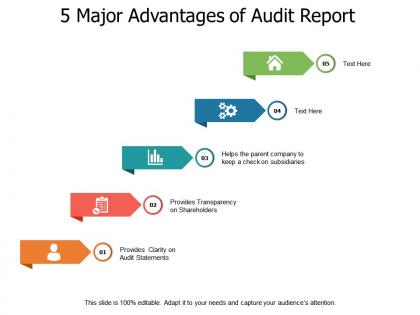
5 major advantages of audit report




Try Before you Buy Download Free Sample Product
 Impress Your
 Audience
 100%
100% Editable
 Save Hours
 of Time


Convince folks that there is no cause for envy with our 5 Major Advantages Of Audit Report. Be able to handle jealous folk.
People who downloaded this PowerPoint presentation also viewed the following :
5 major advantages of audit report with all 5 slides:
Enthrall them with your expertise with our 5 Major Advantages Of Audit Report. They will feel completely awestruck.




FAQs for 5 major advantages
Audit reports provide insights into financial accuracy, internal control effectiveness, compliance with regulations, cash flow patterns, and risk exposure areas. These comprehensive assessments enable management to identify operational inefficiencies, strengthen financial controls, and make informed strategic decisions, with many organizations finding that regular audits enhance investor confidence and competitive positioning.
Businesses can use audit reports to enhance operational efficiency by identifying process bottlenecks, uncovering cost reduction opportunities, and streamlining resource allocation across departments. These comprehensive assessments enable organizations to eliminate redundancies, automate manual processes, and optimize workflow management, with many companies finding that implementing audit recommendations delivers measurable productivity gains and competitive advantage.
Audit reports build stakeholder trust by providing independent verification of financial accuracy, transparent disclosure of company performance, and objective assessment of internal controls and risk management practices. These comprehensive evaluations enable investors, creditors, and regulatory bodies to make informed decisions with confidence, while demonstrating organizational accountability and regulatory compliance, ultimately enhancing market credibility and competitive positioning.
The most common audit types include financial audits, operational audits, compliance audits, IT audits, and internal audits, each serving distinct organizational needs. These audits produce specialized reports tailored to their scope, with financial audits delivering comprehensive financial statements and compliance verification, while operational audits focus on efficiency improvements and IT audits emphasize security vulnerabilities, ultimately enabling organizations to address specific risk areas strategically.
Audit reports help identify potential risks and areas for improvement by systematically analyzing financial controls, operational processes, compliance gaps, and internal weaknesses across organizational functions. These comprehensive assessments enable businesses to proactively address vulnerabilities, streamline inefficient procedures, and strengthen governance frameworks, with many organizations finding that regular audit insights ultimately deliver enhanced risk management and competitive operational advantages.
Audit reports serve as critical documentation demonstrating compliance with regulatory standards, providing independent verification of financial accuracy, internal controls, and operational adherence to industry requirements. Through comprehensive assessments, organizations streamline regulatory submissions, minimize compliance risks, and enhance stakeholder confidence, with many financial institutions and healthcare organizations finding that regular audit documentation significantly reduces regulatory scrutiny and potential penalties.
Audit reports influence strategic decision-making by providing objective financial assessments, identifying operational inefficiencies, and revealing compliance gaps that impact resource allocation. Through comprehensive risk analysis and performance benchmarking, executives can prioritize investments, optimize processes, and enhance governance frameworks, with many organizations finding that regular audit insights accelerate growth strategies and competitive positioning.
Audit findings significantly enhance management accountability by requiring formal responses to identified deficiencies, establishing clear responsibility chains, and mandating corrective action timelines. These findings create transparency frameworks that enable stakeholders, boards, and regulatory bodies to evaluate management performance objectively, with many organizations finding that systematic audit processes ultimately strengthen governance structures and build stakeholder confidence.
Companies should effectively communicate audit results through clear executive summaries, visual dashboards, stakeholder-specific presentations, and transparent action plans that address key findings. These communication strategies enhance stakeholder confidence by delivering accessible insights, demonstrating accountability, and outlining concrete remediation steps, ultimately strengthening governance relationships and maintaining regulatory compliance across diverse audiences.
Best practices for interpreting audit report data include focusing on material findings, analyzing trend patterns over multiple periods, prioritizing high-risk areas, and cross-referencing recommendations with business objectives. Organizations should involve relevant stakeholders in review sessions, develop action plans with clear timelines, and track implementation progress, ultimately transforming audit insights into strategic improvements that enhance operational efficiency and regulatory compliance.
Regular audits enhance financial forecasting by identifying trends, validating data accuracy, and revealing operational patterns that inform future projections. Through systematic examination of financial processes, organizations streamline budget planning, minimize forecasting errors, and enhance strategic decision-making, with many companies finding that consistent audit insights ultimately deliver more reliable revenue predictions and competitive advantage.
Independent auditors bring objectivity, credibility, and unbiased assessment to financial reporting, ensuring compliance with accounting standards and regulatory requirements. Their external perspective enhances stakeholder confidence, with investors, lenders, and regulatory bodies finding that independent verification significantly reduces financial risk, improves transparency, and ultimately delivers greater trust in organizational financial integrity.
Audit reports provide standardized financial metrics, operational data, compliance indicators, risk assessments, and performance ratios that enable direct comparison with industry peers. Through verified benchmarking data, companies can identify performance gaps, optimize resource allocation, and implement strategic improvements, with many organizations finding that regular audit-based comparisons ultimately deliver competitive advantages and enhanced operational efficiency.
Companies face challenges including resource constraints, resistance to change from employees, competing business priorities, inadequate project management capabilities, and insufficient expertise to execute complex recommendations. While these obstacles can delay implementation, organizations that develop structured action plans, allocate dedicated resources, and maintain leadership commitment ultimately streamline operations and enhance compliance, with many finding that phased approaches deliver measurable improvements.
Audit reports serve as continuous improvement tools by identifying operational inefficiencies, highlighting compliance gaps, recommending process enhancements, and establishing performance benchmarks for future assessments. These comprehensive evaluations enable organizations to streamline workflows, minimize risk exposure, and enhance operational transparency, with many companies finding that regular audit insights drive strategic decision-making and ultimately deliver sustained competitive advantage.
No Reviews