

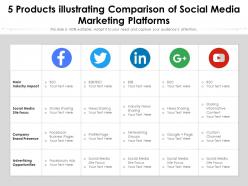
5 products illustrating comparison of social media marketing platforms





Try Before you Buy Download Free Sample Product
 Impress Your
Audience
 100%
Editable
 Save Hours
of Time


Our 5 Products Illustrating Comparison Of Social Media Marketing Platforms are topically designed to provide an attractive backdrop to any subject. Use them to look like a presentation pro.
People who downloaded this PowerPoint presentation also viewed the following :
5 products illustrating comparison of social media marketing platforms with all 2 slides:
Use our 5 Products Illustrating Comparison Of Social Media Marketing Platforms to effectively help you save your valuable time. They are readymade to fit into any presentation structure.
FAQs for 5 products illustrating comparison of social
Major social media marketing platforms differ through audience targeting capabilities, content formats, advertising options, analytics depth, and engagement mechanisms. Facebook excels in detailed demographic targeting and diverse ad formats, Instagram prioritizes visual storytelling with shopping integrations, LinkedIn delivers professional B2B networking with industry-specific targeting, while Twitter enables real-time conversations and trending topic engagement, ultimately allowing businesses to strategically match platform strengths with specific marketing objectives.
User demographics significantly influence marketing strategies by determining content tone, messaging frequency, visual approach, and campaign timing across platforms. LinkedIn's professional audience requires B2B-focused content and industry insights, while Instagram's younger demographics respond better to visual storytelling and influencer partnerships, with many brands finding that platform-specific demographic alignment ultimately delivers higher engagement rates and improved conversion outcomes.
Engagement differs across platforms through unique user behaviors, content formats, and interaction mechanisms, with Instagram prioritizing visual storytelling, LinkedIn emphasizing professional networking discussions, TikTok driving viral short-form content, and Facebook facilitating community conversations. Marketers can leverage these distinctions by tailoring content strategies to each platform's strengths, ultimately delivering more targeted messaging, higher conversion rates, and stronger brand connections across diverse audience segments.
Visual platforms like Instagram and Pinterest require high-quality imagery, storytelling captions, strategic hashtag usage, and lifestyle-focused content that showcases products in authentic contexts. These platforms enhance brand engagement through visual storytelling and aspirational content, while text-based platforms like Twitter emphasize concise messaging, trending topics, and real-time conversations, with many brands finding that visual platforms deliver higher conversion rates for retail and lifestyle sectors.
Algorithm changes on Facebook and Instagram significantly reduce organic reach for businesses by prioritizing personal content, meaningful interactions, and recency over promotional posts. These updates typically decrease business visibility by 20-50%, with many companies finding that enhanced content quality, strategic posting timing, and increased engagement tactics become essential for maintaining audience connection and driving meaningful customer interactions in an increasingly competitive social landscape.
Influencer marketing serves as a strategic bridge between brands and audiences, with effectiveness varying significantly across platforms based on content format, audience demographics, and engagement patterns. Instagram excels for lifestyle and visual products through sponsored posts, TikTok drives viral awareness among younger demographics, while LinkedIn enables B2B thought leadership, ultimately delivering authentic connections and measurable ROI when strategically matched to platform strengths.
Businesses can effectively measure social media ROI by tracking conversion rates, cost per acquisition, engagement metrics, lead generation, and customer lifetime value across platforms. Through platform-specific analytics tools and unified dashboards, companies in retail, SaaS, and e-commerce streamline performance measurement, optimize budget allocation, and identify high-performing channels, ultimately delivering measurable revenue growth and strategic competitive advantage.
TikTok offers unprecedented organic reach through viral potential, authentic user-generated content, and direct access to younger demographics, while Facebook provides sophisticated targeting tools, comprehensive analytics, and established advertising infrastructure. However, TikTok presents content creation challenges requiring constant trend adaptation and faces regulatory uncertainties, whereas Facebook struggles with declining organic reach and increasing competition for audience attention, with many brands finding that strategic combination across platforms delivers optimal results.
Facebook excels through Messenger automation and community building, Instagram leverages visual storytelling and Stories for real-time responses, LinkedIn offers professional relationship management and industry-specific discussions, while Twitter provides instant public communication and crisis management capabilities. These platforms enable businesses to streamline customer interactions, enhance response times, and build stronger relationships, with many companies finding that strategic multi-platform approaches ultimately deliver improved customer satisfaction and competitive advantage.
Privacy policies and data protection regulations like GDPR and CCPA significantly impact social media marketing by requiring explicit consent, limiting data collection, and mandating transparent opt-out processes. These regulations compel organizations to pivot toward first-party data strategies, contextual advertising, and relationship-based marketing, ultimately delivering enhanced customer trust and sustainable competitive advantage in an increasingly privacy-conscious marketplace.
Advertising costs vary significantly across platforms, with LinkedIn typically commanding premium rates for B2B targeting, while Facebook and Instagram offer competitive pricing for broader consumer reach, and TikTok presenting cost-effective opportunities for younger demographics. Businesses should evaluate their target audience demographics, campaign objectives, and expected ROI, with many finding that strategic combinations across multiple platforms deliver optimal cost efficiency and comprehensive market coverage.
Visual content like infographics and videos excel on Instagram and TikTok, while LinkedIn favors professional articles, industry insights, and thought leadership pieces, and Facebook performs well with community-focused posts and live content. Marketers increasingly tailor messages by matching platform demographics with content format, with many organizations finding that platform-specific strategies deliver higher engagement rates and more qualified leads than generic approaches.
Small businesses can effectively utilize multiple platforms by focusing on 2-3 channels where their target audience is most active, repurposing content across platforms, and leveraging free scheduling tools for consistent posting. By creating versatile content that adapts to each platform's format, batching posts weekly, and engaging authentically with followers, small businesses maximize reach while minimizing costs, ultimately building brand awareness and customer relationships efficiently.
Marketers can leverage comprehensive analytics tools like Hootsuite Analytics, Sprout Social, Buffer Analyze, Google Analytics, and native platform insights from Facebook, Instagram, and LinkedIn. These platforms enable cross-platform performance tracking by measuring engagement rates, reach metrics, conversion data, and audience demographics, with many organizations finding that unified dashboards streamline reporting while delivering actionable insights for optimizing content strategies and maximizing ROI.
Ephemeral content transforms marketing practices by encouraging authentic, real-time engagement, creating urgency through limited-time availability, and fostering behind-the-scenes storytelling that builds stronger brand connections. Through these temporary formats, retailers, entertainment companies, and fashion brands deliver exclusive previews, flash promotions, and candid moments, ultimately driving higher engagement rates and more immediate consumer responses than traditional permanent content.
-
Wonderful templates design to use in business meetings.
-
Great product with highly impressive and engaging designs.