

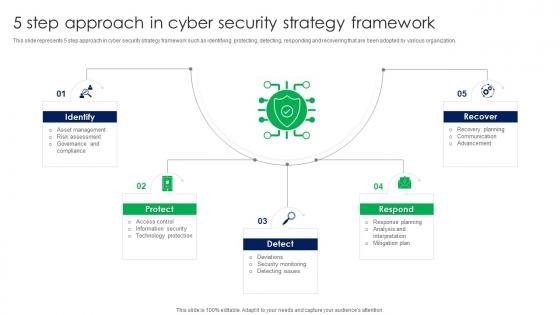
5 Step Approach In Cyber Security Strategy Framework




Try Before you Buy Download Free Sample Product
 Impress Your
 Audience
 100%
100% Editable
 Save Hours
 of Time


This slide represents 5 step approach in cyber security strategy framework such as identifying, protecting, detecting, responding and recovering that are been adopted by various organization.
People who downloaded this PowerPoint presentation also viewed the following :
5 Step Approach In Cyber Security Strategy Framework with all 6 slides:
Use our 5 Step Approach In Cyber Security Strategy Framework to effectively help you save your valuable time. They are readymade to fit into any presentation structure.





FAQs for 5 Step Approach In Cyber
Core components of a Cyber Security Framework include identify, protect, detect, respond, and recover functions, encompassing asset management, access controls, monitoring systems, incident response protocols, and business continuity planning. These integrated components streamline organizational security by establishing clear governance structures, automating threat detection, and ensuring rapid recovery capabilities, with many enterprises finding that comprehensive frameworks ultimately deliver reduced risk exposure and enhanced operational resilience.
Organizations can assess their current cybersecurity posture by conducting comprehensive gap analyses against established frameworks like NIST or ISO 27001, evaluating existing controls, identifying vulnerabilities, and benchmarking maturity levels across all security domains. This structured approach enables businesses to prioritize remediation efforts, allocate resources strategically, and develop roadmaps that enhance their security resilience while ensuring regulatory compliance.
Standards and best practices serve as foundational blueprints for cybersecurity frameworks, providing structured guidelines for risk assessment, incident response, access controls, and compliance requirements. These established protocols enable organizations across industries like healthcare, finance, and manufacturing to implement consistent security measures, streamline regulatory compliance, and enhance their defensive capabilities against evolving threats.
The NIST Cybersecurity Framework emphasizes risk management through five core functions (Identify, Protect, Detect, Respond, Recover), while ISO 27001 provides comprehensive security controls through formal certification requirements. NIST delivers flexible, outcomes-based guidance enabling organizations to adapt cybersecurity measures to their specific needs, whereas ISO 27001 ensures standardized compliance across industries, with many enterprises finding that combining both frameworks enhances overall security posture.
Organizations commonly face challenges including resource constraints, employee resistance to change, complex legacy system integration, inadequate staff training, and maintaining compliance across multiple regulatory requirements. While these obstacles can slow initial implementation, many enterprises find that phased approaches, comprehensive staff education, and strategic vendor partnerships ultimately streamline the process and deliver enhanced security posture.
A Cyber Security Framework helps achieve regulatory compliance by providing structured policies, standardized procedures, and systematic risk assessments that align with legal requirements. Through comprehensive documentation, regular audits, and incident response protocols, organizations can demonstrate adherence to regulations like GDPR, HIPAA, and SOX, while streamlining compliance processes and reducing audit costs.
Organizations should track metrics including incident response time, mean time to detection, security awareness training completion rates, vulnerability remediation speed, and compliance audit scores. These metrics enable businesses to assess their security posture comprehensively, with many financial institutions and healthcare organizations finding that tracking breach costs, system downtime, and regulatory compliance levels ultimately delivers enhanced risk management and operational resilience.
Aligning cybersecurity frameworks with business objectives requires conducting comprehensive risk assessments, mapping security controls to critical business processes, establishing clear governance structures, and defining measurable security metrics tied to business outcomes. Organizations achieve this alignment by integrating security considerations into strategic planning, ensuring regulatory compliance supports business goals, and regularly reviewing frameworks against evolving business needs, ultimately delivering operational resilience and competitive advantage.
Small businesses can adapt cybersecurity frameworks by prioritizing core controls like access management, data backup, and employee training while scaling implementation based on available resources and specific industry risks. Many small organizations find success by starting with essential protections, leveraging cloud-based security solutions, and gradually expanding their cybersecurity posture, ultimately delivering cost-effective protection without overwhelming limited IT budgets.
Risk assessment serves as the foundation of any cybersecurity framework by identifying vulnerabilities, evaluating potential threats, and prioritizing security investments based on actual business impact. This strategic process enables organizations to allocate resources efficiently, implement targeted protections, and maintain regulatory compliance, with many enterprises finding that regular assessments significantly reduce breach costs while enhancing overall operational resilience.
Cyber Security Frameworks facilitate incident response planning by providing structured methodologies for threat detection, response coordination, and recovery protocols. Through standardized procedures like NIST guidelines, organizations streamline communication workflows, automate threat containment, and minimize downtime, with many financial institutions and healthcare providers finding that framework-based approaches reduce incident resolution time while enhancing regulatory compliance.
Emerging cybersecurity framework trends include zero-trust architecture, AI-powered threat detection, cloud-native security models, quantum-resistant encryption, and integrated compliance automation. These approaches streamline protection by eliminating perimeter assumptions, accelerating threat response, and seamlessly adapting to hybrid environments, with organizations increasingly finding that proactive frameworks deliver significant cost reduction and competitive advantage.
Organizations ensure continuous improvement of their Cyber Security Framework through regular risk assessments, threat intelligence monitoring, security audits, and performance metrics analysis. This iterative approach enables companies to adapt to evolving cyber threats, with many financial institutions and healthcare organizations finding that quarterly framework reviews and real-time threat detection significantly enhance their security posture and operational resilience.
Employee training serves as the human firewall within a Cyber Security Framework, enabling staff to recognize phishing attempts, follow secure protocols, and respond appropriately to potential threats. Through regular security awareness programs, organizations significantly reduce human error vulnerabilities, enhance incident response times, and strengthen overall security posture, with many companies finding that well-trained employees become their most effective defense against cyber attacks.
Organizations effectively communicate their Cyber Security Framework to stakeholders through clear visual presentations, executive summaries tailored to different audiences, regular briefings, and comprehensive documentation that translates technical controls into business outcomes. These communication strategies enhance transparency and alignment by demonstrating risk mitigation, compliance achievements, and operational resilience, with many finding that stakeholder engagement ultimately strengthens security investment support.
-
Their designing team is so expert in making tailored templates. They craft the exact thing I have in my mind…..really happy.
-
Fantastic and innovative graphics with useful content. The templates are the best and latest in the industry.