

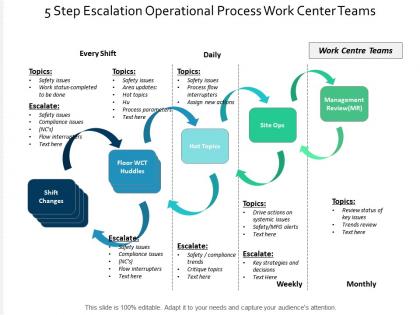
5 step escalation operational process work centre teams




Try Before you Buy Download Free Sample Product
 Impress Your
 Audience
 100%
100% Editable
 Save Hours
 of Time


Convey your ideas exactly as you imagined with our 5 Step Escalation Operational Process Work Centre Teams. You will enjoy the convenience it brings.
People who downloaded this PowerPoint presentation also viewed the following :
5 step escalation operational process work centre teams with all 5 slides:
Try out our catchy 5 Step Escalation Operational Process Work Centre Teams. Get a high rating on the popularity poll.




FAQs for 5 step escalation operational process
Okay so first figure out what actually needs to be escalated - like what's your breaking point? Map out who gets called when things go sideways, starting with your boss and working up. Set deadlines too - maybe 24 hours for first level, 48 for the next. Document everything (yeah it's annoying but trust me). Oh and don't forget to circle back with everyone once it's solved - people hate being left hanging. Honestly the hardest part is just getting that initial hierarchy straight. Once you know who calls who and when, the rest pretty much runs itself.
You need solid escalation rules set up beforehand - like "over 50 customers affected" or "downtime hits 30 minutes." Resource stuff too, when your team's skills or authority just aren't enough. Time limits are huge though. If you can't fix it within your SLA window, escalate automatically. Don't wait around hoping for a miracle - I've seen that backfire so many times. The trick is having these triggers written down clearly so nobody's guessing what to do when everything's on fire. Way better than panic decisions.
Dude, communication literally makes or breaks escalations. Document everything - what's wrong, why you're bumping it up, what you already tried. I've watched so many get stuck in limbo because nobody explained how urgent things actually were. Keep everyone updated as stuff moves forward, especially whoever originally asked for help. Tell them realistic timelines too. Oh and create a solid paper trail so the next person doesn't have to play detective figuring out what happened. Trust me, they'll thank you for it. Nothing worse than inheriting a mess with zero context.
Flowcharts are honestly a game-changer for this stuff. Instead of people getting lost in boring policy documents, they can actually see the whole process laid out. I'd make a simple diagram showing Level 1 → Level 2 → Level 3 with clear triggers for each step. Throw in an org chart so everyone knows who owns what level of escalation. Response time expectations help too - like, is this a same-day thing or can it wait? My team loves having that one-page reference guide they can pull up quickly. Beats digging through a manual every single time.
Ugh, the worst thing you can do is wait forever then just tell your boss "the client's mad" with zero details. Super unhelpful. But also don't escalate literally everything - nobody will take you seriously when something actually important happens. Try the obvious fixes first so you can say what you already attempted. Oh and never blindside your manager in front of the client! That's just awkward for everyone. Give them a quick heads up beforehand. Honestly, timing is everything - early enough that they can actually help, but make sure you've got real info to share.
Yeah, cultural stuff can totally mess with your escalation process. Some cultures hate confrontation so they'll sit on issues until everything's on fire. Others skip right past their manager and go straight to the CEO over minor stuff - which honestly drives me crazy. Response time expectations are all over the place too. The communication thing is huge though - direct cultures giving blunt feedback to indirect cultures when everyone's already stressed? Recipe for disaster. I'd set up clear guidelines that actually account for these differences. Maybe even tweak your approach depending on the region you're dealing with.
Track your escalation rate first - like what percentage of cases actually get bumped up. Resolution times at each level matter too, plus first-call resolution rates. Customer satisfaction scores are honestly the biggest tell since people hate getting transferred around. Oh, and definitely watch for repeat escalations on the same stuff - that's usually where your process is broken. Set up some basic dashboard to check these monthly (nothing fancy). You want enough escalations to handle the tricky cases but not so many that it's all you're doing.
Map out who jumps in at each escalation level first. Figure out your key people - department heads, decision makers, the experts who actually know stuff. Then nail down what triggers their involvement and how fast they need to respond. Honestly, I've watched so many escalations turn into complete disasters because everyone's just standing around confused about their role. Document the communication flow and be super specific about what you need from each person - approval, resources, whatever. Oh, and set up regular check-ins during active issues. Trust me, it'll save you tons of headaches later.
Honestly, most companies just use whatever ticketing system they already have - Jira, ServiceNow, Zendesk. Set up some basic priority rules and let it auto-route stuff. For the actual alerting, PagerDuty's pretty solid (though kinda pricey). Slack channels work great for team notifications, just don't dump everything in your main channel or people tune out. Some folks get fancy with Zapier to connect all their tools, but that's probably overkill starting out. My advice? Map out how you want things to escalate first, then find tools that fit. Way easier than trying to bend your process around whatever software you picked.
Document everything in one place where everyone can see it. Original problem, who escalated when, what you tried, how it ended up. I used to skip the root cause stuff - honestly thought it was just extra work - but it actually saves your ass later when the same thing breaks again. Don't forget those messy email chains with stakeholders either. They're annoying to save but super helpful down the road. Just pick a format and stick with it so people aren't hunting around trying to figure out what happened.
Don't wait until the end - build feedback into every step of your escalation process. After each escalation, loop back with whoever reported it to see if you actually fixed their problem (not just what you thought the problem was). I've watched teams "solve" issues while completely missing what people were actually asking for. Get input from whoever handled it too - they'll spot the gaps in your process. Oh, and make the feedback automatic. Add it to your escalation template or set those 48-hour follow-up reminders. Otherwise you'll forget every time.
Definitely do scenario training - cover when to escalate, who to call, what info to grab first. Role-playing is honestly way better than just handing people a manual to read. Your team needs to know the different escalation paths for different problems, plus how long each level should take. Oh, and communication templates are a lifesaver so people know exactly what details to include. I learned this the hard way at my last job. Practice these situations before they actually happen. That way when things go sideways, nobody's panicking trying to remember the process.
So it really depends on what industry you're in - like healthcare has to escalate super fast because people could literally die, but retail can be way more chill about things. Manufacturing cares most about machines breaking down, financial companies have crazy compliance deadlines they can't miss. Tech focuses on anything that screws up the user experience, and hotels will bend over backwards for guest complaints since bad reviews kill them. Honestly, I'd figure out your top 3 biggest risks first - whether that's safety, money, regulations, whatever - then build your whole escalation thing around those. Makes way more sense than some generic template.
Honestly, having a clear escalation path is a game-changer for team morale. Your people won't feel like they're drowning when stuff hits the fan because they know exactly who to call. Makes them way more confident tackling tough situations instead of just suffering through it alone. I've seen teams transform when they stop feeling abandoned during crises. They'll actually speak up early too, which prevents those small problems from turning into complete disasters. Oh, and don't just stick it in some handbook nobody reads - you've got to actually tell people about the process or it's useless.
Honestly, most people think escalating makes them look incompetent, but it's actually the opposite. You want to flip that mindset completely. Have your leadership team share stories about times they escalated stuff - makes it feel normal. Also celebrate when someone catches something early by speaking up. Give people clear rules about when to escalate so they're not guessing. And here's the big one: never make someone feel bad for raising an issue, even if it turns out to be nothing. I've seen too many disasters happen because people were afraid to look stupid. Way better to have false alarms than miss something important.
No Reviews