

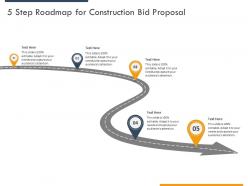
5 step roadmap for construction bid proposal ppt powerpoint presentation pictures skills





Try Before you Buy Download Free Sample Product
 Impress Your
Audience
 100%
Editable
 Save Hours
of Time


Our 5 Step Roadmap For Construction Bid Proposal Ppt Powerpoint Presentation Pictures Skills are topically designed to provide an attractive backdrop to any subject. Use them to look like a presentation pro.
People who downloaded this PowerPoint presentation also viewed the following :
5 step roadmap for construction bid proposal ppt powerpoint presentation pictures skills with all 2 slides:
Use our 5 Step Roadmap For Construction Bid Proposal Ppt Powerpoint Presentation Pictures Skills to effectively help you save your valuable time. They are readymade to fit into any presentation structure.

FAQs for 5 step roadmap for construction bid proposal ppt powerpoint
A successful construction bid proposal encompasses a comprehensive scope of work, a detailed budget breakdown, a realistic project schedule, and compelling qualifications highlighting your team's expertise and experience. These elements work together to demonstrate a clear understanding of the project requirements, a commitment to delivering high-quality work within budget and timeframe, and the ability to effectively manage the complexities of construction projects, ultimately securing the contract and building a strong reputation for your company.
Estimating project costs accurately is crucial for successful bid proposals in the construction industry. Companies can effectively estimate costs by utilizing detailed project plans, analyzing historical data from similar projects, incorporating accurate material and labor pricing, and factoring in potential contingencies for unforeseen expenses. By leveraging software tools, collaborating with experienced estimators, and carefully reviewing all cost elements, construction companies can deliver competitive bids that reflect both profitability and project feasibility.
Common mistakes to avoid when preparing a construction bid proposal include underestimating costs, failing to thoroughly understand the scope of work, and neglecting to clearly outline project timelines. These errors can lead to budget overruns, scope creep, and missed deadlines, ultimately jeopardizing profitability and client relationships. With many construction firms finding that meticulous planning and accurate cost projections are crucial for success, it's essential to prioritize these aspects throughout the proposal development process.
Including a detailed project timeline in a construction bid proposal is crucial because it demonstrates your understanding of the project scope and your ability to deliver on schedule. A well-defined timeline not only outlines key milestones and deliverables but also helps clients visualize the project's progression, fostering trust and confidence in your capabilities. Furthermore, it allows for proactive risk management by identifying potential bottlenecks or dependencies, ultimately leading to smoother project execution and client satisfaction.
Market research plays a crucial role in developing a competitive construction bid by providing insights into project requirements, competitor pricing, and material costs. It enables contractors to tailor bids to specific client needs, understand prevailing market rates, and identify opportunities for cost optimization, ultimately delivering a bid that is both attractive and profitable, especially in a landscape where cost-consciousness is paramount.
Subcontractor relationships significantly impact a construction bid proposal by influencing both cost and schedule estimations. Strong relationships with reliable subcontractors can lead to more accurate pricing, faster turnaround times, and smoother project execution. For example, banks often leverage established relationships with construction firms to secure competitive bids and expedite project timelines, ultimately enhancing their operational efficiency.
Differentiating a construction bid involves highlighting your unique value proposition and demonstrating expertise. Strategies include showcasing specialized skills in areas like sustainable building practices, innovative construction methods, or project management software expertise. With many contractors focusing on price alone, emphasizing proven track records in delivering projects on time and within budget, particularly in specific sectors like healthcare or commercial real estate, can significantly set you apart.
A construction bid proposal should proactively address potential risks and mitigation strategies by outlining specific identified risks and detailing concrete plans to minimize their impact. For example, a proposal for a high-rise project might acknowledge the risk of material delays and propose solutions like securing alternative suppliers or incorporating buffer time into the schedule. This demonstrates foresight, mitigates potential cost overruns, and ultimately builds trust with the client, showcasing the bidder's ability to navigate challenges effectively.
A compelling executive summary for a construction bid proposal should concisely outline your company's understanding of the project scope, key qualifications, proposed approach, and anticipated value proposition. It should highlight your team's experience in similar projects, particularly within the [mention specific sector, e.g., healthcare, commercial] industry, demonstrating your ability to deliver on time and within budget while exceeding client expectations. This summary ultimately needs to convince the client that your firm is the strategic partner best equipped to successfully execute their vision.
Visual elements, such as charts, graphs, and 3D renderings, can significantly enhance the presentation of a construction bid proposal by making complex information more digestible and engaging for clients. These visuals streamline the presentation of project timelines, cost breakdowns, and design concepts, allowing clients to quickly grasp the scope and value of your proposal. For instance, banks reviewing bids for a new branch might find 3D renderings of the proposed building more persuasive than lengthy text descriptions, ultimately leading to a higher likelihood of winning the project.
A construction bid proposal's references and past project examples are crucial for demonstrating your company's capabilities and building trust with potential clients. They showcase your experience in handling similar projects, highlight your ability to deliver on time and within budget, and provide tangible evidence of your quality of work, particularly for projects with unique specifications or challenges. With many clients finding that past performance is a strong indicator of future success, these examples ultimately deliver confidence and credibility, giving your bid a significant edge in a competitive landscape.
Technology can significantly streamline the construction bid proposal process by automating document generation, facilitating collaboration, and enabling real-time data analysis. Cloud-based platforms allow teams to share and edit proposals collaboratively, while AI-powered tools can generate accurate cost estimates and resource allocations based on project specifics. This leads to faster turnaround times, reduced errors, and improved accuracy, ultimately enhancing competitiveness and profitability for construction firms.
Drafting a construction bid proposal involves several legal considerations to protect both parties. These include adhering to contract law principles, ensuring compliance with licensing and insurance requirements, clearly outlining scope of work and payment terms, addressing intellectual property rights, and including dispute resolution clauses. By carefully addressing these legal aspects, contractors can mitigate risks and foster successful project collaborations.
Payment schedules in a construction bid proposal should be structured to ensure both the contractor's financial stability and the owner's confidence in project progress. They typically involve milestone-based payments, tied to key deliverables like foundation completion, framing, roofing, and final inspections. This approach allows for phased disbursements, reflecting the value delivered at each stage, while minimizing risk for both parties. Many construction projects utilize a combination of progress payments and retainage, a percentage withheld until final project completion, to guarantee quality and address potential defects.
Following up after submitting a construction bid proposal involves several best practices to ensure your proposal stands out and increases your chances of winning the project. These practices include promptly sending a thank-you note reiterating your interest and key strengths, researching the client's timeline and following up at appropriate intervals, and offering to answer any questions they may have, demonstrating your commitment and expertise. Many construction firms find that proactive communication and personalized follow-up significantly improve their bid success rate.
No Reviews