

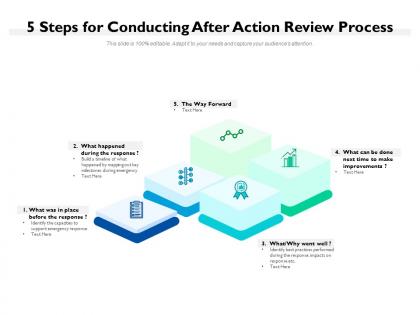
5 steps for conducting after action review process




Try Before you Buy Download Free Sample Product
 Impress Your
Audience
 100%
Editable
 Save Hours
of Time


Our 5 Steps For Conducting After Action Review Process give ideas a chance to flourish. They ensure a great abode.
People who downloaded this PowerPoint presentation also viewed the following :
5 steps for conducting after action review process with all 2 slides:
Our 5 Steps For Conducting After Action Review Process excel at banishing all doubts. They get it all into clear focus.


FAQs for 5 steps for conducting after
Key components of an effective After Action Review include clear objective setting, comprehensive data collection, stakeholder participation, timeline analysis, and actionable recommendations development. These structured elements enhance organizational learning by identifying successes and improvement areas, facilitating knowledge transfer across teams, and ultimately delivering improved performance and strategic advantage for future initiatives.
AARs improve team collaboration and accountability by creating structured reflection sessions where team members openly discuss successes, challenges, and lessons learned together. Through systematic evaluation of project phases, teams develop shared understanding, establish clearer communication protocols, and create actionable improvement plans, with many organizations finding that regular AARs ultimately enhance trust, transparency, and collective ownership of outcomes.
Best practices for facilitating After Action Review sessions include establishing psychological safety, asking structured open-ended questions, focusing on facts rather than blame, encouraging equal participation, and documenting actionable insights. These approaches streamline organizational learning by creating honest dialogue, identifying specific improvement opportunities, and capturing institutional knowledge, with many teams finding that regular AAR sessions ultimately enhance performance and build stronger collaborative relationships.
Effective AAR documentation involves capturing key decisions, performance metrics, root causes of successes and failures, and specific improvement recommendations in structured formats. Organizations across industries, from military units to healthcare teams, find that standardized templates, visual summaries, and action-oriented language ensure insights translate into implementable changes, ultimately enhancing operational efficiency and institutional knowledge retention.
AARs enhance corporate performance through project debriefs, crisis response evaluations, product launch assessments, strategic initiative reviews, and team performance analyses. These structured review processes streamline organizational learning by identifying successful practices, addressing operational gaps, and accelerating knowledge transfer, with many companies finding that regular AARs ultimately deliver improved decision-making and competitive advantage.
Teams should avoid blame-focused discussions, superficial analysis, incomplete participation, and failing to document actionable insights during After Action Reviews. These pitfalls undermine the process by creating defensive environments, missing root causes, and preventing meaningful improvement, with successful organizations finding that structured facilitation, psychological safety, and systematic follow-through ultimately deliver sustained operational enhancement and team development.
Organizations ensure AAR lessons are implemented through systematic knowledge management systems, standardized documentation processes, leadership accountability measures, and integration into project planning templates. By creating centralized lesson databases, conducting mandatory pre-project reviews of relevant AARs, and establishing metrics that track implementation rates, companies like consulting firms and construction organizations deliver improved project outcomes, reduced repeat failures, and enhanced organizational learning capabilities.
Leadership drives After Action Review success by setting expectations for honest dialogue, psychological safety, and continuous improvement culture. Effective leaders model vulnerability by acknowledging their own mistakes, facilitate balanced discussions between stakeholders, and ensure actionable insights translate into systematic organizational changes, ultimately creating environments where teams embrace learning over blame and drive operational excellence.
AARs can be adapted for remote teams through video conferencing platforms, collaborative digital whiteboards, shared documentation systems, and structured breakout sessions for smaller group discussions. These virtual approaches enable distributed teams to maintain the same depth of reflection and learning as in-person sessions, while recorded sessions provide ongoing reference materials, ultimately ensuring consistent knowledge transfer across different time zones and work arrangements.
**INPUT**: What metrics or indicators can be used to measure the effectiveness of an AAR? **OUTPUT**: AAR effectiveness metrics include participant engagement scores, implementation rates of identified improvements, cycle time reduction, error recurrence rates, and knowledge retention assessments. These indicators enable organizations to track how successfully teams translate insights into operational improvements, with many finding that combining quantitative performance data with qualitative feedback surveys delivers the most comprehensive view of AAR impact. **Word count: 58**
Feedback during After Action Reviews should focus on actions and outcomes rather than personal attributes, using specific examples, balanced observations that highlight both successes and improvement areas, and future-oriented language. This approach creates psychological safety while maintaining accountability, with many organizations finding that structured, objective feedback encourages honest participation, promotes continuous learning, and ultimately delivers stronger team performance and organizational resilience.
Technology tools that enhance After Action Reviews include collaboration platforms like Microsoft Teams and Slack, survey tools such as SurveyMonkey and Typeform, project management software like Asana and Trello, and analytics platforms including Tableau and Power BI. These technologies streamline data collection, enable real-time feedback gathering, and facilitate comprehensive analysis, with many organizations finding that digital AAR processes deliver faster insights, better documentation, and more actionable outcomes for future initiatives.
Cultural differences significantly impact AAR processes through varying communication styles, feedback approaches, hierarchical expectations, and conflict resolution methods across international teams. These cultural nuances can influence participation levels, with some cultures favoring direct feedback while others prefer indirect approaches, ultimately requiring facilitators to adapt methodologies and create inclusive environments that leverage diverse perspectives for enhanced organizational learning.
Follow-up actions include implementing identified improvements, updating procedures and training materials, communicating lessons learned across teams, establishing accountability measures, and scheduling progress reviews. These reinforcement strategies streamline organizational learning by embedding insights into workflows, enhancing future performance capabilities, and ensuring continuous improvement, with many organizations finding that systematic follow-through ultimately delivers sustained operational excellence and competitive advantage.
After Action Reviews should be conducted immediately after significant projects, milestones, or critical incidents, with regular quarterly sessions for ongoing operations and annual comprehensive reviews for strategic initiatives. This frequency enables organizations to capture fresh insights while events remain clear, systematically improve processes across departments like manufacturing and healthcare, and ultimately deliver enhanced performance and competitive advantage through continuous organizational learning.
No Reviews