

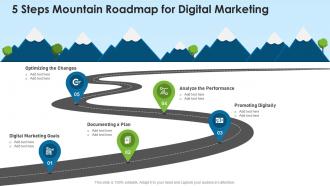
5 steps mountain roadmap for digital marketing





Try Before you Buy Download Free Sample Product
 Impress Your
Audience
 100%
Editable
 Save Hours
of Time


Our 5 Steps Mountain Roadmap For Digital Marketing are topically designed to provide an attractive backdrop to any subject. Use them to look like a presentation pro.
People who downloaded this PowerPoint presentation also viewed the following :
5 steps mountain roadmap for digital marketing with all 9 slides:
Use our 5 Steps Mountain Roadmap For Digital Marketing to effectively help you save your valuable time. They are readymade to fit into any presentation structure.








FAQs for 5 steps mountain roadmap
A successful digital marketing roadmap includes target audience analysis, competitive research, channel strategy, content planning, and performance metrics. These components work together by aligning marketing objectives with customer journey mapping, budget allocation, and timeline development, with many organizations finding that this strategic approach delivers measurable ROI and sustainable competitive advantage.
Businesses can assess their current digital marketing efforts through website analytics review, social media performance analysis, conversion rate evaluation, customer acquisition cost calculation, and competitive benchmarking studies. Through comprehensive audits, organizations identify content gaps, channel effectiveness, and ROI inconsistencies across platforms, while comparing performance against industry standards, ultimately enabling data-driven roadmap prioritization and strategic resource allocation.
Audience segmentation enables targeted messaging, personalized content delivery, optimized channel selection, improved resource allocation, and enhanced campaign performance measurement. Through demographic, behavioral, and psychographic data analysis, companies in retail, financial services, and healthcare deliver more relevant customer experiences, increase conversion rates, and achieve significantly better ROI while reducing acquisition costs.
Companies should prioritize digital marketing channels based on audience behavior data, channel ROI performance, and business objectives alignment. By analyzing customer journey touchpoints, budget allocation efficiency, and competitive landscape positioning, organizations can strategically sequence their investments, with many finding that starting with high-converting channels like email and search enables sustainable growth foundation.
Essential metrics include conversion rate, customer acquisition cost, return on ad spend, click-through rate, and lifetime customer value. These metrics enable businesses to optimize budget allocation, identify high-performing channels, and maximize ROI across campaigns, with many organizations finding that tracking these KPIs delivers enhanced targeting precision and significantly improved marketing efficiency.
AI and automation significantly transform digital marketing roadmaps by enabling predictive analytics, personalized customer journeys, automated content optimization, and real-time campaign adjustments. These technologies streamline marketing operations through intelligent lead scoring, chatbot customer service, and programmatic advertising, with many organizations finding that automated workflows reduce manual tasks while delivering enhanced targeting accuracy and improved ROI.
Ongoing optimization requires continuous performance monitoring, A/B testing campaign elements, analyzing customer behavior data, updating content based on market trends, and refining target audience segments. Through regular analytics reviews and competitor analysis, organizations streamline their marketing spend, enhance conversion rates, and adapt messaging strategies, with many companies finding that systematic optimization delivers significantly improved ROI and sustained competitive advantage.
Seasonal trends and market fluctuations significantly impact digital marketing roadmaps by requiring strategic adjustments to campaign timing, budget allocation, content themes, and channel prioritization throughout the year. Organizations increasingly build flexible roadmaps that accommodate peak seasons, economic shifts, and consumer behavior changes, with many retail and hospitality businesses finding that quarterly roadmap reviews enable faster pivots, optimized resource allocation, and sustained competitive advantage across varying market conditions.
Content marketing integration best practices include aligning content with customer journey stages, establishing consistent brand messaging across channels, leveraging data analytics for optimization, and coordinating with SEO and social media efforts. These strategic approaches streamline marketing operations by enhancing audience engagement, improving conversion rates, and maximizing resource efficiency, with many organizations finding that integrated content delivers significantly higher ROI than isolated campaigns.
Businesses can effectively manage their digital marketing roadmap budget by prioritizing high-ROI channels, setting clear performance metrics, implementing phased rollouts, and maintaining flexible allocation strategies across campaigns. Through systematic tracking and regular optimization, organizations streamline resource distribution, minimize wasteful spending, and maximize campaign effectiveness, with many companies finding that strategic budget management delivers 30-40% better marketing returns.
User experience significantly shapes digital marketing initiatives by determining customer engagement rates, conversion optimization, and brand loyalty across all digital touchpoints. Effective UX design streamlines customer journeys, reduces bounce rates, and enhances personalization strategies, with many e-commerce and SaaS companies finding that superior user experiences directly correlate with higher ROI and sustained competitive advantage in increasingly crowded digital markets.
Social media platforms can be strategically utilized by creating targeted content calendars, leveraging platform-specific advertising tools, and implementing cross-channel integration with email and SEO efforts. These approaches streamline brand visibility, enhance customer engagement, and deliver measurable ROI, with many retail and B2B organizations finding that strategic social media integration ultimately accelerates lead generation and customer acquisition.
Common pitfalls include lack of clear objectives, insufficient audience research, ignoring mobile optimization, inconsistent brand messaging, and neglecting data analytics. These missteps significantly impact campaign effectiveness, with many organizations finding that poor targeting and inadequate budget allocation across channels ultimately undermine ROI and competitive positioning in increasingly crowded digital landscapes.
Businesses should revisit their digital marketing roadmaps quarterly for strategic assessments and monthly for tactical adjustments, with continuous monitoring of key performance indicators throughout. This approach enables organizations to respond to market shifts, algorithm changes, and consumer behavior trends, while many companies finding that regular roadmap optimization delivers improved campaign performance, better resource allocation, and sustained competitive advantage in increasingly dynamic digital landscapes.
SEO serves as the foundation of digital marketing ecosystems by enhancing organic visibility, driving qualified traffic, and supporting content marketing, social media, and paid advertising efforts. It amplifies other marketing channels through improved search rankings, keyword insights, and user experience optimization, with businesses finding that strong SEO strategies ultimately deliver sustainable lead generation and competitive advantage.
-
Understandable and informative presentation.
-
Use of icon with content is very relateable, informative and appealing.
-
Unique and attractive product design.