

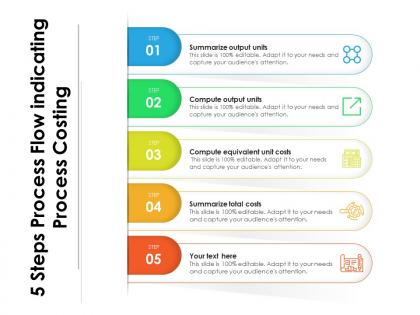
5 steps process flow indicating process costing




Try Before you Buy Download Free Sample Product
 Impress Your
 Audience
 100%
100% Editable
 Save Hours
 of Time


Our 5 Steps Process Flow Indicating Process Costing are topically designed to provide an attractive backdrop to any subject. Use them to look like a presentation pro.
People who downloaded this PowerPoint presentation also viewed the following :
5 steps process flow indicating process costing with all 2 slides:
Use our 5 Steps Process Flow Indicating Process Costing to effectively help you save your valuable time. They are readymade to fit into any presentation structure.
FAQs for 5 steps process flow
Process costing operates on principles of continuous production flow, homogeneous product output, and systematic cost accumulation across sequential departments or processes. This method enables manufacturers in industries like chemicals, textiles, and food processing to allocate direct materials, labor, and overhead costs proportionally, ultimately delivering accurate per-unit costs and enhanced operational efficiency.
Process costing applies to continuous, homogeneous production where costs are averaged across identical units, while job order costing tracks specific, unique projects with individual cost accumulation. Manufacturing industries like chemical processing, oil refining, and food production utilize process costing for standardized outputs, whereas custom manufacturers, construction companies, and consulting firms employ job order costing, ultimately delivering different reporting structures and cost management approaches.
Process costing is predominantly used in manufacturing industries like chemicals, petroleum refining, food processing, textiles, and pharmaceuticals, where products flow continuously through standardized production stages. These industries benefit from process costing because they produce homogeneous products in large volumes through repetitive processes, enabling streamlined cost allocation, enhanced operational efficiency, and simplified inventory valuation across multiple production departments.
Companies effectively implement process costing by establishing clear cost centers for each production stage, implementing robust tracking systems for materials and labor, and training staff on accurate data collection methods. Through standardized procedures and regular reconciliation processes, manufacturers in industries like chemicals, textiles, and food processing streamline cost allocation, enhance operational transparency, and ultimately deliver more precise pricing strategies.
Equivalent unit calculation serves as the foundation of process costing by converting partially completed units into equivalent fully completed units for accurate cost allocation. This methodology enables manufacturers in industries like chemicals, textiles, and food processing to determine precise per-unit costs across production stages, ultimately delivering accurate inventory valuation and informed pricing decisions for competitive advantage.
Direct materials, labor, and overhead costs integrate into process costing through systematic allocation across production departments, with costs accumulated continuously as products flow through sequential stages. These three cost components are tracked separately within each process, then combined using equivalent units calculations to determine per-unit costs, enabling manufacturers in industries like chemicals, food processing, and textiles to achieve accurate product costing and improved operational efficiency.
Process costing offers superior accuracy for financial reporting through standardized cost allocation, simplified variance analysis, streamlined inventory valuation, and enhanced regulatory compliance across high-volume production environments. Unlike job costing's complexity, this method enables manufacturers in chemicals, food processing, and pharmaceuticals to deliver consistent financial statements, reduce administrative overhead, and ultimately provide stakeholders with more reliable profitability insights for strategic decision-making.
Companies manage continuous production costs through process costing by accumulating expenses across production departments, tracking direct materials and labor at each stage, and applying overhead systematically throughout the workflow. This method enables manufacturers like chemical plants, food processors, and textile companies to distribute costs evenly across identical units, ultimately delivering accurate per-unit pricing and streamlined cost control in high-volume operations.
Transitioning from job order costing to process costing presents challenges including reconfiguring accounting systems, retraining staff on continuous production metrics, establishing standardized cost allocation methods, and adapting inventory valuation processes. Manufacturing companies, particularly in chemicals and food processing, often find that while initial implementation requires significant resource investment, the transition ultimately streamlines operations and enhances cost transparency across production lines.
Process costing significantly impacts inventory valuation by averaging production costs across homogeneous units, creating consistent per-unit costs for work-in-process and finished goods inventory. This systematic approach streamlines cost of goods sold reporting by providing standardized unit costs throughout production cycles, with manufacturing companies like chemical processors and food producers finding that it delivers more accurate financial reporting and simplified inventory management for continuous production environments.
Technology enhances process costing accuracy through automated data collection, real-time inventory tracking, advanced analytics, and integrated ERP systems that eliminate manual errors. These digital solutions streamline cost allocation by providing instant visibility into production flows, enabling manufacturers and chemical processors to optimize resource allocation, reduce processing time, and deliver more precise financial reporting for strategic decision-making.
Strategies include lean manufacturing principles, automation technologies, real-time monitoring systems, continuous improvement methodologies, and standardized quality controls. These approaches streamline operations by minimizing material waste, reducing labor inefficiencies, and optimizing resource allocation, with many manufacturing organizations finding that systematic process optimization ultimately delivers lower production costs and enhanced competitive positioning.
Businesses utilize process costing data for decision-making by identifying cost reduction opportunities, optimizing resource allocation, setting competitive pricing strategies, and evaluating departmental performance across production stages. This strategic combination enables manufacturing companies, food processors, and chemical manufacturers to streamline operations, enhance profitability, and make informed capacity planning decisions, ultimately delivering operational efficiency and sustainable competitive advantage in increasingly cost-conscious markets.
Common misconceptions about process costing include believing it's only suitable for manufacturing, that it can't handle varying product qualities, that setup costs are prohibitively high, and that it lacks precision for decision-making. However, many service industries, healthcare systems, and financial institutions successfully implement process costing to streamline operations and enhance cost transparency, ultimately delivering improved resource allocation and competitive advantage.
Process costing enables more accurate product pricing by precisely calculating per-unit costs across high-volume production, allowing companies to set competitive prices while maintaining profit margins. This detailed cost visibility helps manufacturers in industries like chemicals, food processing, and textiles optimize pricing strategies, reduce waste, and respond quickly to market pressures, ultimately delivering better profitability and competitive positioning.
-
The content is very helpful from business point of view.
-
The Designed Graphic are very professional and classic.
-
Top Quality presentations that are easily editable.
-
Great product with effective design. Helped a lot in our corporate presentations. Easy to edit and stunning visuals.
-
Good research work and creative work done on every template.