

51 Percent Attack On Blockchain Technology Training Ppt





Try Before you Buy Download Free Sample Product
 Impress Your
Audience
 100%
Editable
 Save Hours
of Time


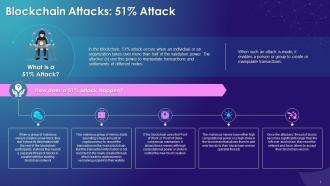
This slide showcases information about the concept of a 51 percent attack on blockchain. It explains that in blockchain, 51 Percent attack is made when an individual or an organization takes over more than half of the validation power, manipulating the transaction and settlements of different nodes. It also provides information on the actual conduct of the attack.
People who downloaded this PowerPoint presentation also viewed the following :
51 Percent Attack On Blockchain Technology Training Ppt with all 16 slides:
Use our 51 Percent Attack On Blockchain Technology Training Ppt to effectively help you save your valuable time. They are readymade to fit into any presentation structure.















FAQs for 51 Percent Attack On Blockchain
A 51 percent attack occurs when a single entity or coordinated group controls more than half of a blockchain network's mining power or computing resources, enabling them to manipulate transaction verification, reverse payments, and potentially double-spend cryptocurrency. This vulnerability presents both security challenges and opportunities for enhanced network design, with many financial institutions and blockchain developers increasingly implementing multi-layered consensus mechanisms, distributed validation protocols, and strategic network monitoring to strengthen defenses and maintain transaction integrity in an increasingly digital financial landscape.
A 51 percent attack can enable double-spending transactions, reverse confirmed payments, prevent new transactions from confirming, and manipulate blockchain records, ultimately undermining network security and user trust. Such attacks devastate cryptocurrency value, disrupt financial services relying on that blockchain, and force exchanges to halt trading, with smaller networks finding recovery particularly challenging without immediate community intervention.
Miners can increase attack success through strategic hash power accumulation, coordinating with other mining pools, targeting smaller networks with lower security, and timing attacks during periods of reduced network activity. While technically possible through resource consolidation and network vulnerability exploitation, such attacks ultimately damage blockchain credibility and miner profitability, making them economically counterproductive in established networks.
Preventing 51 percent attacks involves increasing network hash rate through broader miner participation, implementing proof-of-stake consensus mechanisms, establishing checkpointing systems, and deploying hybrid consensus models that combine multiple validation methods. These security measures enhance blockchain resilience by distributing computational power across diverse mining pools, with financial institutions and supply chain networks finding that strategic diversification ultimately delivers stronger transaction integrity and reduced vulnerability to malicious actors.
Smaller cryptocurrencies with lower hash rates and mining participation are most vulnerable to 51 percent attacks, including newer altcoins, proof-of-work tokens with limited adoption, and blockchain networks with concentrated mining pools. These vulnerabilities stem from reduced computational requirements and fewer validators securing the network, with many financial institutions finding that established cryptocurrencies like Bitcoin offer significantly greater security through distributed mining power.
Strong governance mechanisms significantly reduce 51% attack susceptibility by implementing validator diversity requirements, stake distribution limits, consensus algorithm upgrades, and rapid response protocols for suspicious activity. Well-governed networks like Ethereum and Cardano demonstrate enhanced security through community-driven decisions, automated threat detection, and economic penalties for malicious behavior, ultimately delivering greater network resilience and institutional confidence.
Historical 51 percent attacks include Ethereum Classic's multiple attacks in 2019-2020, Bitcoin Gold's repeated vulnerabilities, and Vertcoin's network compromises. These incidents resulted in millions in stolen cryptocurrency, temporary network shutdowns, and significantly damaged investor confidence, with many exchanges delisting affected cryptocurrencies and institutional adoption declining substantially across smaller blockchain networks.
Mining centralization directly increases 51 percent attack risk by concentrating computational power among fewer entities, making network control more feasible for malicious actors. When mining pools or large operations control significant hash rates, they can potentially coordinate to manipulate blockchain transactions, double-spend coins, and disrupt network integrity, ultimately undermining the decentralized security model that cryptocurrencies depend upon.
Yes, PoS systems can face 51% attacks when malicious actors control majority stake, though economic barriers make this significantly more challenging than proof-of-work systems. Unlike mining equipment, attacking PoS requires purchasing actual tokens, with validators risking substantial financial losses through slashing mechanisms, ultimately making such attacks economically prohibitive for most blockchain networks.
In proof-of-work blockchains, a 51 percent attack requires controlling majority computing power to rewrite transaction history, while proof-of-stake systems need majority token ownership to manipulate consensus. PoW attacks demand enormous energy costs and specialized hardware, whereas PoS attacks involve significant financial stake forfeiture through slashing mechanisms, making both economically prohibitive for established networks.
Network size plays a crucial role in preventing 51 percent attacks, as larger networks with more distributed miners or validators make it exponentially more expensive and technically challenging for attackers to gain majority control. Smaller blockchain networks face higher vulnerability because acquiring the necessary computational power or stake becomes more feasible, with many cryptocurrency projects finding that network growth and decentralization ultimately deliver enhanced security and investor confidence.
Community responses to a 51 percent attack significantly influence blockchain resilience through coordinated defense mechanisms, rapid protocol upgrades, enhanced network decentralization, and strategic consensus modifications. These collaborative efforts enable networks to implement stronger security measures, attract additional validators, and restore market confidence, with many blockchain ecosystems finding that united community action ultimately delivers improved attack resistance and long-term network stability.
Conducting a 51 percent attack raises significant ethical concerns including network disruption, financial harm to users, erosion of trust, and potential legal violations, even when performed for research purposes. While security researchers argue such testing can expose vulnerabilities and strengthen blockchain protocols, the potential for widespread economic damage and undermining confidence in decentralized systems ultimately outweighs academic benefits, with many institutions finding that simulated environments deliver safer research outcomes.
**INPUT**: How does the economic incentive structure of a cryptocurrency affect the likelihood of a 51 percent attack? **OUTPUT**: A cryptocurrency's economic incentive structure significantly influences attack likelihood through mining rewards, network hash rate distribution, and the cost-benefit ratio of launching an assault. Higher mining rewards attract more participants, increasing security, while lower-value networks become vulnerable targets, with many smaller cryptocurrencies finding that inadequate incentives ultimately deliver insufficient protection against coordinated attacks. [Word count: 57]
Future developments include proof-of-stake consensus mechanisms, sharding protocols, hybrid consensus models, cross-chain interoperability solutions, and enhanced cryptographic techniques. These innovations streamline network security by distributing validation power, reducing energy costs, and creating multiple verification layers, with many blockchain networks finding that strategic combinations ultimately deliver stronger attack resistance and operational efficiency.
-
One-stop solution for all presentation needs. Great products with easy customization.
-
I was able to find the right choice of PPT template for my thesis with SlideTeam. Thank you for existing.