

5G Technology And Agriculture Industry Relationship Comparison Between 4G And 5G




Try Before you Buy Download Free Sample Product
 Impress Your
 Audience
 100%
100% Editable
 Save Hours
 of Time


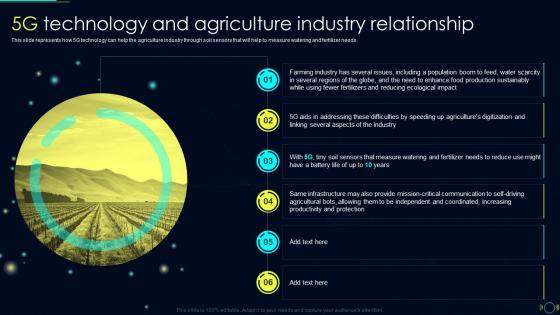
This slide represents how 5G technology can help the agriculture industry through soil sensors that will help to measure watering and fertilizer needs.
People who downloaded this PowerPoint presentation also viewed the following :
5G Technology And Agriculture Industry Relationship Comparison Between 4G And 5G with all 6 slides:
Use our 5G Technology And Agriculture Industry Relationship Comparison Between 4G And 5G to effectively help you save your valuable time. They are readymade to fit into any presentation structure.





FAQs for 5G Technology And Agriculture Industry Relationship Comparison Between
5G technology revolutionizes precision farming by delivering ultra-low latency, massive device connectivity, and higher bandwidth compared to 4G networks, enabling real-time data processing from IoT sensors, drones, and autonomous machinery. Through instantaneous communication capabilities, agricultural operations can monitor soil conditions, optimize irrigation systems, and coordinate harvesting equipment seamlessly, ultimately delivering enhanced crop yields and operational efficiency.
5G enables autonomous farming machinery through ultra-low latency communication, real-time data processing, massive device connectivity, and enhanced GPS accuracy for precise navigation. This technology allows tractors, harvesters, and drones to operate seamlessly across vast agricultural operations, with many farms finding that 5G-powered automation delivers reduced labor costs, optimized resource usage, and significantly improved operational efficiency.
5G technology enhances real-time data collection through ultra-low latency sensors, high-bandwidth IoT networks, edge computing capabilities, and seamless connectivity across vast agricultural areas. These technologies enable farmers to monitor soil moisture, nutrient levels, and crop health instantaneously, while automated systems deliver precise irrigation and fertilization responses, ultimately optimizing yields and reducing resource waste.
5G connectivity enables farmers to enhance supply chain transparency through real-time tracking systems, IoT sensors monitoring crop conditions, and blockchain integration for traceability verification. This technology streamlines operations by accelerating data transmission between farms, distributors, and retailers, while enabling predictive analytics for inventory management, ultimately delivering faster decision-making and reduced waste throughout agricultural networks.
5G technology enables farmers to achieve cost savings through precision agriculture applications, automated equipment management, reduced labor requirements, optimized resource utilization, and minimized crop losses. Through real-time monitoring and data-driven insights, agricultural operations can streamline irrigation systems, enhance livestock management, and improve supply chain efficiency, ultimately delivering operational cost reductions of 15-20% while increasing overall productivity.
5G facilitates better weather forecasting and climate monitoring by enabling real-time data collection from IoT sensors, supporting high-resolution satellite connectivity, and processing massive datasets instantly across agricultural networks. Through ultra-low latency connections, farmers receive precise weather predictions, soil moisture analytics, and climate pattern insights within minutes, ultimately enhancing crop protection decisions and resource allocation strategies.
5G significantly enhances remote sensing technologies in agriculture by enabling real-time data transmission from drones, satellites, and IoT sensors, facilitating faster processing of high-resolution imagery, and supporting instant analysis of crop conditions, soil moisture, and pest detection. This connectivity allows farmers to make immediate irrigation adjustments, optimize fertilizer application, and respond to emerging issues, ultimately delivering more precise resource management and higher crop yields.
5G enables IoT-powered irrigation systems by providing ultra-low latency communication, massive device connectivity, and real-time data processing capabilities that traditional networks cannot support. Through enhanced bandwidth and reliability, agricultural operations can deploy thousands of soil moisture sensors, weather monitoring devices, and automated sprinklers simultaneously, ultimately delivering precise water management and significant resource savings.
5G technology helps reduce agriculture's environmental footprint by enabling precision farming through real-time soil monitoring, automated irrigation systems, and targeted pesticide application that minimizes chemical usage. Through IoT sensors and AI-driven analytics, farms can optimize resource allocation, reduce water consumption by up to 30%, and decrease fertilizer waste, while ultimately delivering sustainable practices and improved crop yields.
Farmers transitioning to 5G-enabled agricultural solutions face infrastructure costs, technical complexity, and workforce training requirements, alongside concerns about data security and system integration with existing equipment. While initial investment presents challenges, many agricultural operations find that strategic implementation through phased deployment and partnership programs ultimately delivers enhanced operational efficiency, precision farming capabilities, and competitive advantage in increasingly data-driven markets.
Smallholder farmers can leverage 5G technology through affordable precision tools like smartphone-based crop monitoring, real-time weather alerts, and IoT sensors for soil analysis, while large operations focus on automated machinery and comprehensive data systems. This democratization of agricultural technology enables smaller farms to access previously expensive precision farming capabilities, optimize resource usage, and connect directly to markets through enhanced connectivity, ultimately delivering competitive advantages and improved yields regardless of farm size.
Cybersecurity measures for 5G-enabled agricultural systems include network segmentation, end-to-end encryption, multi-factor authentication, regular security updates, and continuous monitoring protocols. These technologies enhance farm operations by protecting IoT sensors, automated machinery, and data analytics platforms from cyber threats, while enabling secure remote monitoring of livestock and crops, ultimately delivering operational efficiency and competitive advantage in increasingly connected agricultural environments.
5G enables blockchain integration in agriculture by providing the high-speed, low-latency connectivity essential for real-time data verification, secure supply chain tracking, and automated smart contract execution across farming operations. Through this strategic combination, agricultural organizations can streamline crop monitoring, livestock management, and distribution processes, while ensuring data transparency and traceability, ultimately delivering enhanced food safety and operational efficiency.
**INPUT**: What are the long-term prospects for 5G adoption in rural areas and its implications for agriculture? **OUTPUT**: Long-term 5G adoption in rural areas shows promising potential despite infrastructure challenges, with agricultural applications including precision farming, autonomous equipment, real-time crop monitoring, and supply chain optimization. These technologies streamline farming operations by enabling faster data transmission, enhanced connectivity for IoT devices, and improved decision-making capabilities, ultimately delivering increased yields and operational efficiency for agricultural enterprises. *[Word count: 58 words]*
5G technology enhances pest and disease management through real-time monitoring via IoT sensors, automated drone surveillance, and AI-powered predictive analytics that detect threats early. These connected systems enable precision pesticide application, reduce chemical usage by up to 30%, and deliver faster response times, with many agricultural operations finding that immediate data transmission ultimately minimizes crop losses while improving yield quality.
-
“I really like the convenient operation and professionalism I saw on the SlideTeam website. I want to express my regards and appreciation to the team.”
-
The designs by SlideTeam are honestly the best I have seen so far. Will be definitely coming back for more.