

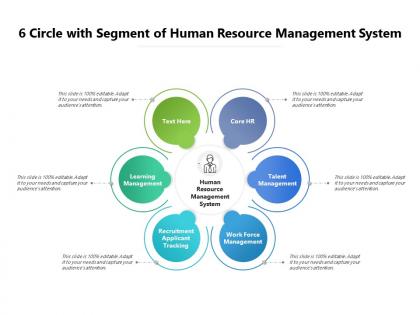
6 circle with segment of human resource management system




Try Before you Buy Download Free Sample Product
 Impress Your
 Audience
 100%
100% Editable
 Save Hours
 of Time


Our 6 Circle With Segment Of Human Resource Management System are explicit and effective. They combine clarity and concise expression.
People who downloaded this PowerPoint presentation also viewed the following :
6 circle with segment of human resource management system with all 2 slides:
Give your audience a fulfilling experience. They will find our 6 Circle With Segment Of Human Resource Management System elevating.
FAQs for 6 circle with segment of human
Effective HRMS platforms include automated payroll processing, comprehensive employee data management, performance tracking systems, recruitment workflow automation, and integrated benefits administration. These features streamline HR operations by reducing manual tasks, enhancing data accuracy, and improving employee self-service capabilities, with many organizations finding that strategic HRMS implementation ultimately delivers cost reduction, faster HR processes, and enhanced employee experiences across departments.
An HRMS streamlines recruitment and onboarding by automating job postings, candidate screening, interview scheduling, and document management, while centralizing all hiring workflows in one platform. Through digital onboarding modules, new employees complete paperwork, training, and compliance requirements seamlessly, with many organizations finding that automated processes reduce hiring time by 40% and enhance the overall candidate experience.
An HRMS facilitates performance management through automated goal tracking, continuous feedback systems, standardized evaluation templates, real-time performance analytics, and comprehensive reporting dashboards. These integrated tools streamline the entire review process by enabling managers to monitor progress consistently, while employees receive ongoing development insights, ultimately delivering more objective assessments and strategic talent decisions across organizations.
HRMS transforms workforce data into strategic insights by analyzing employee performance metrics, turnover patterns, recruitment effectiveness, skill gaps, and compensation trends. Through predictive analytics and reporting dashboards, organizations streamline talent acquisition, optimize resource allocation, and enhance succession planning, with many companies finding that data-driven HR decisions ultimately deliver improved employee retention and competitive advantage.
HRMS software assists in compliance by automatically tracking labor regulations, maintaining accurate employee records, monitoring work hours and overtime, and generating required regulatory reports. These systems streamline compliance across payroll, benefits administration, and workplace safety standards, with many organizations finding that automated alerts and documentation significantly reduce legal risks while ensuring consistent adherence to evolving labor laws.
Common HRMS integration challenges include data migration complexities, legacy system compatibility issues, user adoption resistance, workflow disruption during transition, and ensuring seamless connectivity with payroll, benefits, and performance management platforms. While these obstacles initially slow implementation timelines, organizations increasingly find that partnering with experienced vendors and conducting phased rollouts ultimately delivers enhanced operational efficiency and streamlined HR processes.
Cloud-based HRMS offers superior scalability through automatic resource allocation, instant capacity expansion, and pay-as-you-grow pricing models, while on-premise solutions require significant infrastructure investments and lengthy implementation cycles. These cloud systems enable remote workforce management, real-time data access across multiple locations, and seamless integration with existing business applications, ultimately delivering enhanced operational efficiency and competitive advantage for growing organizations.
An HRMS significantly enhances employee engagement and satisfaction by streamlining performance management, enabling transparent communication, facilitating career development tracking, and providing self-service capabilities for leave requests and benefits management. Through automated workflows and real-time feedback systems, organizations deliver faster response times, personalized development opportunities, and improved work-life balance, with many companies finding that employees report higher job satisfaction when empowered with accessible HR tools.
Organizations ensure HRMS data security through multi-layered encryption, role-based access controls, regular security audits, compliance with regulations like GDPR, and secure cloud hosting with backup protocols. These comprehensive measures protect sensitive employee information while enabling seamless HR operations, with many enterprises finding that robust security frameworks ultimately enhance trust, reduce compliance risks, and deliver competitive advantage in talent management.
Current HRMS trends include AI-powered recruitment, employee self-service portals, predictive analytics for workforce planning, mobile-first platforms, and integrated performance management systems. These technologies streamline operations by automating routine tasks, enhancing employee experiences, and delivering data-driven insights, with many organizations finding that strategic adoption significantly improves talent retention and operational efficiency.
HRMS systems support diversity and inclusion initiatives by enabling bias-free recruitment through blind resume screening, tracking diversity metrics across hiring and promotions, and facilitating equitable performance evaluations. These platforms help organizations identify pay gaps, monitor representation across departments, and create inclusive career development pathways, with many companies finding that data-driven approaches ultimately enhance workplace equity and employee retention.
HRMS tools provide comprehensive metrics including employee turnover rates, time-to-hire, cost-per-hire, employee satisfaction scores, training completion rates, and performance management indicators. These analytics enable HR teams to track recruitment efficiency, monitor workforce engagement, and measure training ROI, while identifying retention patterns and optimizing resource allocation, ultimately delivering data-driven insights that enhance organizational productivity and strategic decision-making.
Mobile accessibility significantly enhances HRMS usability by enabling employees to access payroll information, request time off, update personal details, and complete performance reviews from anywhere, anytime. This convenience streamlines HR processes while boosting employee engagement, with many organizations finding that mobile-enabled HRMS delivers faster approvals, reduced administrative overhead, and ultimately higher adoption rates across diverse workforces.
Best practices for HRMS training include role-based curriculum development, hands-on simulation environments, phased rollout approaches, comprehensive documentation creation, and ongoing support systems establishment. These methodologies streamline adoption by addressing specific departmental needs, minimizing operational disruption, and building user confidence, with many organizations finding that combining interactive workshops with peer mentoring ultimately delivers faster proficiency rates and higher system utilization across teams.
Small businesses can leverage HRMS to compete with larger organizations by automating recruitment processes, standardizing performance evaluations, and delivering professional employee experiences that rival enterprise-level systems. Through strategic HRMS implementation, smaller companies streamline onboarding, enhance talent retention with data-driven insights, and optimize resource allocation, ultimately enabling them to attract top-tier candidates while maintaining operational efficiency that larger competitors often struggle to achieve.
No Reviews