

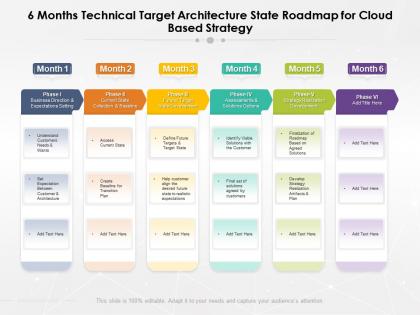
6 months technical target architecture state roadmap for cloud based strategy




Try Before you Buy Download Free Sample Product
 Impress Your
Audience
 100%
Editable
 Save Hours
of Time


A well thought out action plan makes execution easier and increases the possibility of success significantly. Ensure hitting all the milestones within the deadlines by introducing our fully customizable 6 Months Technical Target Architecture State Roadmap For Cloud Based Strategy. Streamline the work related information, budget, timeframe, key deliverable, landmarks, and major steps involved, all in one place to give an organized overview of the project by utilizing our PowerPoint theme. Minimize time lag and increase work efficiency by providing insight into the process with our comprehensively researched roadmap PowerPoint layout. Color coding helps in highlighting the process and grabs the attention of the audience. Download our handy 6 Months Technical Target Architecture State Roadmap For Cloud Based Strategy to identify the possible problem areas in a much shorter time and propose solutions. Have a productive brainstorming session with your workforce by utilizing our action plan visualization tool.
People who downloaded this PowerPoint presentation also viewed the following :
6 months technical target architecture state roadmap for cloud based strategy with all 2 slides:
Give your audience a fulfilling experience. They will find our 6 Months Technical Target Architecture State Roadmap For Cloud Based Strategy elevating.


FAQs for 6 months technical target architecture state roadmap for
Key components include cloud readiness assessment, workload migration prioritization, security and compliance frameworks, cost optimization strategies, and governance models. These elements work together by evaluating current infrastructure capabilities, identifying applications suitable for cloud transition, and establishing robust oversight mechanisms, with many organizations finding that this structured approach accelerates digital transformation while minimizing operational risks.
Organizations align their cloud strategy with business goals by conducting comprehensive assessments of operational needs, establishing clear performance metrics, and creating phased migration plans that prioritize high-impact applications. Through strategic roadmapping, companies streamline costs, enhance scalability, and accelerate innovation, with many financial services and retail organizations finding that cloud-first approaches ultimately deliver competitive advantages and improved customer experiences.
Key factors include security requirements, compliance obligations, cost considerations, scalability needs, and existing infrastructure compatibility. Organizations in highly regulated sectors like healthcare and financial services often favor private or hybrid models for sensitive data control, while rapidly growing companies frequently choose public clouds for flexibility and reduced capital expenditure, ultimately delivering optimized performance and strategic competitive advantage.
Organizations can assess cloud readiness by conducting comprehensive infrastructure audits, evaluating application portfolios, analyzing security frameworks, reviewing network capabilities, and assessing staff expertise levels. Through systematic assessment tools and cloud readiness frameworks, companies identify migration priorities, potential bottlenecks, and resource requirements, while determining optimal cloud models, ultimately streamlining their transition strategy and minimizing operational disruptions.
Security and compliance serve as foundational pillars in cloud strategy roadmaps, influencing architecture decisions, vendor selection, data governance frameworks, and regulatory adherence protocols. These considerations drive strategic choices around hybrid deployments, encryption standards, and access controls, with organizations in healthcare, financial services, and government finding that proactive security integration ultimately delivers faster compliance audits and reduced operational risks.
Businesses leverage cloud technologies to drive innovation through scalable infrastructure, rapid prototyping capabilities, advanced analytics tools, and seamless collaboration platforms that eliminate traditional IT constraints. These cloud-enabled approaches accelerate time-to-market by reducing development cycles, enabling faster testing and deployment, and providing on-demand resources, with many organizations finding significant competitive advantages through enhanced agility and reduced operational overhead.
Common pitfalls include inadequate security planning, underestimating migration complexity, insufficient cost modeling, poor change management, and lack of stakeholder alignment. Organizations often rush implementation without proper training or governance frameworks, leading to budget overruns and operational disruptions, with many finding that phased approaches with clear milestones deliver better outcomes and sustained competitive advantage.
Organizations should prioritize cloud migration initiatives based on business impact, technical complexity, cost-benefit analysis, security requirements, and regulatory compliance needs. Many enterprises find success by starting with low-risk applications like development environments, then progressing to customer-facing systems, ultimately delivering reduced operational costs, enhanced scalability, and competitive advantage in an increasingly digital marketplace.
Tools and frameworks for developing a cloud strategy roadmap include cloud readiness assessment tools, migration planning frameworks like AWS Migration Hub, multi-cloud management platforms, cost optimization analyzers, and governance frameworks such as COBIT. These strategic resources streamline planning by providing structured evaluation processes, automated discovery capabilities, and comprehensive risk assessments, ultimately enabling organizations to accelerate their digital transformation while minimizing operational disruptions.
Organizations ensure seamless integration through hybrid cloud architectures, API-driven connectivity, data synchronization protocols, standardized security frameworks, and middleware solutions that bridge environments. These technologies streamline operations by enabling real-time data flow, maintaining consistent user experiences, and preserving existing investments, with many financial services and healthcare institutions finding that strategic integration delivers enhanced scalability while minimizing operational disruption.
Key cloud strategy metrics include cost reduction percentages, application migration timelines, system uptime rates, security incident frequencies, and user adoption levels. These measurements enable organizations to track operational efficiency, financial performance, and strategic objectives, with many enterprises finding that combining technical metrics with business outcomes delivers comprehensive visibility into their cloud transformation success and competitive positioning.
Businesses effectively manage multi-cloud environments through centralized governance frameworks, standardized security protocols, unified monitoring systems, and strategic workload distribution across providers. This approach enables organizations to optimize costs, minimize vendor lock-in, and enhance operational resilience, with many financial services and healthcare institutions finding that diversified cloud strategies ultimately deliver greater flexibility and competitive advantage.
Cloud readiness training encompasses cloud fundamentals, platform-specific certifications, security protocols, DevOps practices, and change management methodologies. Organizations typically invest in vendor-provided courses, hands-on labs, mentorship programs, and cross-functional workshops, with many finding that combining formal training with real-world project experience accelerates adoption and delivers sustainable expertise across teams.
Vendor selection is critically important to cloud strategy success, directly impacting cost management, security compliance, scalability options, and integration capabilities. The right vendor partnership enables seamless migration, reduces operational complexity, and delivers long-term strategic value, while poor selection can result in vendor lock-in, unexpected costs, and limited growth flexibility for organizations.
Key trends include edge computing, multi-cloud strategies, serverless architectures, AI-driven automation, and enhanced security frameworks. These technologies streamline operations by reducing latency, optimizing resource allocation, and automating routine processes, with many organizations finding that strategic cloud evolution ultimately delivers faster innovation cycles and significant competitive advantages.
No Reviews