

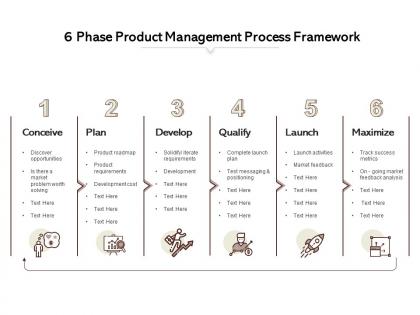
6 phase product management process framework




Try Before you Buy Download Free Sample Product
 Impress Your
 Audience
 100%
100% Editable
 Save Hours
 of Time


Our 6 Phase Product Management Process Framework ensure you are never hamstrung. Get access to different approaches.
People who downloaded this PowerPoint presentation also viewed the following :
6 phase product management process framework with all 5 slides:
Our 6 Phase Product Management Process Framework ensure you better yourself. Accomplish beyond your biggest dreams.



FAQs for 6 phase product
Essential product management skills include strategic thinking, user research, data analysis, cross-functional collaboration, and technical comprehension. These competencies enable product managers to translate market insights into roadmaps, coordinate engineering and marketing teams effectively, and make data-driven decisions, with many organizations finding that skilled product managers ultimately deliver faster time-to-market and enhanced customer satisfaction.
Product managers effectively prioritize features by evaluating customer impact, business value, development effort, and strategic alignment with company goals. Through frameworks like MoSCoW or value-versus-effort matrices, they balance user needs with technical constraints and market opportunities, while regularly reassessing priorities based on customer feedback, competitive pressures, and resource availability, ultimately delivering maximum value efficiently.
Agile, Lean, Design Thinking, Scrum, and DevOps represent the most effective product development methodologies, each addressing specific aspects of speed, customer focus, and iterative improvement. These approaches streamline development cycles by emphasizing rapid prototyping, continuous feedback, and cross-functional collaboration, with many organizations finding that strategic combinations deliver faster time-to-market and enhanced customer satisfaction.
Market research influences product strategy by providing customer insights, competitive analysis, market trends, demand forecasting, and user behavior data that guide strategic decisions. Through surveys, focus groups, and analytics, product managers can validate assumptions, identify opportunities, and minimize risks, while many organizations finding that research-driven strategies deliver higher success rates, better market positioning, and ultimately stronger competitive advantage in increasingly dynamic markets.
User feedback serves as a critical input throughout the product management lifecycle, informing initial market research, feature prioritization, design validation, and post-launch optimization strategies. This continuous feedback loop enables product managers to make data-driven decisions, reduce development risks, and ensure market-product fit, with many technology companies finding that systematic feedback collection ultimately delivers higher user satisfaction and competitive differentiation.
Product managers should communicate with stakeholders through regular updates, transparent progress reports, structured feedback sessions, and collaborative planning meetings, ensuring alignment across development cycles. These communication strategies streamline decision-making by establishing clear expectations, minimizing project delays, and maintaining stakeholder engagement, with many organizations finding that consistent, multi-channel communication ultimately delivers faster product launches and enhanced market responsiveness.
Product managers in agile environments commonly face challenges including shifting priorities, stakeholder alignment, resource constraints, scope creep, and balancing technical debt with feature development. These obstacles often emerge through rapid iteration cycles, cross-functional team coordination, and competing customer demands, with many organizations finding that clear communication frameworks and strategic roadmap flexibility ultimately enhance delivery speed and product quality.
Product managers balance user needs and business objectives by conducting comprehensive user research, analyzing market data, prioritizing features through frameworks like RICE or MoSCoW, and maintaining continuous stakeholder communication. Through strategic roadmapping and iterative testing, they identify solutions that enhance user satisfaction while driving revenue growth, with many organizations finding that user-centric products ultimately deliver stronger business performance and competitive advantage.
Product managers should track user engagement metrics, revenue growth, customer acquisition cost, retention rates, and feature adoption rates. These metrics work together by providing comprehensive insights into product performance, user satisfaction, and market viability, with many organizations finding that combining quantitative data with qualitative feedback ultimately delivers clearer strategic direction and competitive advantage.
A product roadmap aligns team efforts by providing shared visibility into priorities, timelines, and strategic objectives, while managing stakeholder expectations through transparent communication of deliverables and dependencies. This strategic planning tool enables cross-functional teams to coordinate resources effectively, anticipate potential bottlenecks, and maintain focus on key outcomes, ultimately delivering more cohesive product development and reducing miscommunication across organizations.
Product managers can leverage competitive intelligence platforms, SWOT analysis, feature comparison matrices, pricing benchmarking, and customer feedback mining to conduct thorough competitor analysis. These strategic approaches enable organizations to identify market gaps, anticipate competitor moves, and optimize product positioning, with many successful companies finding that regular competitive assessments ultimately deliver enhanced market share and stronger differentiation strategies.
Product managers ensure alignment between cross-functional teams through regular stakeholder meetings, shared roadmaps, clear communication protocols, and unified success metrics. These strategic approaches streamline coordination by establishing common goals, facilitating transparent progress tracking, and maintaining consistent messaging across engineering, marketing, and sales teams, ultimately delivering faster product launches and enhanced market responsiveness.
Essential product management tools include project management platforms like Jira and Asana, analytics software such as Google Analytics and Mixpanel, roadmap planning tools like ProductPlan, user feedback systems, and collaboration platforms like Slack. These technologies streamline workflow by centralizing task tracking, enabling data-driven decisions, and facilitating cross-functional communication, ultimately delivering faster product iterations and enhanced team productivity.
Product managers handle market and technology changes by continuously monitoring industry developments, conducting regular market research, and maintaining flexible product roadmaps that can pivot quickly. They collaborate with engineering teams to assess technical feasibility, engage customers for feedback on emerging needs, and work with sales teams to understand competitive pressures, ultimately ensuring their products remain relevant and competitive in an increasingly dynamic marketplace.
Best practices for conducting a product release include establishing clear success metrics, coordinating cross-functional teams, implementing staged rollout phases, monitoring real-time performance data, and preparing rapid response protocols. Post-launch reviews should analyze user adoption rates, feature utilization, customer feedback, and revenue impact, with many organizations finding that structured retrospectives within 30 days enable faster iterations and competitive advantage.
No Reviews