

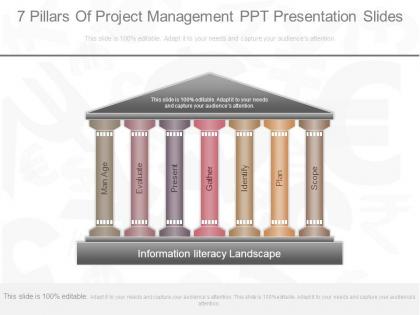
7 pillars of project management ppt presentation slides




Try Before you Buy Download Free Sample Product
 Impress Your
 Audience
 100%
100% Editable
 Save Hours
 of Time


Our 7 Pillars Of Project Management Ppt Presentation Slides ensure you are never hard pressed. They enable convenient functioning.
People who downloaded this PowerPoint presentation also viewed the following :
7 pillars of project management ppt presentation slides with all 7 slides:
Draw their admiration with our 7 Pillars Of Project Management Ppt Presentation Slides. Handle every event with great elan.





FAQs for 7 pillars of project management
The key components include scope definition, timeline planning, resource allocation, risk assessment, quality control, stakeholder communication, and budget management. These pillars work together by establishing clear boundaries, ensuring efficient resource utilization, and maintaining consistent oversight, with many organizations finding that integrated management across all seven areas delivers improved project outcomes and competitive advantage.
Effective communication enhances project management's seven pillars by ensuring stakeholder alignment, clarifying scope boundaries, facilitating resource coordination, maintaining timeline transparency, and enabling proactive risk identification. Through regular updates, structured meetings, and collaborative platforms, project managers streamline decision-making processes, minimize misunderstandings, and accelerate issue resolution, with many organizations finding that consistent communication ultimately delivers improved project outcomes and enhanced team productivity.
Risk management integrates into project management pillars through stakeholder communication protocols, resource contingency planning, timeline buffer allocation, and quality assurance checkpoints. These integration methods enable organizations across sectors like construction, IT, and manufacturing to anticipate disruptions, maintain project momentum, and deliver outcomes within budget, ultimately enhancing operational efficiency and competitive advantage.
Stakeholder engagement ensures alignment between project objectives and business expectations, facilitating clear communication, managing scope changes, and securing necessary resources throughout the project lifecycle. Effective engagement strategies enable project managers to anticipate potential roadblocks, build consensus among diverse teams, and ultimately deliver outcomes that satisfy both technical requirements and strategic business goals.
Project managers can effectively measure each pillar's success through key performance indicators like scope adherence rates, budget variance percentages, timeline completion metrics, quality defect rates, stakeholder satisfaction scores, team productivity indices, and risk mitigation effectiveness. These measurement frameworks enable organizations to identify bottlenecks early, optimize resource allocation across departments, and ultimately deliver projects that enhance operational efficiency and competitive advantage.
**INPUT**: What tools and methodologies can support the implementation of the seven pillars in a project? **OUTPUT**: Project management tools supporting the seven pillars include Gantt charts, risk registers, stakeholder matrices, communication platforms, and resource allocation software, combined with methodologies like Agile, Waterfall, and hybrid approaches. These frameworks streamline planning, enhance team collaboration, and automate progress tracking, with many organizations finding that integrated platforms ultimately deliver improved project outcomes and operational efficiency. [Word count: 59 words]
Team collaboration significantly influences project management pillar execution by enhancing communication flow, accelerating decision-making processes, and ensuring coordinated resource allocation across all project phases. Through collaborative frameworks, organizations streamline stakeholder alignment, minimize project delays, and deliver improved quality outcomes, with many project teams finding that integrated collaboration tools ultimately enhance operational efficiency and competitive project delivery timelines.
Project managers face challenges including resource constraints limiting proper planning, stakeholder misalignment affecting communication clarity, scope creep undermining defined objectives, and budget pressures compromising quality standards. These obstacles often intersect across multiple pillars simultaneously, with many organizations finding that inadequate executive support, competing priorities, and unrealistic timelines create cascading effects that test adherence to fundamental project management principles while demanding adaptive leadership approaches.
The seven pillars adapt through customized frameworks, industry-specific methodologies, scalable processes, flexible resource allocation, and tailored risk management approaches. Through strategic modification, construction projects emphasize safety and regulatory compliance, while software development focuses on iterative testing and user feedback, with many organizations finding that sector-specific adaptations ultimately deliver faster project completion and enhanced stakeholder satisfaction.
Project management pillars contribute to organizational success by establishing structured frameworks for resource allocation, risk mitigation, timeline adherence, quality assurance, and stakeholder alignment across all business initiatives. These foundational elements streamline operations, enhance decision-making capabilities, and minimize project failures, with many organizations finding that systematic implementation delivers improved profitability, faster time-to-market, and sustained competitive advantage in increasingly complex business environments.
**INPUT**: What strategies can be employed to strengthen the foundation of each pillar? **OUTPUT**: Strengthening project management pillars requires implementing robust governance frameworks, standardized communication protocols, comprehensive risk assessment processes, and integrated stakeholder engagement strategies. Organizations enhance these foundations through regular training programs, technology adoption for real-time monitoring, and establishing clear accountability structures, with many enterprises finding that systematic pillar reinforcement delivers improved project success rates and operational efficiency. [Word count: 58 words]
Technology and software enhance the seven pillars by automating project scheduling, streamlining communication workflows, providing real-time budget tracking, and enabling data-driven risk assessment. Through integrated project management platforms, organizations achieve improved resource allocation, faster decision-making, and enhanced stakeholder transparency, with many finding that digital tools ultimately deliver greater operational efficiency and competitive advantage.
Training for mastering project management pillars includes PMP certification, agile methodology courses, risk management workshops, stakeholder communication training, and budget planning seminars. Professional development programs, mentorship opportunities, and hands-on project simulations enable managers to build competencies across all seven pillars, ultimately delivering enhanced project success rates and competitive advantage.
Feedback loops can be established through regular stakeholder surveys, milestone reviews, performance dashboards, and cross-functional retrospectives that evaluate each pillar's effectiveness against predefined metrics. These assessment mechanisms enable project managers to identify bottlenecks, optimize resource allocation, and enhance team collaboration, with many organizations finding that continuous feedback ultimately delivers improved project outcomes and strategic alignment.
Notable case studies include Toyota's lean manufacturing implementation, which exemplified stakeholder engagement and risk management through supplier partnerships and continuous improvement protocols, and NASA's Mars rover missions, demonstrating exceptional scope definition and quality management. These projects succeeded by integrating multiple pillars simultaneously, with organizations like Amazon and Microsoft leveraging comprehensive communication frameworks and resource optimization to deliver complex initiatives while maintaining stakeholder alignment and achieving strategic objectives.
-
Appreciate the research and its presentable format.
-
I discovered this website through a google search, the services matched my needs perfectly and the pricing was very reasonable. I was thrilled with the product and the customer service. I will definitely use their slides again for my presentations and recommend them to other colleagues.