

7 Step Model Of Spear Phishing Attack




Try Before you Buy Download Free Sample Product
 Impress Your
Audience
 100%
Editable
 Save Hours
of Time


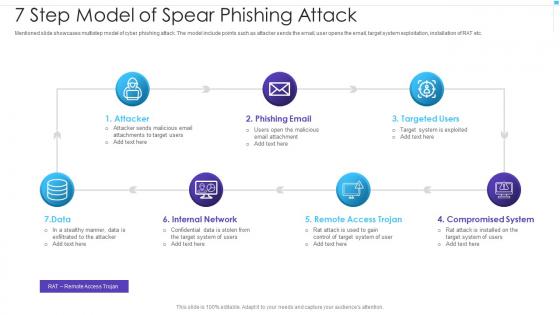
Mentioned slide showcases multistep model of cyber phishing attack. The model include points such as attacker sends the email, user opens the email, target system exploitation, installation of RAT etc.
People who downloaded this PowerPoint presentation also viewed the following :
7 Step Model Of Spear Phishing Attack with all 6 slides:
Use our 7 Step Model Of Spear Phishing Attack to effectively help you save your valuable time. They are readymade to fit into any presentation structure.






FAQs for 7 Step Model Of
A spear phishing attack is a highly targeted cyber assault that customizes malicious emails for specific individuals or organizations, using personal information to appear legitimate, unlike regular phishing which sends generic messages to broad audiences. Through detailed reconnaissance, attackers craft personalized content referencing job roles, colleagues, or company details, making these attacks significantly more convincing and dangerous than mass phishing campaigns.
Common spear phishing tactics include personalized emails mimicking trusted contacts, fake urgent requests from executives, malicious attachments disguised as legitimate documents, compromised websites hosting credential harvesting forms, and social media reconnaissance for target profiling. These sophisticated approaches streamline cybercriminal operations by exploiting human psychology, leveraging corporate hierarchies, and mimicking authentic communications, with many organizations finding that employee education and advanced email filtering ultimately deliver stronger security postures.
Individuals can identify spear phishing emails by examining sender authenticity, checking for urgent language or unusual requests, verifying links before clicking, and noting personalized information that seems suspicious. These emails often target specific employees with tailored content, impersonate trusted contacts, and create false urgency, with many organizations finding that employee training significantly enhances detection rates and reduces successful attacks.
Social engineering serves as the psychological foundation of spear phishing attacks, enabling cybercriminals to manipulate targets through carefully crafted emotional triggers, urgency tactics, and authority impersonation. These psychological techniques exploit human trust and decision-making patterns, with attackers increasingly leveraging detailed personal information to create convincing scenarios that bypass traditional security measures, ultimately making employees the most vulnerable entry point.
**INPUT**: What are the typical targets for spear phishing attacks, and why? **OUTPUT**: Typical spear phishing targets include C-suite executives, IT administrators, finance personnel, HR managers, and employees with privileged system access. These individuals present high-value opportunities because they control sensitive data, financial resources, and network permissions, with attackers finding that targeting specific roles significantly increases success rates and potential damage.
Organizations can train employees through targeted security awareness programs, simulated phishing exercises, real-time email alerts, and regular training updates on emerging threats. These comprehensive approaches enhance detection skills by teaching employees to verify sender authenticity, scrutinize suspicious links, and report potential attacks, ultimately reducing security vulnerabilities and strengthening organizational cyber defenses against sophisticated threats.
Companies can implement multi-layered email security systems, employee training programs, advanced threat detection software, email authentication protocols, and zero-trust network architectures to combat spear phishing attacks. These security measures work by filtering suspicious communications, educating staff on social engineering tactics, and monitoring network behaviors, ultimately delivering enhanced cybersecurity resilience and protecting sensitive organizational data.
AI and machine learning combat spear phishing by analyzing email patterns, detecting behavioral anomalies, and identifying sophisticated social engineering tactics that traditional filters miss. These technologies enhance threat detection through real-time content analysis, sender verification, and predictive modeling, with many financial institutions and healthcare organizations finding that automated AI systems significantly reduce successful attacks while streamlining security operations.
Consequences of spear phishing attacks include financial losses, data breaches, identity theft, compromised systems, and regulatory penalties for organizations. These targeted attacks can devastate businesses through stolen intellectual property, disrupted operations, and damaged customer trust, with many financial institutions and healthcare organizations finding recovery costs often exceed initial losses by significant margins.
Spear phishing attacks can severely damage an organization's reputation by exposing sensitive customer data, disrupting operations, and undermining stakeholder confidence in security practices. These breaches often result in negative media coverage, regulatory penalties, and customer attrition, with many organizations finding that rebuilding trust requires years of transparent communication and enhanced cybersecurity investments.
High-profile spear phishing attacks include the 2016 Democratic National Committee breach, Target's 2013 data compromise, RSA SecurID token theft, and Google/Facebook's $100 million business email scam. These incidents demonstrate how targeted social engineering exploits human vulnerabilities through personalized messaging, with organizations increasingly recognizing that employee training and multi-layered security protocols deliver stronger defenses against sophisticated threat actors.
Multi-factor authentication significantly reduces spear phishing risks by requiring additional verification beyond compromised passwords, such as biometric scans, security tokens, or mobile app confirmations. Even when attackers successfully deceive employees into revealing login credentials through targeted emails, the secondary authentication layer prevents unauthorized access, with many financial institutions and healthcare organizations finding that MFA reduces successful breaches by over 99%.
After discovering a spear phishing attempt, organizations should immediately isolate affected systems, analyze the attack vector, assess data exposure, notify relevant stakeholders, and strengthen security protocols. These response measures enable companies to minimize damage, preserve evidence for investigation, and enhance future defenses, with many financial institutions and healthcare organizations finding that swift, comprehensive responses ultimately reduce recovery costs and maintain customer trust.
Individuals can report spear phishing attacks through the FBI's Internet Crime Complaint Center (IC3), Anti-Phishing Working Group (APWG), Federal Trade Commission (FTC), and their email providers' abuse reporting systems. These resources enable victims to contribute to broader threat intelligence databases, help law enforcement track cybercriminal patterns, and protect others from similar attacks, while organizations increasingly use this collective data to strengthen their security defenses.
Ongoing security assessments enhance spear phishing defenses by identifying vulnerabilities, testing employee awareness through simulated attacks, and evaluating current security controls. These regular evaluations enable organizations to strengthen email filtering, update training programs, and refine incident response procedures, with many financial institutions and healthcare organizations finding that continuous assessment significantly reduces successful attack rates while improving overall security posture.
-
You can rely on SlideTeam whenever you run out of designs for your presentation. Thank you so much SlideTeam!
-
The presentations are very helpful. I am always able to get appropriate templates for the different topics related to my profession.