

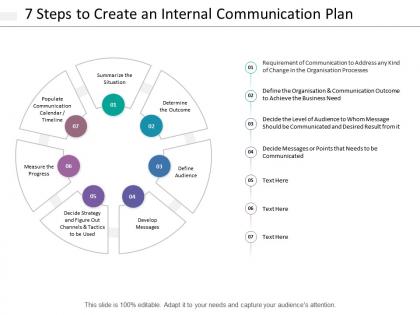
7 steps to create an internal communication plan




Try Before you Buy Download Free Sample Product
 Impress Your
 Audience
 100%
100% Editable
 Save Hours
 of Time


Encourage the humble with our 7 Steps To Create An Internal Communication Plan. Give them the incentive to continue the effort.
People who downloaded this PowerPoint presentation also viewed the following :
7 steps to create an internal communication plan with all 5 slides:
Our 7 Steps To Create An Internal Communication Plan are essentially elegant. They embody it in their approach.

FAQs for 7 steps to create an
Key components of an effective internal communication plan include clear objectives, target audience identification, message consistency, communication channels selection, and feedback mechanisms. These elements work together by establishing transparent information flow, ensuring timely updates across departments, and creating structured dialogue pathways, with many organizations finding that strategic internal communication ultimately enhances employee engagement and operational efficiency.
Organizations assess internal communication effectiveness through employee surveys measuring message clarity and engagement, communication audits evaluating channel usage and reach, feedback loops tracking response rates, and performance metrics analyzing information flow speed and accuracy. These assessment methods enable leaders to identify gaps in messaging, optimize channel selection, and enhance employee engagement, while many organizations finding that regular evaluation ultimately delivers improved productivity, stronger alignment, and competitive advantage through better-informed teams.
Leadership plays a pivotal role in shaping internal communication strategy by establishing vision, setting tone, defining communication priorities, and modeling transparent practices throughout the organization. Through strategic messaging frameworks and consistent engagement approaches, leaders enable cultural alignment, enhance employee trust, and streamline information flow, with many organizations finding that executive commitment ultimately delivers stronger workforce cohesion and operational efficiency.
Technology enhances internal communication by streamlining information flow through unified platforms, enabling real-time collaboration, and automating routine updates across departments. Through tools like integrated messaging systems and project management platforms, organizations reduce email overload, accelerate decision-making, and improve transparency, with many companies finding that digital solutions ultimately deliver faster response times and stronger cross-functional alignment.
Best practices for creating communication flowcharts include defining clear message hierarchies, establishing decision points, mapping stakeholder touchpoints, incorporating feedback loops, and setting defined timelines for each communication stage. These structured approaches streamline information flow by eliminating bottlenecks, ensuring accountability, and maintaining transparency, with many organizations finding that visual flowcharts reduce miscommunication and accelerate project delivery across departments.
Internal communication plans should be reviewed quarterly and updated annually, with additional reviews triggered by major organizational changes, new technology implementations, or significant shifts in business strategy. Many organizations find that regular quarterly assessments enable them to identify communication gaps, measure engagement effectiveness, and adapt messaging strategies, while annual comprehensive updates ensure alignment with evolving business objectives and maintain competitive organizational agility.
Feedback can be effectively gathered through employee surveys, focus groups, suggestion boxes, one-on-one meetings, and digital collaboration platforms. These methods enable organizations to identify communication gaps, measure message clarity, and assess channel effectiveness, with many companies finding that systematic feedback collection ultimately enhances employee engagement and streamlines organizational decision-making processes.
Internal communication metrics include employee engagement scores, message reach and open rates, feedback response rates, knowledge retention assessments, and cross-departmental collaboration indicators. These measurements enable organizations to track communication effectiveness by monitoring participation levels, comprehension rates, and behavioral changes, with many companies finding that regular metric analysis drives improved employee satisfaction, reduced information silos, and ultimately enhanced organizational alignment and productivity.
An internal communication plan accommodates different styles by offering multiple channels like email updates, video messages, team meetings, collaborative platforms, and visual dashboards for various learning preferences. This multi-channel approach ensures introverted employees receive written communications while extroverted staff engage through meetings and discussions, ultimately enhancing message retention and organizational alignment across diverse teams.
Strategies include regular leadership updates, open feedback channels, transparent decision-making processes, consistent messaging across departments, and accessible information sharing platforms. These approaches enhance organizational trust by providing clear context for changes, enabling two-way dialogue, and demonstrating accountability, with many companies finding that proactive transparency significantly improves employee engagement and reduces workplace uncertainty.
An internal communication plan promotes employee engagement and morale by fostering transparency, providing regular feedback channels, recognizing achievements, and ensuring consistent messaging across all organizational levels. Through strategic communication initiatives, companies enhance trust, reduce uncertainty, and create stronger workplace connections, with many organizations finding that structured communication approaches ultimately deliver improved retention rates, higher productivity, and enhanced collaborative culture.
Common pitfalls include unclear messaging hierarchies, inadequate feedback mechanisms, over-reliance on single channels, inconsistent timing, and neglecting audience segmentation. These oversights can create communication silos, reduce employee engagement, and diminish organizational alignment, with many companies finding that strategic multi-channel approaches with regular assessment cycles ultimately deliver stronger internal cohesion and operational efficiency.
An internal communication plan addresses organizational change and crisis through clear messaging protocols, designated communication channels, regular leadership updates, transparent timeline sharing, and proactive feedback mechanisms. During transitions, organizations like healthcare systems and financial institutions find that structured communication reduces uncertainty, maintains employee engagement, and preserves operational continuity, ultimately delivering faster adaptation and stronger organizational resilience.
Cultural differences significantly influence internal communication strategies by affecting communication styles, hierarchy expectations, feedback preferences, and information processing methods across diverse teams. Organizations must adapt their approaches to accommodate varying cultural norms around directness, formality, and decision-making processes, with many multinational companies finding that culturally-sensitive communication frameworks enhance employee engagement, reduce misunderstandings, and ultimately deliver stronger collaboration and organizational cohesion.
Visual elements enhance internal communication effectiveness by improving information retention, reducing cognitive load, and accelerating comprehension through infographics, charts, and interactive dashboards. These tools streamline complex data presentation, enable faster decision-making across departments, and ultimately deliver clearer messaging and stronger employee engagement, with many organizations finding that visual-first approaches significantly boost communication outcomes.
No Reviews