


8 Deadly Wastes Powerpoint Presentation Slides




Try Before you Buy Download Free Sample Product
 Impress Your
 Audience
 100%
100% Editable
 Save Hours
 of Time


Our well investigated topics highlight major concerns being faced in the industry. 8 deadly wastes PowerPoint presentation slides covers the significant concerns hindering the productivity of an organization. Summarized through the overview, service sectors and lean downtime, major concerns can be comprehended through following eight subdivisions, defects, overproduction, waiting, non-value added processing, transportation, inventory, motion waste, and employees unutilized skills. Diminishing waste not only protects money on costly waste hauling but also manifests industry leadership and contributes to corporate social responsibility by reducing greenhouse gas emissions and overcoming the global uncertainties to human health caused by our waste brooks. Furthermore, comparisons can be done through the clustered column, scatter line and area chart PowerPoint slides in bar and graphs topic. Numerous icons have been included here extensively designed for the concerned topics which you can use for your personalization. Get ready for a superior experience with our PowerPoint templates and excel towards productivity, click the download button. Display godliness with our 8 Deadly Wastes Powerpoint Presentation Slides. They help you advocate cleanliness.
People who downloaded this PowerPoint presentation also viewed the following :
Content of this Powerpoint Presentation
Slide 1: This slide introduces 8 Deadly Wastes. State your company name and get started.
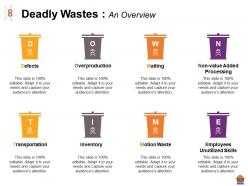
Slide 2: This slide presents an overview of eight Deadly Wastes- Defects, Transportation, Overproduction, Inventory, Waiting, Motion Waste, Non-value Added Processing, Employees Unutilized Skills.
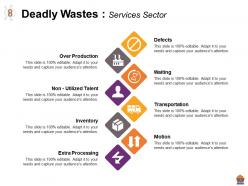
Slide 3: This slide shows 8 Deadly Wastes: Services Sector which consists of- Defects, Waiting, Transportation, Motion, Over Production, Non - Utilized Talent, Inventory, Extra Processing.
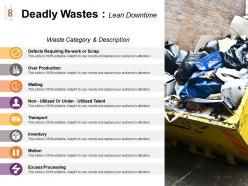
Slide 4: This slide shows Deadly Wastes: Lean Downtime Defects Requiring Re-work or Scrap, Over Production, Waiting, Non - Utilized Or Under - Utilized Talent, Transport, Inventory, Motion, Excess Processing.
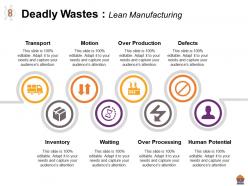
Slide 5: This slide shows eight Deadly Wastes: Lean Manufacturing which includes- Transport, Inventory, Motion, Over Production, Defects, Waiting, Over Processing, Human Potential.
Slide 6: This is a Coffee Break slide to halt. You may change it as per requirement.
Slide 7: This slide is titled Charts & Graphs to move forward. You may change it as per requirement.
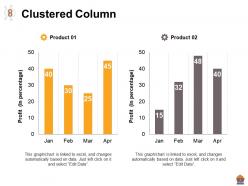
Slide 8: This is a Clustered Column slide to present product/ entity comparison, specifications etc.
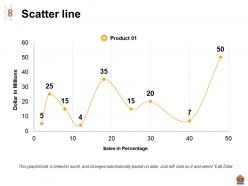
Slide 9: This is a Scatter Line slide to present product/ entity information, specifications etc.
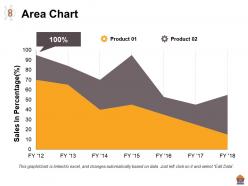
Slide 10: This is an Area Chart slide to present product/ entity comparison, specifications etc.
Slide 11: This is 8 Deadly Wastes Icon Slide. Alter icons on the basis of your requirement.
Slide 12: This slide is titled Additional Slides. You can change the slide content as per your needs.
Slide 13: This slide contains Our Mission with text boxes.
Slide 14: This Meet Our Team slide with background imagery.
Slide 15: This is an About Us slide with relevant background imagery and text box to state your specification etc.
Slide 16: This is Our Goal slide. State your important goals here.
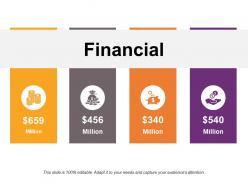
Slide 17: This slide is titled as Financials. Show finance related stuff here.
Slide 18: This is a Thank You slide with Address# street number, city, state, Contact Numbers, Email Address.
8 Deadly Wastes Powerpoint Presentation Slides with all 18 slides:
Indulge in intelligent arguments with our 8 Deadly Wastes Powerpoint Presentation Slides. Convince folks you have an agile brain.








FAQs for 8 Deadly Wastes
Lean Six Sigma's core principles include waste elimination, defect reduction, process standardization, data-driven decision making, and continuous improvement cycles. These methodologies streamline operations by identifying bottlenecks, reducing variability, and optimizing workflows, with many manufacturing and healthcare organizations finding that strategic implementation delivers faster cycle times, lower costs, and enhanced customer satisfaction.
Organizations effectively integrate Lean and Six Sigma by combining Lean's waste elimination focus with Six Sigma's statistical process control, creating a comprehensive approach that streamlines operations while reducing defects. This strategic combination enables companies to accelerate improvement cycles, enhance quality metrics, and deliver measurable cost reductions, with many manufacturing and healthcare organizations finding that integrated teams achieve faster project completion and sustained operational excellence.
Data analysis serves as the foundation of DMAIC, driving evidence-based decisions through statistical measurement, root cause identification, process mapping, and performance tracking at each phase. Organizations across manufacturing, healthcare, and financial services leverage analytics tools like control charts, regression analysis, and hypothesis testing to quantify problems, validate solutions, and sustain improvements, ultimately delivering measurable cost reductions and operational excellence.
Lean Six Sigma adapts to service industries by focusing on process flow, customer experience, and data analysis rather than physical defects, emphasizing waste reduction in waiting times, handoffs, and information processing. While manufacturing targets product quality and production efficiency, service applications in banking, healthcare, and hospitality streamline customer interactions, reduce service delivery times, and enhance satisfaction scores, ultimately delivering improved operational efficiency and competitive advantage.
Common Lean Six Sigma implementation challenges include employee resistance to change, insufficient leadership commitment, inadequate training resources, and difficulty measuring project outcomes. While these obstacles can slow initial adoption, organizations increasingly find that addressing cultural barriers through comprehensive training and clear communication ultimately delivers improved operational efficiency and competitive advantage across departments.
Lean Six Sigma enhances customer satisfaction by eliminating process defects, reducing delivery times, and streamlining service interactions through data-driven analysis and continuous improvement methodologies. Organizations across retail, healthcare, and financial services utilize these principles to minimize errors, accelerate response times, and deliver consistent experiences, ultimately building stronger customer loyalty and competitive advantage.
Essential Lean Six Sigma tools include DMAIC methodology, value stream mapping, root cause analysis, statistical process control, and waste identification techniques. These methodologies streamline operations by eliminating inefficiencies, reducing defects, and optimizing workflows, with manufacturing, healthcare, and financial services organizations finding that strategic implementation delivers significant cost reductions and enhanced operational efficiency.
Lean Six Sigma identifies waste as non-value-adding activities like overproduction, waiting, defects, excess inventory, unnecessary motion, over-processing, and underutilized talent. By systematically eliminating these wastes, organizations achieve reduced operational costs, faster cycle times, improved quality, and enhanced customer satisfaction, with manufacturing companies often seeing 15-30% cost reductions and service industries delivering significantly faster processing times.
Lean Six Sigma methodologies can absolutely be adapted for small businesses through simplified tools, focused project selection, and scaled implementation approaches that match available resources and organizational size. Small manufacturers, service providers, and retail operations successfully implement modified versions by concentrating on high-impact processes, using basic statistical tools rather than complex analyses, and training key employees in core principles, ultimately delivering cost reductions and improved customer experiences without overwhelming limited staff or budgets.
Organizations should monitor defect rates, cycle times, customer satisfaction scores, cost savings, and process efficiency metrics to assess Lean Six Sigma success. These measurements enable businesses to track operational improvements across manufacturing, healthcare, and financial services sectors, while demonstrating tangible ROI through reduced waste, faster delivery times, and enhanced quality outcomes.
Leadership sustains Lean Six Sigma culture through visible commitment, resource allocation, employee empowerment, and consistent communication of improvement goals. By actively participating in projects, recognizing achievements, and integrating continuous improvement metrics into performance evaluations, leaders demonstrate strategic value, with many organizations finding that executive sponsorship ultimately delivers enhanced operational efficiency and sustained competitive advantage.
Employee training programs contribute to Lean Six Sigma implementation by building data analysis skills, process mapping capabilities, problem-solving methodologies, statistical literacy, and change management competencies across organizational levels. Through comprehensive certification programs, manufacturing companies, healthcare systems, and financial institutions enhance employee engagement, reduce implementation resistance, and accelerate project success rates, ultimately delivering sustainable operational improvements and competitive advantage.
Lean Six Sigma facilitates cross-functional collaboration through structured problem-solving methodologies, standardized communication protocols, and shared data-driven decision making processes. These techniques enable teams to work toward common goals using tools like value stream mapping and process improvement frameworks, ultimately breaking down silos while delivering measurable results across departments.
General Electric's implementation across manufacturing operations, Motorola's defect reduction initiatives, Bank of America's mortgage processing improvements, and Toyota's production system optimization demonstrate successful Lean Six Sigma transformations. These organizations achieved significant cost reductions, enhanced operational efficiency, and improved customer satisfaction, with many finding that combining lean principles with Six Sigma methodology delivers sustainable competitive advantages across diverse industries.
Lean Six Sigma aligns with quality frameworks like ISO and TQM by sharing core principles of continuous improvement, customer focus, and data-driven decision making. While ISO provides standardization structure and TQM emphasizes cultural transformation, Lean Six Sigma delivers tactical methodologies for waste elimination and defect reduction, with many organizations finding that combining these frameworks creates comprehensive quality systems that enhance operational efficiency and competitive advantage.
-
Great experience, I would definitely use your services further.
-
It saves your time and decrease your efforts in half.