

8 Phase Product Lifecycle Management Process Strategic Product Development Strategy




Try Before you Buy Download Free Sample Product
 Impress Your
 Audience
 100%
100% Editable
 Save Hours
 of Time


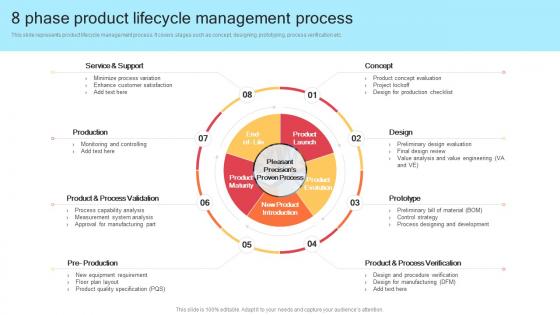
This slide represents product lifecycle management process. It covers stages such as concept, designing, prototyping, process verification etc.
People who downloaded this PowerPoint presentation also viewed the following :
8 Phase Product Lifecycle Management Process Strategic Product Development Strategy with all 6 slides:
Use our 8 Phase Product Lifecycle Management Process Strategic Product Development Strategy to effectively help you save your valuable time. They are readymade to fit into any presentation structure.





FAQs for 8 Phase Product Lifecycle Management Process Strategic
The key stages include introduction, growth, maturity, and decline, each requiring distinct marketing approaches regarding pricing, promotion, distribution, and positioning strategies. During introduction, companies focus on awareness-building and market education, while growth emphasizes market share expansion, maturity requires differentiation and customer retention, and decline involves strategic decisions about product discontinuation or repositioning, ultimately enabling businesses to optimize resource allocation and maximize profitability.
Companies effectively gather customer feedback through surveys, interviews, social media monitoring, analytics platforms, and beta testing programs throughout development, launch, and post-market phases. These methods enable organizations to identify pain points, track satisfaction metrics, and adapt products accordingly, with many retail and technology companies finding that continuous feedback loops ultimately deliver improved customer experiences and competitive advantage.
Technology enhances PLM processes by automating workflows, enabling real-time collaboration, integrating data across departments, and providing advanced analytics for decision-making. Through cloud-based PLM platforms and IoT integration, manufacturers streamline product development, reduce time-to-market, and improve quality control, with many organizations finding that these technologies ultimately deliver significant competitive advantages and operational efficiency.
Common PLM implementation challenges include data integration complexities, resistance to change management, inadequate cross-functional collaboration, insufficient training resources, and technology adoption barriers. These obstacles often stem from siloed organizational structures and legacy systems, with many manufacturing and automotive companies finding that phased implementation approaches, comprehensive stakeholder engagement, and strategic change management ultimately deliver smoother transitions and sustainable competitive advantages.
Organizations ensure cross-departmental collaboration during product development by implementing integrated PLM platforms, establishing cross-functional teams with clear communication protocols, and creating shared project dashboards with real-time visibility. These approaches streamline coordination between engineering, marketing, manufacturing, and quality teams, with many companies finding that structured collaboration reduces development cycles by 20-30% while minimizing costly design revisions.
Sustainability influences product lifecycle management through eco-friendly design principles, circular economy integration, sustainable sourcing requirements, carbon footprint tracking, and end-of-life recycling protocols. These practices enable organizations to reduce environmental impact while enhancing operational efficiency, with manufacturing and consumer goods companies finding that sustainable PLM delivers cost savings, regulatory compliance, and competitive advantage in increasingly environmentally-conscious markets.
PLM software solutions facilitate regulatory compliance by centralizing documentation, automating audit trails, and maintaining version control across product development phases. These systems enable manufacturers in pharmaceuticals, aerospace, and medical devices to streamline regulatory submissions, track compliance requirements throughout the lifecycle, and ultimately reduce approval times while minimizing costly regulatory risks.
Organizations should track time-to-market, development costs, product quality metrics, revenue per product, and lifecycle profitability to assess PLM success. These metrics enable companies to streamline development processes, reduce operational costs, and enhance product performance, with many manufacturing and technology firms finding that comprehensive tracking ultimately delivers faster innovation cycles and improved competitive positioning.
Digital twins and simulations revolutionize product development by enabling virtual prototyping, real-time performance monitoring, predictive maintenance scheduling, and accelerated testing cycles throughout the entire lifecycle. These technologies streamline development timelines, reduce physical prototyping costs, and enhance product quality, with manufacturers in automotive, aerospace, and consumer electronics finding that virtual testing delivers faster time-to-market and significantly improved operational efficiency.
Data analytics significantly enhances product lifecycle management by providing actionable insights across conception, development, launch, growth, and decline phases through market research analysis, performance monitoring, and predictive modeling. Through advanced analytics, organizations streamline decision-making, reduce time-to-market, and optimize resource allocation, with manufacturing and retail companies finding that data-driven approaches deliver enhanced customer experiences and sustained competitive advantage.
PLM accelerates time-to-market by streamlining product development workflows, enabling concurrent engineering processes, and facilitating real-time collaboration across cross-functional teams. Through integrated data management and automated approval workflows, organizations in automotive, electronics, and consumer goods significantly reduce development cycles, minimize design iterations, and enhance coordination between engineering, manufacturing, and supply chain teams, ultimately delivering faster product launches and competitive advantage.
Globalization significantly impacts product lifecycle management by creating complex multi-regional supply chains, accelerating time-to-market pressures, and requiring coordinated development across dispersed teams. Manufacturing companies increasingly leverage PLM systems to streamline global collaboration, standardize processes across facilities, and manage regulatory compliance in different markets, ultimately delivering faster innovation cycles and reduced operational costs.
Companies manage product obsolescence through strategic planning, inventory optimization, customer communication, and phased discontinuation processes. These approaches enable organizations to minimize losses while maximizing value extraction, with many manufacturers finding that early obsolescence planning, coupled with effective new product introductions and customer migration strategies, ultimately delivers smoother transitions and sustained competitive advantage.
Agile methodologies transform traditional PLM by introducing iterative development cycles, cross-functional collaboration, and rapid prototyping instead of linear, sequential phases. These approaches enable faster time-to-market, enhanced customer feedback integration, and greater adaptability to market changes, with many manufacturing and technology companies finding that agile PLM delivers improved innovation speed and competitive responsiveness.
Effective product lifecycle management drives innovation by systematically capturing market feedback, analyzing performance data, and identifying enhancement opportunities throughout each product phase. Through integrated PLM systems, companies streamline development cycles, accelerate time-to-market, and enable rapid iteration based on customer insights, ultimately delivering differentiated products that outpace competitors in crowded markets.
-
Eye-catching PPT designs, outstanding team, and best customer service. I’m a super satisfied customer here!
-
Unique design & color.