

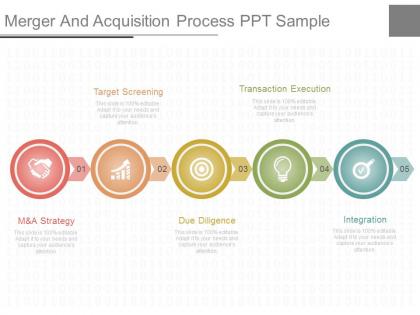
A merger and acquisition process ppt sample




Try Before you Buy Download Free Sample Product
 Impress Your
 Audience
 100%
100% Editable
 Save Hours
 of Time


Give all available products a look. You will elect to go with our A Merger And Acquisition Process Ppt Sample.
People who downloaded this PowerPoint presentation also viewed the following :
A merger and acquisition process ppt sample with all 7 slides:
Use our A Merger And Acquisition Process Ppt Sample to weave a web of your great ideas. They are guaranteed to attract even the most critical of your colleagues.







FAQs for A merger and acquisition
The key stages in the merger and acquisition process include strategic planning, target identification, due diligence, valuation, negotiation, regulatory approval, and integration. These stages enable organizations to systematically evaluate opportunities, assess financial and operational risks, and execute transactions that deliver synergies, market expansion, and competitive advantages, with many companies finding that thorough preparation ultimately determines long-term success.
Companies determine merger or acquisition pursuit by evaluating strategic fit, financial synergies, market positioning, cultural compatibility, and regulatory considerations. Through comprehensive due diligence, organizations assess revenue enhancement opportunities, cost reduction potential, and competitive advantages, with many finding that strategic combinations enable faster market expansion, operational efficiency improvements, and enhanced shareholder value in increasingly competitive business environments.
Due diligence serves as the comprehensive investigation phase where acquiring companies thoroughly evaluate target businesses' financial health, legal compliance, operational efficiency, and strategic value. This critical process enables buyers to identify potential risks, validate assumptions, and negotiate appropriate deal terms, while sellers can demonstrate their company's true worth, ultimately ensuring informed decision-making and successful transaction outcomes.
Companies can effectively value acquisition targets through multiple methodologies including discounted cash flow analysis, comparable company analysis, precedent transaction analysis, and asset-based valuation approaches. These methods work together by examining financial projections, market multiples, and strategic synergies, with many organizations finding that combining quantitative metrics with qualitative factors like market position and growth potential delivers more accurate valuations and competitive acquisition advantages.
Common legal considerations in mergers and acquisitions include due diligence reviews, regulatory compliance, antitrust approvals, contract assignments, and intellectual property transfers. These legal frameworks streamline transaction processes by identifying potential liabilities, ensuring regulatory adherence, and protecting stakeholder interests, with many organizations finding that thorough legal preparation ultimately delivers smoother integrations and reduced post-merger risks.
Cultural differences significantly impact M&A success by affecting employee retention, productivity, and integration timelines, with misaligned values, communication styles, and management approaches creating operational friction. Companies like Daimler-Chrysler and AOL-Time Warner demonstrate how cultural clashes can undermine synergies, while successful integrations prioritize cultural assessment early, ultimately delivering smoother transitions and preserved talent retention.
Organizations can finance acquisitions through debt financing, equity financing, cash reserves, seller financing, mezzanine financing, and strategic partnerships. These methods enable companies to structure deals by leveraging existing capital, securing bank loans, or issuing new shares, with many finding that combining multiple financing approaches optimizes capital allocation while minimizing financial risk and preserving operational flexibility.
The most significant M&A risks include cultural integration challenges, overvaluation of target companies, regulatory approval delays, talent retention issues, and IT systems consolidation problems. These risks can derail expected synergies and ROI, with many organizations finding that thorough due diligence, cultural assessment, and phased integration planning help minimize potential disruptions while maximizing strategic value.
Integration planning should be approached through structured phase management, clear communication protocols, cultural assessment frameworks, and dedicated integration teams with defined timelines. Organizations typically find success by prioritizing critical business functions first, establishing unified operational procedures, and maintaining transparent stakeholder communication, while many companies leverage detailed roadmaps to minimize disruption and accelerate synergy realization across departments.
Financial advisors play crucial roles in M&A transactions, including valuation analysis, due diligence coordination, deal structuring, negotiation support, and regulatory compliance guidance. These professionals streamline complex processes by identifying synergies, assessing financial risks, and optimizing transaction terms, with many organizations finding that experienced advisors significantly enhance deal success rates while minimizing costly oversights.
Market conditions significantly influence M&A activity through interest rates, stock valuations, credit availability, regulatory environments, and economic stability. During favorable conditions, companies leverage lower borrowing costs and higher valuations to pursue strategic acquisitions, while uncertain markets often delay deals, with many organizations finding that timing market cycles ultimately delivers better transaction outcomes and competitive positioning.
Common M&A pitfalls include inadequate due diligence, cultural misalignment, overvaluation, poor integration planning, and insufficient stakeholder communication. These challenges can derail transactions by creating unexpected liabilities, employee resistance, and operational disruptions, with many organizations finding that thorough preparation and strategic change management ultimately deliver smoother integrations and better outcomes.
Companies effectively communicate merger changes through multi-channel strategies including town halls, executive briefings, digital platforms, regular updates, and dedicated communication teams. These approaches streamline information flow by addressing concerns proactively, maintaining transparency throughout integration phases, and ensuring consistent messaging across all stakeholder groups, ultimately delivering enhanced trust and smoother organizational transitions.
Key M&A success metrics include revenue synergies, cost reduction achievements, market share expansion, customer retention rates, and employee satisfaction scores. These measurements enable organizations to track operational efficiency, cultural integration success, and strategic value creation, with many companies finding that balanced scorecards combining financial and operational indicators ultimately deliver the most comprehensive assessment of merger performance.
Regulatory oversight significantly influences M&A strategies by requiring extensive due diligence, compliance assessments, and antitrust evaluations before deal completion. Companies must navigate sector-specific regulations, with financial institutions and healthcare organizations finding that early regulatory engagement, strategic timing adjustments, and comprehensive documentation streamline approval processes while minimizing delays.
-
Excellent template with unique design.
-
Amazing product with appealing content and design.