

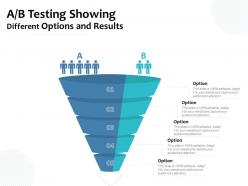
Ab testing showing different options and results





Try Before you Buy Download Free Sample Product
 Impress Your
Audience
 100%
Editable
 Save Hours
of Time


Be the dynamo with our AB Testing Showing Different Options And Results. Your thoughts will generate some sparks.
People who downloaded this PowerPoint presentation also viewed the following :
Ab testing showing different options and results with all 5 slides:
Our AB Testing Showing Different Options And Results have dynamic powers. They will get your thoughts into motion.


FAQs for Ab testing showing different
A/B testing enables marketers to optimize campaigns by comparing different versions of content, emails, landing pages, and advertisements to determine which performs better. Through systematic testing, businesses enhance conversion rates, reduce customer acquisition costs, and maximize ROI, with companies like e-commerce retailers and SaaS providers finding that data-driven optimization delivers significantly improved marketing performance.
A/B testing in presentation templates involves creating multiple design variations to test elements like layout structures, color schemes, typography choices, slide transitions, and visual hierarchy arrangements. Organizations can systematically test these variations with different audience segments, measuring engagement metrics, comprehension rates, and retention levels, ultimately delivering data-driven template designs that maximize communication effectiveness and audience impact.
Key metrics include conversion rates, statistical significance, confidence intervals, effect size, and user engagement patterns. These measurements enable organizations to validate hypothesis accuracy, assess business impact, and optimize customer experiences, with many companies finding that prioritizing both statistical validity and practical significance ultimately delivers more reliable insights and sustainable competitive advantage.
Psychological factors significantly influence A/B testing outcomes through cognitive biases, user expectations, behavioral patterns, and emotional responses to design elements. These psychological drivers affect click-through rates, conversion behaviors, and user engagement across different demographics, with many e-commerce and SaaS companies finding that understanding user psychology enhances test accuracy and delivers more reliable optimization results.
Common A/B testing pitfalls include running tests with insufficient sample sizes, testing multiple variables simultaneously, stopping tests too early, ignoring statistical significance, and failing to account for external factors. These mistakes undermine data reliability and lead to poor decision-making, with many organizations finding that proper test duration, isolated variables, and statistical rigor ultimately deliver more accurate insights and sustainable business improvements.
A/B testing informs presentation UX design by comparing different visual layouts, navigation flows, color schemes, and interactive elements to determine which versions drive better audience engagement and comprehension. Through systematic testing of slide transitions, font choices, and content organization, designers can optimize presentation effectiveness, reduce cognitive load, and enhance information retention, ultimately delivering more impactful communication experiences.
Sample sizes play a critical role in A/B test reliability by determining statistical significance, reducing margin of error, and ensuring results represent your broader audience accurately. Larger sample sizes deliver more confident conclusions and minimize the risk of false positives, with many organizations finding that inadequate samples lead to misguided decisions that ultimately harm conversion rates and business outcomes.
Seasonal trends can significantly impact A/B testing by influencing audience behavior, content preferences, and engagement patterns that vary throughout the year. Different seasons affect how viewers respond to visual elements, messaging tone, and call-to-action effectiveness, with many marketing teams finding that holiday periods, back-to-school seasons, and quarterly business cycles require distinct presentation approaches to maintain accurate testing results.
A/B testing improves webinar engagement by comparing different elements like registration pages, email invitations, presentation formats, and interactive features to identify what resonates most with audiences. Through testing variables such as webinar titles, timing, content structure, and call-to-action placements, organizations can optimize participation rates, increase audience retention, and ultimately deliver more compelling experiences that drive better business outcomes.
A/B testing for mobile presentations can evaluate touch gestures versus click navigation, portrait versus landscape orientations, slide animations, font sizes, and interactive elements like swipe patterns. Through mobile-specific metrics, organizations can optimize user engagement, reduce bounce rates, and enhance presentation effectiveness across devices, with many companies finding that mobile-adapted testing delivers significantly improved audience retention and interaction rates.
A/B testing frequency depends on your content volume, audience size, and business objectives, with most organizations conducting tests monthly or quarterly for major content elements while running continuous micro-tests for smaller components. Companies with high traffic volumes can test weekly across different content types, while smaller businesses benefit from focused quarterly campaigns, ultimately finding that consistent testing cycles deliver measurable improvements in engagement and conversion rates.
Popular A/B testing tools include Google Optimize, Optimizely, VWO, Adobe Target, and Unbounce, each offering comprehensive testing capabilities across web and mobile platforms. These solutions streamline experiment design, automate statistical analysis, and deliver actionable insights through intuitive dashboards, with many marketing teams finding that integrated platforms significantly reduce testing complexity while accelerating optimization cycles.
A/B testing enhances call-to-action effectiveness by comparing different versions of messaging, placement, visual design, and wording to identify what drives audience engagement. Through systematic testing of elements like button colors, text phrasing, and positioning, organizations can optimize conversion rates, reduce decision friction, and ultimately deliver more compelling presentations that generate measurable business outcomes.
A/B testing ethical considerations include informed consent, data privacy protection, avoiding manipulative practices, ensuring equitable treatment across user groups, and maintaining transparency in testing methodologies. These considerations help organizations balance innovation with user trust, particularly in sectors like healthcare and financial services, where testing impacts can be significant, ultimately delivering responsible optimization while preserving customer relationships and regulatory compliance.
A/B testing enables businesses to tailor offerings by comparing different versions of products, messaging, pricing, and user experiences across diverse audience segments simultaneously. Through systematic testing, companies can identify which variations resonate with specific demographics, geographic regions, or customer behaviors, ultimately delivering personalized experiences that increase engagement, conversion rates, and customer satisfaction across their entire market spectrum.
No Reviews