

Action plan ppt examples






Try Before you Buy Download Free Sample Product
 Impress Your
 Audience
 100%
100% Editable
 Save Hours
 of Time


Benefit from brainstorming with our Action Plan Ppt Examples. Experiment with fresh and creative ideas.
People who downloaded this PowerPoint presentation also viewed the following :
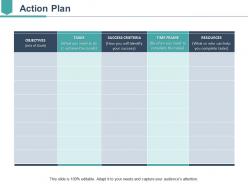
Action plan ppt examples with all 5 slides:
Put your best face forward with our Action Plan Ppt Examples. Give your appearance an elegant boost.
FAQs for Action
Effective action plan templates include clear objectives, specific tasks with deadlines, assigned responsibilities, required resources, measurable milestones, and risk mitigation strategies. These components work together by ensuring accountability, tracking progress systematically, and maintaining alignment across teams, with many organizations finding that structured templates streamline project execution and deliver measurable outcomes more consistently.
Action plan templates can be tailored by incorporating industry-specific objectives, regulatory requirements, stakeholder roles, and performance metrics unique to each sector. In healthcare, templates emphasize patient outcomes and compliance protocols, while education focuses on learning objectives and student engagement, and marketing prioritizes campaign timelines and ROI metrics, ultimately enabling organizations to streamline planning processes while maintaining industry relevance.
Common mistakes include setting unrealistic timelines, lacking specific measurable goals, failing to assign clear ownership, insufficient resource allocation, and neglecting regular progress reviews. These oversights often derail implementation across organizations, with many businesses finding that strategic action plans succeed through detailed accountability frameworks, realistic milestone mapping, and consistent monitoring systems, ultimately delivering sustainable execution and competitive advantage.
Measuring action plan success involves tracking key performance indicators, milestone completion rates, budget adherence, timeline accuracy, and outcome quality against predefined benchmarks. Through regular progress reviews, stakeholder feedback sessions, and data analytics, organizations streamline performance evaluation, identify improvement opportunities, and ensure strategic objectives are met, ultimately delivering measurable results and competitive advantage.
Timelines and deadlines create accountability, urgency, and measurable progress within action plans, ensuring tasks remain prioritized and resources are allocated efficiently. They enable teams to track milestones, identify bottlenecks early, and maintain momentum toward strategic objectives, with many organizations finding that clear temporal boundaries significantly enhance project completion rates and overall operational effectiveness.
Visual elements enhance action plan clarity by incorporating flowcharts, timelines, progress bars, color-coded priorities, and interactive dashboards that transform complex information into digestible formats. These design strategies streamline communication across teams, minimize misunderstandings, and accelerate decision-making processes, with many organizations finding that visual presentations deliver faster stakeholder buy-in and improved project execution rates.
Best practices for communicating action plans include establishing clear timelines, defining specific roles and responsibilities, using visual dashboards, conducting regular progress updates, and maintaining transparent reporting channels. These approaches enhance stakeholder engagement by providing consistent visibility into project milestones, enabling proactive issue resolution, and building trust through accountability, with many organizations finding that structured communication frameworks ultimately deliver improved project outcomes and stronger stakeholder alignment.
Action plans can be adapted for team collaboration through shared digital platforms, clearly defined role assignments, regular check-in schedules, transparent progress tracking, and collaborative milestone reviews. These modifications enhance accountability by establishing team-wide visibility into individual contributions, enabling real-time updates and feedback loops, while fostering collective ownership of outcomes and streamlined communication across all project phases.
Action plan tools include Microsoft Project, Asana, Trello, Monday.com, and Smartsheet, which streamline task organization, timeline management, and team collaboration. These platforms enhance project visibility by automating progress tracking, centralizing communication, and enabling real-time updates, with many organizations finding that integrated dashboards ultimately deliver faster execution and improved accountability across teams.
Resources should be allocated within an action plan by prioritizing high-impact activities, assigning skilled personnel to critical tasks, and establishing clear budget parameters for each phase. Strategic allocation involves balancing immediate needs with long-term objectives, while incorporating buffer resources for unexpected challenges, ultimately ensuring streamlined execution and optimal return on investment across all project components.
Short-term action plans typically span weeks to months, focusing on immediate objectives, tactical execution, and quick wins, while long-term plans extend over years, emphasizing strategic goals, resource allocation, and sustained growth. These approaches work together seamlessly, with many organizations finding that short-term plans deliver operational momentum and measurable progress, ultimately supporting broader strategic initiatives and competitive positioning.
Action plans help in risk management by providing structured frameworks for identifying potential threats, assessing their impact, and implementing preventive measures across operations. Through systematic planning, organizations streamline response protocols, allocate resources efficiently, and establish clear accountability chains, with many financial institutions and healthcare systems finding that proactive action plans significantly reduce operational disruptions and enhance business continuity.
Action plan templates can incorporate feedback and revisions through built-in review cycles, collaborative editing features, milestone checkpoints, stakeholder comment sections, and version control systems. These mechanisms enable teams to adapt strategies based on real-world performance, stakeholder input, and changing market conditions, with many organizations finding that structured revision processes ultimately enhance project outcomes and team alignment.
During the action plan review process, organizations should ask whether objectives are being met on schedule, what obstacles are hindering progress, if resources are adequately allocated, and how stakeholder engagement levels are performing. These critical questions enable teams to identify bottlenecks, reallocate resources strategically, and adjust timelines accordingly, with many businesses finding that structured review processes ultimately enhance project success rates and operational efficiency.
Setting SMART goals enhances action plan quality by providing specific targets, measurable outcomes, achievable milestones, relevant priorities, and time-bound deadlines that eliminate ambiguity and enable focused execution. Through this structured approach, organizations streamline resource allocation, track progress more effectively, and maintain accountability across teams, with many businesses finding that SMART frameworks significantly improve project completion rates and strategic outcomes.
-
Easily Understandable slides.
-
Enough space for editing and adding your own content.