

Active and passive learning pyramid




Try Before you Buy Download Free Sample Product
 Impress Your
 Audience
 100%
100% Editable
 Save Hours
 of Time


Our Active And Passive Learning Pyramid are topically designed to provide an attractive backdrop to any subject. Use them to look like a presentation pro.
People who downloaded this PowerPoint presentation also viewed the following :
Active and passive learning pyramid with all 2 slides:
Use our Active And Passive Learning Pyramid to effectively help you save your valuable time. They are readymade to fit into any presentation structure.

FAQs for Active and
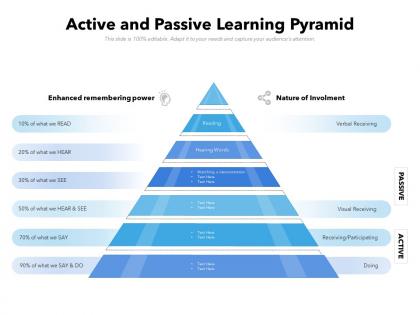
The Active Learning Pyramid's key principles include progressive engagement levels, retention rate optimization, participatory learning methods, experiential application, and immediate feedback integration. These principles work by moving learners from passive absorption to active participation, with teaching others and hands-on practice delivering 75-90% retention rates, while traditional lectures achieve only 5-10% retention.
The Active Learning Pyramid facilitates teaching by structuring activities from passive lecture formats to highly interactive methods like peer teaching, group discussions, and hands-on practice. This progression enhances student engagement through increasing participation levels, with many educators finding that higher-pyramid activities like simulations and collaborative projects deliver significantly improved retention rates, deeper comprehension, and ultimately stronger academic outcomes.
Educators can implement the Active Learning Pyramid by incorporating hands-on activities, group discussions, peer teaching, case studies, and real-world problem-solving exercises that engage students beyond passive listening. These methodologies enhance retention rates significantly, with many institutions finding that interactive approaches like collaborative projects and student presentations deliver improved comprehension, stronger critical thinking skills, and ultimately better academic outcomes.
Research demonstrates that active learning methods from the pyramid deliver significantly higher retention rates, with peer teaching achieving 90% retention compared to traditional lectures at 5%. Studies across educational institutions show that interactive techniques like group discussions, hands-on practice, and immediate application enhance comprehension by 40-60%, ultimately delivering improved test scores, better skill transfer, and sustained knowledge retention for long-term academic success.
The Active Learning Pyramid integrates different learning styles by incorporating visual, auditory, and kinesthetic elements across its retention levels, from passive lectures to active teaching and practice. Through discussion groups, demonstrations, and hands-on practice sessions, learners engage multiple sensory pathways simultaneously, with many organizations finding that this multi-modal approach enhances knowledge retention and accommodates diverse learning preferences effectively.
**INPUT**: What specific techniques can be used at each level of the Active Learning Pyramid? **OUTPUT**: Active Learning Pyramid techniques include lectures and reading at foundational levels, demonstrations and audiovisual materials in the middle, while upper levels incorporate discussion groups, practice sessions, peer teaching, and immediate application exercises. These progressive methods enhance retention by moving from passive absorption to active engagement, with educational institutions and corporate training programs finding that hands-on application and collaborative learning ultimately deliver significantly higher knowledge retention rates. [Word count: 60 words]
Students typically respond more positively to active learning methods, showing increased engagement, retention, and critical thinking skills compared to passive lecture attendance. Research across universities and educational institutions demonstrates that active learning approaches, including group discussions, problem-solving exercises, and hands-on activities, enhance student participation and academic performance, with many educators finding that these methods create more dynamic classroom environments and ultimately deliver better learning outcomes.
Collaboration serves as a foundational element across all Active Learning Pyramid tiers, from peer discussions in lower levels to group problem-solving and team-based projects in higher tiers. Through collaborative approaches, educational institutions and corporate training programs enhance knowledge retention, develop critical thinking skills, and improve communication abilities, with many organizations finding that structured collaborative learning delivers significantly better outcomes than traditional individual-focused methods.
The Active Learning Pyramid adapts to virtual environments through interactive video conferences, breakout room discussions, collaborative online simulations, and digital peer teaching platforms. These technologies enhance remote engagement by facilitating real-time polling, virtual case studies, and screen-sharing presentations, with many educational institutions finding that hybrid models ultimately deliver improved participation rates and flexible learning experiences.
Educators transitioning to Active Learning Pyramid approaches often face challenges including curriculum restructuring, technology integration requirements, increased preparation time, student resistance to participation, and assessment method modifications. While these obstacles initially demand significant investment in training and resources, many institutions find that systematic implementation, starting with smaller interactive elements, ultimately delivers enhanced student engagement, improved retention rates, and more effective learning outcomes.
The Active Learning Pyramid effectively translates to corporate training environments, with methods like simulations, role-playing exercises, peer teaching, and hands-on workshops delivering significantly higher retention rates than traditional lectures. Many organizations find that interactive training approaches, especially those involving real project applications and collaborative problem-solving, enhance skill acquisition while reducing training costs and accelerating employee competency development.
Assessment methods using the Active Learning Pyramid shift from passive testing to dynamic evaluation through peer discussions, collaborative projects, practical demonstrations, and real-time problem-solving activities. These approaches enable educators to measure comprehension through student presentations, group analyses, and hands-on applications, ultimately delivering more accurate insights into learning retention and practical skill development.
Teachers can access learning management systems, interactive presentation software, collaboration platforms, assessment tools, and professional development resources to implement the Active Learning Pyramid effectively. These technologies streamline lesson planning, facilitate group discussions, and enable real-time feedback, with many educators finding that strategic combinations enhance student engagement, improve knowledge retention, and ultimately deliver measurable learning outcomes.
Teachers can measure Active Learning Pyramid success through student engagement metrics, comprehension assessments, retention rates, and participation quality across different learning levels. Many educators find that combining formative assessments with peer feedback and self-reflection activities provides comprehensive insights, ultimately delivering improved academic outcomes and enhanced critical thinking skills in increasingly interactive classroom environments.
Cultural context significantly influences the Active Learning Pyramid through varying communication styles, hierarchical structures, individual versus collective orientations, and technological accessibility across different societies. Educational institutions in collectivist cultures often emphasize group discussions and peer teaching, while individualistic cultures may favor personal reflection and independent practice, with many organizations finding that adapting the pyramid's levels to local learning preferences ultimately delivers more effective knowledge retention and cross-cultural engagement.
No Reviews