

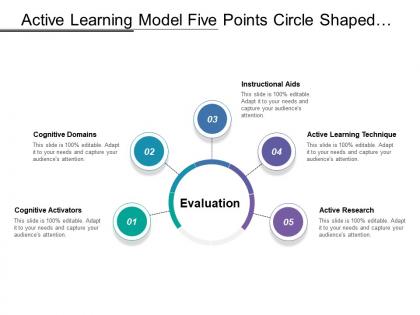
Active learning model five points circle shaped evaluation




Try Before you Buy Download Free Sample Product
 Impress Your
Audience
 100%
Editable
 Save Hours
of Time


Complete the job with our Active Learning Model Five Points Circle Shaped Evaluation. End it off in a flourish.
People who downloaded this PowerPoint presentation also viewed the following :
Active learning model five points circle shaped evaluation with all 5 slides:
Convince folks that conditions are better than expected with our Active Learning Model Five Points Circle Shaped Evaluation. It will drastically alter impressions.


FAQs for Active learning model five points
The Active Learning Evaluation Model includes uncertainty sampling, query strategy optimization, performance metrics tracking, data labeling efficiency measures, and model improvement validation. These components work together by identifying informative samples, streamlining annotation processes, and measuring learning effectiveness, with organizations in healthcare, finance, and manufacturing finding that strategic implementation reduces labeling costs while accelerating model accuracy improvements.
The Active Learning Evaluation Model differs from traditional assessment methods by emphasizing continuous feedback, peer collaboration, real-time adjustments, and hands-on problem-solving rather than standardized testing. This approach enables educators to assess student understanding through interactive projects, group discussions, and practical applications, ultimately delivering more personalized learning experiences and better academic outcomes.
The Active Learning Evaluation Model enhances student engagement through interactive assessments, peer feedback systems, real-time progress tracking, collaborative problem-solving activities, and personalized learning pathways. These approaches streamline traditional evaluation methods by encouraging participation, fostering critical thinking, and providing immediate insights into comprehension, with many educational institutions finding that students demonstrate significantly higher retention rates and academic performance.
**INPUT**: What types of assessments are most effective within the Active Learning Evaluation Model? **OUTPUT**: Effective assessments within the Active Learning Evaluation Model include peer evaluations, real-time feedback mechanisms, collaborative project assessments, self-reflection portfolios, and performance-based demonstrations. These assessment types enhance learning outcomes by encouraging continuous engagement, promoting critical thinking skills, and enabling immediate course corrections, with many educational institutions finding that this comprehensive approach ultimately delivers improved student retention and deeper knowledge acquisition. [Word count: 60 words]
Educators can effectively implement the Active Learning Evaluation Model by incorporating real-time assessment techniques, collaborative group activities, peer feedback systems, and interactive digital tools throughout their lessons. This approach enables teachers to monitor student comprehension continuously, adjust instruction dynamically, and enhance engagement levels, with many educational institutions finding that students demonstrate improved retention and critical thinking skills.
Feedback serves as the critical mechanism for continuous improvement in Active Learning Evaluation Models, enabling algorithms to refine predictions, identify knowledge gaps, and prioritize high-value data points for human annotation. Through iterative feedback loops, organizations in healthcare, finance, and manufacturing can enhance model accuracy, reduce training costs, and accelerate deployment timelines, ultimately delivering more reliable AI systems with significantly fewer labeled examples.
Technology enhances the Active Learning Evaluation Model through learning analytics platforms, real-time feedback systems, adaptive assessment tools, interactive simulations, and AI-powered performance tracking. These technologies streamline evaluation by automating data collection, personalizing learning paths, and providing instant insights, with educational institutions finding that integrated assessment delivers more accurate student progress monitoring and improved learning outcomes.
Educators may face challenges including resistance to changing traditional assessment methods, increased time requirements for designing interactive evaluations, technology integration difficulties, and managing diverse learning styles within active assessments. However, these obstacles present opportunities for professional development and enhanced student engagement, with many institutions finding that strategic implementation ultimately delivers improved learning outcomes and competitive educational advantage.
The Active Learning Evaluation Model accommodates diverse learning styles through multimodal assessments, personalized feedback mechanisms, collaborative group activities, hands-on experiential components, and adaptive questioning techniques. This strategic combination enables visual, auditory, kinesthetic, and analytical learners to demonstrate knowledge effectively, while organizations increasingly find that diverse evaluation approaches enhance training outcomes, improve employee engagement, and ultimately deliver more comprehensive skill development across different learning preferences.
Success metrics for Active Learning Evaluation Model include model accuracy improvement rates, labeling efficiency ratios, annotation cost reduction, convergence speed measurements, and human expert time savings. These metrics enable organizations to track performance gains while minimizing data labeling costs, with many machine learning teams finding that combining accuracy benchmarks with resource optimization delivers significant competitive advantages and faster model deployment cycles.
The Active Learning Evaluation Model promotes critical thinking by encouraging students to analyze information, question assumptions, synthesize concepts from multiple sources, and apply knowledge to real-world scenarios rather than passively receiving content. Through interactive discussions, problem-solving exercises, and reflective assessments, educators can enhance student engagement, develop analytical reasoning abilities, and foster deeper comprehension, with many institutions finding that this approach ultimately delivers improved academic outcomes and better preparation for professional challenges.
Research from institutions like MIT, Stanford, and Carnegie Mellon demonstrates that active learning evaluation models improve student retention rates by 15-25%, reduce achievement gaps, and enhance critical thinking skills through real-time feedback mechanisms. These studies show that organizations implementing structured active learning assessments experience significantly higher engagement levels, faster skill acquisition, and improved knowledge transfer, with educational institutions and corporate training programs finding measurably better learning outcomes.
Peer feedback within the Active Learning Evaluation Model can be structured through rubric-based assessments, anonymous peer reviews, collaborative project evaluations, and structured discussion protocols. These methods enhance learning by encouraging critical thinking, diverse perspectives, and collaborative problem-solving, while many educational institutions find that systematic peer feedback ultimately improves student engagement and deeper understanding.
The Active Learning Evaluation Model supports collaborative learning by facilitating peer feedback, group problem-solving, real-time assessment sharing, and collective reflection on learning outcomes. Through interactive evaluation frameworks, educational institutions and corporate training programs enhance team-based learning experiences, streamline knowledge transfer between participants, and ultimately deliver improved group performance with enhanced critical thinking skills.
Instructors can modify the Active Learning Evaluation Model by adapting assessment criteria to discipline-specific learning objectives, incorporating subject-relevant interactive techniques, and adjusting feedback mechanisms to match field requirements. For example, science courses might emphasize lab-based peer evaluations and data analysis discussions, while humanities classes focus on collaborative textual analysis and debate assessments, ultimately enhancing student engagement across diverse academic contexts.
-
Awesomely designed templates, Easy to understand.
-
Wonderful templates design to use in business meetings.