

Addressing Algorithmic Bias In AI Driven Recruitment Ppt Presentation




Try Before you Buy Download Free Sample Product
 Impress Your
 Audience
 100%
100% Editable
 Save Hours
 of Time


Get our professionally created Addressing Algorithmic Bias in AI-Driven Recruitment PowerPoint presentation. This comprehensive presentation explains the importance of identifying algorithmic biases in an AI-driven recruitment company. Learn about the difficulty of AI bias and the long history of fighting against discrimination in hiring. Moreover, the Algorithmic bias PPT templates display details related to mitigating algorithmic bias in a different framework that refines trust around AI technologies. Implement steps such as transparency, accountability, and the ethical use of AI while empowering equality through fair hiring practices. Furthermore, the AI-driven recruitment PPT slides will help you understand the importance of fairness-aware AI, communicate those initiatives with stakeholders, and maintain high ethical standards. Download now and start on your mission to improve diversity in recruitment.
People who downloaded this PowerPoint presentation also viewed the following :
Content of this Powerpoint Presentation
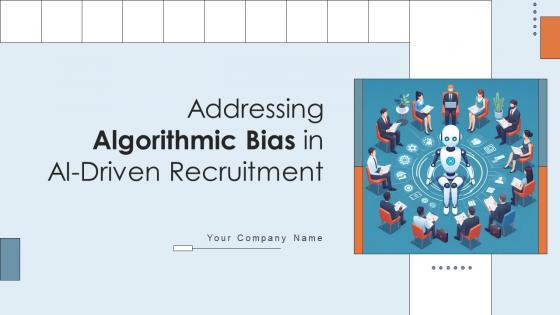
Slide 1: This slide introduces Addressing Algorithmic Bias in AI-Driven Recruitment. State your company name and begin.
Slide 2: This is an Agenda slide. State your agendas here.
Slide 3: This slide shows Table of Content for the presentation.
Slide 4: This slide shows title for topics that are to be covered next in the template.
Slide 5: This slide provides details related to a company that aims to revolutionize hiring with advanced AI technology, offering products such as resume screening tools etc.
Slide 6: This slide depicts the flowchart representing the recruitment process in a staffing agency, specifying the following steps: identifying needs, strategizing, selecting candidates etc.
Slide 7: This slide defines the innovative AI solutions for recruitment as blending employer criteria, past hiring data, and advanced algorithms etc.
Slide 8: This slide shows title for topics that are to be covered next in the template.
Slide 9: This slide defines that addressing AI bias in recruitment is crucial to ensure fair hiring practices, as biased algorithms can favor specific demographics etc.
Slide 10: This slide depicts the causes of discrimination in hiring, highlighting the potential algorithmic biases that intensify these disparities underscoring the importance of developing fair and unbiased AI systems.
Slide 11: This slide shows title for topics that are to be covered next in the template.
Slide 12: This slide defines the need for mitigating algorithmic bias in AI-driven recruitment to ensure fairness, build trust, and prevent the reinforcement of societal biases.
Slide 13: This slide depicts the framework that underscores the significance of addressing bias in AI recruitment through unbiased datasets, transparency, and management oversight etc.
Slide 14: This slide defines the process of implementing ethical AI in recruitment to address transparency, governance, fairness, diversity, user education, ethical guidelines etc.
Slide 15: This slide shows title for topics that are to be covered next in the template.
Slide 16: This slide defines implementing solutions such as open communication and providing clear explanations, transparency and explainability in AI systems.
Slide 17: This slide displays the details related to implementing transparent practices in a hiring company, such as openly communicating objectives, data sources, algorithms etc.
Slide 18: This slide depicts implementing a comprehensive communication plan that ensures transparency and understanding of AI systems, enhancing trust and alignment with stakeholders etc.
Slide 19: This slide shows title for topics that are to be covered next in the template.
Slide 20: This slide defines how establishing clear lines of accountability, developing governance protocols, and implementing regular audits in hiring agencies can effectively overcome algorithmic biases.
Slide 21: This slide presents how assigning responsibility to the hiring agency ensures accountability and effectively addresses errors and biases in AI deployment and maintenance.
Slide 22: This slide depicts how algorithmic fairness audits are essential for identifying and mitigating biases in AI recruitment systems, ensuring fair and unbiased hiring decisions.
Slide 23: This slide shows title for topics that are to be covered next in the template.
Slide 24: This slide defines implementing fairness-aware AI that involves developing algorithms that ensure equitable outcomes, conducting regular audits to identify biases etc.
Slide 25: This slide presents how implementing fairness-aware AI in hiring agencies can revolutionize their processes, ensuring equitable opportunities while adhering to ethical guidelines.
Slide 26: This slide provides details related to AI technologies, from NLP-enabled software to video interview analytics, to streamline candidate sourcing, screening, and evaluation processes.
Slide 27: This slide shows title for topics that are to be covered next in the template.
Slide 28: This slide defines promoting diversity, providing training, establishing an inclusive culture, and securing leadership commitment to effectively mitigate algorithmic bias.
Slide 29: This slide presents promoting diversity and inclusion within the hiring agency as leading to improved collaboration, creativity, and innovation, contributing to the mitigation of algorithmic bias.
Slide 30: This slide shows title for topics that are to be covered next in the template.
Slide 31: This slide defines the overview, which consists of details related to education initiatives, awareness campaigns, and training programs so users and stakeholders can better understand AI systems.
Slide 32: This slide presents the implementation of training sessions, awareness campaigns, and feedback mechanisms that foster user understanding and engagement in the AI-driven hiring process.
Slide 33: This slide shows title for topics that are to be covered next in the template.
Slide 34: This slide defines implementing strong ethical guidelines throughout the AI lifecycle as crucial to mitigating algorithmic bias effectively and ensuring fairness, transparency etc.
Slide 35: This slide presents how the hiring agency integrates ethical guidelines into AI-driven hiring by establishing clear policies, conducting regular training etc.
Slide 36: This slide shows title for topics that are to be covered next in the template.
Slide 37: This slide defines the continuous improvement in AI systems, which involves collecting user feedback, iteratively enhancing algorithms, and maintaining transparency etc.
Slide 38: This slide presents the hiring company that adopts a user-centric approach, leveraging feedback, iterative improvements, monitoring, and transparency to ensure fairness.
Slide 39: This slide shows title for topics that are to be covered next in the template.
Slide 40: This slide presents details related to staying updated, adhering to legal requirements, developing compliance protocols, and providing training so that organizations can ensure regulatory compliance.
Slide 41: This slide defines how hiring agencies prioritize regulatory compliance through regular checks, data protection measures, dedicated compliance teams etc.
Slide 42: This slide shows title for topics that are to be covered next in the template.
Slide 43: This slide defines engaging external auditors and conducting regular audits using comprehensive evaluation criteria, which ensures unbiased assessments, enhanced transparency etc.
Slide 44: This slide presents how implementing external audits by AI ethics experts provides unbiased validation while detailed reports and transparent processes build stakeholder trust.
Slide 45: This slide shows title for topics that are to be covered next in the template.
Slide 46: This slide depicts quantified improvements demonstrating the potential positive impact of mitigating algorithmic bias across various aspects of the hiring process.
Slide 47: This slide defines the positive impact of implementing transparency, accountability, etc., significantly reducing algorithmic bias in hiring processes, improving trust, fair treatment etc.
Slide 48: This slide defines how implementing mitigation steps positively impacts job ad distribution and candidate evaluations, fostering diversity and ensuring fairness in hiring practices.
Slide 49: This slide presents implementing mitigation steps such as continuous improvement, regulatory compliance, and independent audits and their positive impact.
Slide 50: This slide shows all the icons included in the presentation.
Slide 51: This slide is titled as Additional Slides for moving forward.
Slide 52: This slide depicts Venn diagram with text boxes.
Slide 53: This slide provides 30 60 90 Days Plan with text boxes.
Slide 54: This slide presents Roadmap with additional textboxes. It can be used to present different series of events.
Slide 55: This is Our Target slide. State your targets here.
Slide 56: This slide contains Puzzle with related icons and text.
Slide 57: This slide shows Post It Notes for reminders and deadlines. Post your important notes here.
Slide 58: This slide displays Mind Map with related imagery.
Slide 59: This is an Idea Generation slide to state a new idea or highlight information, specifications etc.
Slide 60: This is a Thank You slide with address, contact numbers and email address along with socials.
Addressing Algorithmic Bias In AI Driven Recruitment Ppt Presentation with all 68 slides:
Use our Addressing Algorithmic Bias In AI Driven Recruitment Ppt Presentation to effectively help you save your valuable time. They are readymade to fit into any presentation structure.










FAQs for Addressing Algorithmic Bias In AI Driven
Ugh, it's mostly the training data being totally biased. Like, your AI is learning from old hiring records that already had discrimination baked in - so now it's copying those same prejudices against women, minorities, older people, whatever. Algorithms also get weirdly fixated on random stuff like what college someone went to or buzzwords that end up correlating with certain groups. I swear some of this bias is so sneaky you'd never catch it! You've gotta test your system regularly with different candidate profiles and clean up that training data to actually reflect who you want hiring.
Document everything about your AI hiring process - what data you're collecting, how it makes decisions, the whole deal. Candidates need to know how they're being evaluated. Most companies can't even explain what their system actually does, which is honestly pretty embarrassing. Publish regular audits showing how different groups perform in your system. Also set up an appeals process for when people think the AI screwed up. Yeah, it's a ton of paperwork but transparency matters here. Start with just figuring out what your current system does first.
Look, data diversity is basically your safety net against biased hiring algorithms. If you only train AI on one type of candidate, it'll assume that's what "good" looks like - which is obviously wrong. You need training data from different demographics and backgrounds so the algorithm actually learns to spot talent everywhere, not just pattern-match to previous hires. I've seen companies mess this up so badly. The more diverse your historical data, the fairer your AI becomes at evaluating people. Just make sure you're auditing those datasets regularly and including underrepresented groups.
Your AI system will just copy whatever biased hiring decisions happened before. So if your company always picked men for engineering or only recruited from fancy schools, the algorithm thinks that's how it should work. Pretty messed up, right? The thing can't figure out which patterns are actually good versus which ones are just old discrimination playing out. Short sentences, longer explanations - it all gets baked in as "this is normal." You've got to clean up that training data first and fix the bias issues before you even think about using AI for recruiting.
Ugh, biased AI in hiring is such a mess. So basically these systems learn from old hiring data, which means they just copy whatever prejudices already existed. They'll literally penalize people with certain names or downgrade candidates from specific schools. The algorithms love traditionally "male" language too - it's honestly ridiculous. What's really scary? This happens automatically at massive scale, so companies don't even realize they're filtering out amazing diverse candidates. You might think you're being more efficient, but you're actually just automating discrimination. Most places won't catch it until they actually audit their whole process.
Honestly, start with monthly spot checks using different candidate profiles - the results will probably shock you at first. Run those job descriptions through bias detection tools too. I'd track pass-through rates by gender, race, age groups, stuff like that. Having diverse teams review the AI's picks is clutch. Set up bias thresholds so the system automatically flags itself when things get weird. Oh, and don't stress about doing full quarterly audits right away if that feels like too much - being consistent with smaller checks beats going overboard then burning out. The data's usually pretty revealing once you dig into it.
Oh man, this is such a big deal. Americans get super focused on individual fairness - like, did this one person get screwed over? But in places like Japan or China, they're more worried about whole communities getting hurt by the algorithm. Europeans don't trust this stuff at all (honestly, can't blame them), while Americans are way more chill about it. The exact same hiring AI could look totally fair in one country and completely messed up in another. If your friend's company is going global with this, they definitely need to test how different cultures react, not just whether the tech actually works.
Oh man, AI hiring is such a mess right now. Biggest issue? These systems just bake in all our existing biases against women and minorities. Your algorithm might reject people for stuff that has nothing to do with the job but correlates with race or gender. Plus you can't even explain why someone got rejected - total black box situation. That's gonna be a legal nightmare. Look, if you're gonna use this tech anyway, at least check your results by demographics regularly. And seriously, don't let the AI make final calls without human oversight.
Start with diverse training data - seriously, garbage in means garbage out. Build in fairness constraints that actually force equal treatment across demographics. Test everything against gender, race, whatever protected classes matter for your use case. It's crazy how many teams skip this then act shocked when their AI only picks male engineers. Set up bias detection tools to catch sketchy patterns. Oh, and don't forget monitoring after launch because bias can sneak back in when your candidate pool shifts. Regular audits are your friend here.
Check out IBM's AI Fairness 360 - it's probably your best bet for testing demographic parity across different groups. Google's What-If Tool works well too, and Microsoft's Fairlearn is decent if you're already using their stuff. The real challenge isn't the tools themselves though, it's convincing people to actually run these audits consistently. I'd start by auditing what you have now before trying to fix anything. For corrections, you can tweak thresholds or re-weight your training data. Oh, and post-processing techniques help too - there's a bunch of ways to approach it once you know where the problems are.
Don't treat fairness like some add-on feature - bake it right into your process from day one. Check your training data for bias first, then monitor how different groups are being affected by the outcomes. Honestly, most companies skip this step and regret it later when things blow up. Get diverse people reviewing the AI's recommendations, not just your usual hiring team. Oh, and be upfront with candidates about how you're using AI - people appreciate the transparency. Set specific bias limits the same way you'd track any other performance metric. Takes extra time initially but saves you from major headaches down the road.
Ugh, algorithmic bias is such a mess. You'll send in applications that get auto-rejected for totally random stuff - wrong resume format, your school isn't "prestigious" enough, even your address sometimes. It's honestly pretty awful when you think about it. Plus you never find out why you got filtered out, so there's no way to fix it next time. The whole thing feels like throwing applications into a void. If companies actually cared, they'd be transparent about their process and let humans review the weird edge cases. But most don't bother.
Yeah, it's a mess right now tbh. The EU just labeled recruitment AI as "high-risk" under their new AI Act, so companies need transparency reports and bias testing. Over here, the EEOC is basically saying "hey, those old discrimination laws? They apply to AI too." New York's making companies do bias audits, but most states haven't caught up yet. I'd start documenting how your AI makes decisions and test for discriminatory patterns regularly - that stuff's gonna be required everywhere soon anyway. Better to get ahead of it now than scramble later.
Start by getting diverse training data and auditing for bias regularly. Don't let the AI make final hiring calls - combine it with structured interviews. Your dev team needs to be diverse too (seriously, so many companies skip this basic step). Test across different demographic groups before you launch anything. Set up fairness metrics, not just efficiency ones. Document everything you're doing to prevent bias - you'll need proof when people start asking questions. Oh, and be transparent about the whole process. Candidates and regulators will want to see your work.
Honestly, you need to stay on top of this stuff because bias issues change constantly. What looked totally fine last year? Yeah, that might be a red flag now. Monthly reading helps - industry reports, webinars, whatever works for you. The field moves crazy fast. Plus when vendors come at you claiming their tools are "completely bias-free," you'll actually know the right questions to ask. (Spoiler: nothing's actually bias-free, but some are way better than others.) You'll catch problems in your current systems that you'd totally miss otherwise. Even just dedicating a few hours monthly makes a huge difference.
-
Excellent template with unique design.
-
Unique and attractive product design.