

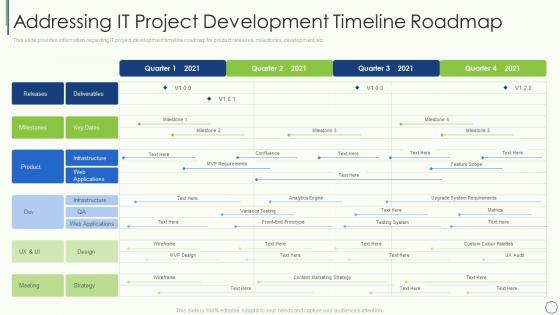
Addressing it project development timeline roadmap key elements of project management it




Try Before you Buy Download Free Sample Product
 Impress Your
 Audience
 100%
100% Editable
 Save Hours
 of Time


This slide provides information regarding IT project development timeline roadmap for product releases, milestones, development, etc.
People who downloaded this PowerPoint presentation also viewed the following :
Addressing it project development timeline roadmap key elements of project management it with all 6 slides:
Use our Addressing It Project Development Timeline Roadmap Key Elements Of Project Management It to effectively help you save your valuable time. They are readymade to fit into any presentation structure.





FAQs for Addressing it project development timeline roadmap key elements of
Key phases include project initiation, requirements analysis, system design, development and coding, testing and quality assurance, deployment, and maintenance. These phases streamline project delivery by establishing clear milestones, allocating resources efficiently, and minimizing risks, with many organizations finding that structured roadmaps reduce development time and costs while enhancing system reliability.
Agile methodologies integrate into project development through iterative sprints, cross-functional collaboration, continuous feedback loops, and adaptive planning cycles. These approaches streamline delivery by breaking complex projects into manageable phases, enabling faster pivots based on stakeholder input, and ultimately delivering higher-quality outcomes with reduced time-to-market, particularly benefiting software development teams and digital transformation initiatives.
Stakeholder engagement shapes roadmaps by identifying business priorities, defining success metrics, securing resource commitments, and ensuring alignment across departments. Through regular feedback sessions and collaborative planning, organizations can balance technical requirements with business objectives, minimize scope creep, and maintain project momentum, with many finding that early stakeholder involvement significantly reduces implementation delays and increases adoption rates.
Development timelines are determined by evaluating project complexity, resource availability, stakeholder requirements, technical dependencies, and risk factors through detailed planning sessions. Project managers collaborate with development teams, conduct task breakdown analysis, and incorporate buffer periods for testing phases, with many organizations finding that iterative sprint planning delivers more accurate timelines and better project outcomes.
Common pitfalls include inadequate stakeholder engagement, unrealistic timeline estimation, insufficient resource allocation, poor risk assessment, and lack of clear communication protocols. These challenges often derail projects in healthcare, manufacturing, and financial services sectors, with many organizations finding that thorough upfront planning and regular milestone reviews ultimately deliver better outcomes and significantly reduce costly delays.
Risk management should be incorporated through continuous assessment phases, contingency planning at each milestone, regular stakeholder reviews, and buffer allocation for critical path activities. This strategic approach enables project teams to identify potential bottlenecks early, maintain realistic timelines, and ensure resource flexibility, with many organizations finding that proactive risk integration ultimately delivers smoother implementations and higher success rates.
Project tracking and collaboration tools include Jira, Asana, Microsoft Project, Slack, and Confluence, which streamline task management, communication, and documentation processes. These platforms enhance operational efficiency by centralizing project data, automating workflow notifications, and enabling real-time collaboration, with many development teams finding that integrated toolsets reduce project delays while improving transparency and stakeholder engagement.
Budget constraints significantly influence project development decisions by determining scope limitations, resource allocation priorities, technology choices, timeline adjustments, and feature prioritization throughout the development lifecycle. These financial parameters enable organizations to make strategic trade-offs between functionality and cost-effectiveness, with many development teams finding that well-managed constraints ultimately drive innovation and streamline delivery processes.
Key progress metrics include milestone completion rates, budget variance, resource utilization, code quality scores, and stakeholder satisfaction indices. These measurements enable project managers to identify bottlenecks early, optimize resource allocation, and maintain timeline adherence, with many organizations finding that integrated dashboards tracking these metrics simultaneously deliver enhanced transparency and ultimately improve project success rates.
Ensuring alignment requires establishing clear success metrics, conducting regular stakeholder reviews, and maintaining consistent communication channels throughout the development lifecycle. Through strategic planning sessions and milestone assessments, organizations streamline decision-making, minimize scope drift, and accelerate delivery timelines, with many finding that structured alignment frameworks ultimately deliver enhanced operational efficiency and stronger competitive positioning.
Effective resource allocation strategies include capacity planning, skill-based assignment matrices, cross-functional team structures, priority-based budgeting frameworks, and agile resource reallocation protocols. These approaches streamline project delivery by matching expertise to critical tasks, optimizing team utilization, and enabling rapid resource shifts, with many IT organizations finding that strategic resource management reduces project timelines while enhancing overall delivery quality.
User feedback can be integrated through iterative sprints, continuous user testing, prototype reviews, stakeholder interviews, and agile development cycles that incorporate real-time input. These approaches streamline development by validating features early, reducing costly revisions, and ensuring final products meet actual user needs, with many software teams finding that regular feedback loops ultimately deliver more successful implementations and higher user adoption rates.
Documentation best practices include maintaining real-time project wikis, standardized code comments, architectural decision records, user story acceptance criteria, and comprehensive testing protocols. These practices streamline knowledge transfer, reduce onboarding time, and minimize project risks, with many development teams finding that consistent documentation ultimately delivers faster troubleshooting, improved collaboration, and enhanced project scalability.
Projects can evolve through iterative development cycles, regular stakeholder feedback, flexible architecture design, and continuous market research. Agile methodologies enable organizations to pivot quickly, with many tech companies and financial institutions finding that modular frameworks, regular sprint reviews, and adaptive resource allocation deliver faster innovation and competitive responsiveness in increasingly dynamic markets.
IT project development roadmap training includes technical skill development, project management methodologies, collaboration tools proficiency, risk assessment techniques, and change management processes. Through structured workshops and ongoing mentorship programs, organizations enhance team capabilities in agile practices, stakeholder communication, and timeline management, with many finding that comprehensive training ultimately delivers improved project success rates and streamlined development cycles.
-
Awesomely designed templates, Easy to understand.
-
Really like the color and design of the presentation.