


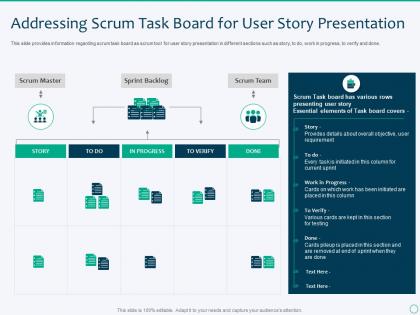
Addressing scrum task board for user story presentation scrum master tools and techniques it




Try Before you Buy Download Free Sample Product
 Impress Your
 Audience
 100%
100% Editable
 Save Hours
 of Time


This slide provides information regarding scrum task board as scrum tool for user story presentation in different sections such as story, to do, work in progress, to verify and done.
People who downloaded this PowerPoint presentation also viewed the following :
Addressing scrum task board for user story presentation scrum master tools and techniques it with all 2 slides:
Use our Addressing Scrum Task Board For User Story Presentation Scrum Master Tools And Techniques IT to effectively help you save your valuable time. They are readymade to fit into any presentation structure.
FAQs for Addressing scrum task board for user story presentation scrum master tools
The primary purpose of a Scrum Task Board in agile project management is to provide visual transparency of work progress, facilitate daily communication among team members, and enable real-time tracking of sprint tasks. This collaborative tool enhances team coordination by displaying task statuses, identifying bottlenecks quickly, and maintaining sprint focus, ultimately delivering improved project visibility and faster delivery cycles.
A Scrum Task Board improves team collaboration and communication by providing visual transparency into sprint progress, enabling real-time status updates, and creating shared accountability for deliverables. Through centralized task visibility, teams streamline daily standups, identify bottlenecks faster, and coordinate work more effectively, ultimately delivering enhanced project alignment and accelerated development cycles.
A typical Scrum Task Board includes columns for "To Do," "In Progress," "Testing," and "Done," along with user stories, tasks, team member assignments, and progress indicators. These components streamline workflow visibility by tracking sprint progress, identifying bottlenecks, and enhancing team collaboration, with many development teams finding that visual task management ultimately delivers faster deliveries and improved project transparency.
Physical Scrum Task Boards use sticky notes and whiteboards for tactile collaboration, while digital versions offer remote accessibility, automated tracking, and real-time updates across distributed teams. Digital boards enable seamless integration with project management tools, enhanced reporting capabilities, and better scalability for growing organizations, ultimately delivering greater flexibility and operational efficiency.
A Scrum Task Board enhances project progress tracking by providing visual workflow transparency, real-time task status updates, bottleneck identification, and team accountability measures. Through column-based organization and daily stand-up integration, development teams can monitor sprint velocity, identify impediments early, and maintain stakeholder alignment, ultimately delivering faster project completion and improved resource allocation across software development cycles.
Common challenges include unclear task definitions, inconsistent board updates, overloading sprint backlogs, poor task size estimation, and inadequate daily standup discussions around board progress. Teams often struggle with maintaining real-time accuracy and ensuring all members actively engage with the visual workflow, though implementing clear update protocols and regular retrospectives helps streamline board effectiveness and enhances team collaboration.
Tasks on a Scrum Task Board are effectively prioritized through Product Owner ranking, story point estimation, sprint goal alignment, and dependency mapping. Teams utilize MoSCoW prioritization, value-based sequencing, and daily standup discussions to ensure highest-impact work progresses first, with many development teams finding that visual priority indicators and regular backlog refinement sessions ultimately deliver faster sprint completion and enhanced product value.
Techniques for maintaining an organized Scrum Task Board include regular daily standup reviews, clear task categorization with swim lanes, consistent card formatting standards, automated integration with project management tools, and designated ownership assignments. These organizational methods streamline workflow visibility by reducing bottlenecks, enhancing team communication, and ensuring accurate sprint progress tracking, with many development teams finding that systematic board maintenance ultimately delivers faster feature delivery and improved project transparency.
A Scrum Task Board should be updated daily during the Daily Scrum meeting, with team members moving tasks between columns as work progresses from "To Do" to "In Progress" to "Done." This real-time visibility enables teams to identify blockers quickly, maintain sprint momentum, and ensure transparent communication, with many organizations finding that consistent daily updates significantly improve delivery predictability and team coordination.
Daily stand-up meetings serve as the primary touchpoint for teams to review and update the Scrum Task Board, with members discussing task progress, identifying blockers, and moving items between columns like "To Do," "In Progress," and "Done." These brief sessions enhance team transparency and coordination by ensuring the board reflects real-time project status, ultimately enabling faster problem resolution and maintaining sprint momentum.
A Scrum Task Board facilitates bottleneck identification by providing visual transparency of work distribution, task progression, and team capacity across sprint cycles. Through real-time status tracking, teams quickly spot accumulating tasks in specific columns, overloaded team members, and delayed deliverables, ultimately enabling faster resolution and improved workflow efficiency.
Scrum Task Board metrics include velocity tracking, cycle time measurement, work-in-progress limits, burndown rates, and task completion patterns. These performance indicators streamline project management by identifying bottlenecks, measuring sprint efficiency, and enhancing team productivity, with many software development organizations finding that these metrics ultimately deliver faster delivery cycles and improved resource allocation.
Organizations can tailor Scrum Task Boards by customizing column structures, adding workflow-specific swim lanes, integrating team-specific metrics, and incorporating automated notifications that align with their operational processes. Through strategic modifications like priority indicators and role-based access controls, companies in sectors like software development and manufacturing streamline project visibility, enhance team coordination, and ultimately deliver faster sprint completions while maintaining quality standards.
Visual cues and color-coding on Scrum Task Boards enhance team communication, streamline progress tracking, accelerate decision-making, and improve workflow transparency. These visual elements enable teams to quickly identify bottlenecks, prioritize urgent tasks, and maintain sprint momentum, with many development organizations finding that strategic color-coding ultimately delivers faster delivery cycles and enhanced collaboration.
Remote teams effectively utilize Scrum Task Boards through digital collaboration platforms, real-time status updates, daily stand-up integration, clear visual indicators, and synchronized sprint tracking. These tools streamline communication by enabling transparent work visibility, automated progress notifications, and seamless task handoffs, with many distributed organizations finding that virtual boards enhance accountability while maintaining team cohesion and project momentum.
-
Great quality slides in rapid time.