

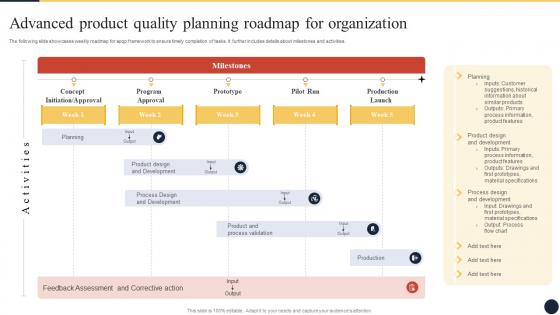
Advanced Product Quality Planning Roadmap For Organization




Try Before you Buy Download Free Sample Product
 Impress Your
 Audience
 100%
100% Editable
 Save Hours
 of Time


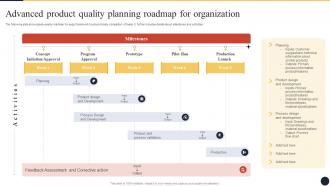
The following slide showcases weekly roadmap for apqp framework to ensure timely completion of tasks. It further includes details about milestones and activities.
People who downloaded this PowerPoint presentation also viewed the following :
Advanced Product Quality Planning Roadmap For Organization with all 6 slides:
Use our Advanced Product Quality Planning Roadmap For Organization to effectively help you save your valuable time. They are readymade to fit into any presentation structure.





FAQs for Advanced Product Quality Planning
APQP encompasses five interconnected phases: planning and program definition, product design and development, process design and development, product and process validation, and production feedback and corrective action. These phases create a seamless workflow where outputs from each stage become inputs for the next, with manufacturing organizations finding that this systematic approach streamlines product launches, reduces quality risks, and accelerates time-to-market while ensuring consistent production readiness.
APQP improves product quality by establishing structured design reviews, comprehensive risk assessments, and rigorous testing protocols throughout development phases, while reducing time through parallel processing and early issue identification. In automotive and electronics manufacturing, companies streamline workflows, minimize costly late-stage changes, and accelerate time-to-market, ultimately delivering superior products with enhanced operational efficiency and competitive advantage.
Cross-functional collaboration is essential for APQP success, as it integrates expertise from engineering, manufacturing, quality, procurement, and suppliers throughout product development phases. This strategic coordination enables faster problem resolution, reduces design iterations, and ensures manufacturing feasibility, with automotive and aerospace companies finding that collaborative teams deliver higher quality products while minimizing costly late-stage changes.
APQP aligns seamlessly with ISO/TS 16949 by providing the structured product development framework that automotive quality standards require, sharing common principles of risk management, continuous improvement, and customer focus. Through integrated documentation systems and phase-gate reviews, organizations streamline compliance across both frameworks while enhancing supplier relationships and product quality, ultimately delivering reduced development costs and faster market entry in increasingly competitive automotive markets.
Critical APQP planning tools include design failure mode and effects analysis (DFMEA), design for manufacturability reviews, prototype control plans, design verification plans, and product quality planning timelines. These methodologies streamline product development by identifying potential risks early, establishing robust manufacturing processes, and ensuring design feasibility, with automotive and aerospace manufacturers finding that systematic APQP implementation significantly reduces development costs and accelerates time-to-market.
Organizations measure APQP effectiveness through key performance indicators like on-time delivery rates, first-pass yield percentages, customer satisfaction scores, defect reduction metrics, and launch milestone adherence. These measurements enable companies to identify process bottlenecks, optimize resource allocation, and enhance product quality outcomes, with many manufacturers finding that systematic APQP tracking delivers faster time-to-market and improved competitive positioning.
Teams commonly face challenges including inadequate cross-functional communication, insufficient supplier integration, timeline compression, resource constraints, and documentation gaps during APQP implementation. These obstacles can be mitigated through early stakeholder engagement, robust project management systems, and standardized templates, with many automotive manufacturers finding that proactive risk assessment and regular milestone reviews ultimately deliver smoother product launches and enhanced quality outcomes.
APQP contributes to risk management by establishing systematic checkpoints, conducting thorough design reviews, and implementing preventive quality measures throughout development phases. Through structured validation processes, manufacturers identify potential failures early, minimize costly redesigns, and ensure regulatory compliance, with automotive and aerospace companies finding that proactive APQP implementation significantly reduces product recalls and launch delays.
Customer feedback influences APQP through design validation, specification refinement, risk identification, and quality requirement adjustments throughout product development phases. This input enables manufacturers to address potential issues early, optimize product features, and ensure final outputs meet market expectations, ultimately reducing launch risks and enhancing customer satisfaction in competitive markets.
Product Quality Planning within APQP ensures systematic development processes that minimize defects, reduce costs, and accelerate time-to-market through structured cross-functional collaboration and risk mitigation strategies. This approach enables manufacturers across automotive, aerospace, and electronics industries to deliver consistent quality outcomes while streamlining supplier relationships and regulatory compliance, ultimately providing competitive advantage through enhanced customer satisfaction and operational efficiency.
Digital tools enhance APQP workflow by automating documentation, enabling real-time collaboration across teams, and providing centralized data management with version control. Cloud-based platforms streamline phase gate reviews, integrate quality metrics tracking, and facilitate supplier communication, while many automotive manufacturers finding that digital APQP systems reduce development timelines and improve compliance accuracy.
Key APQP metrics include customer satisfaction scores, defect rates, cost variance, schedule adherence, and supplier performance indicators. These measurements enable organizations to monitor quality gates, identify process improvements, and ensure robust product launches, with many automotive and manufacturing companies finding that systematic tracking reduces launch risks by 40% while accelerating time-to-market and enhancing competitive positioning.
Lessons learned from previous APQP projects inform new initiatives by identifying process bottlenecks, supplier performance gaps, and design validation challenges that can be proactively addressed. Organizations leverage these insights to refine timing schedules, enhance cross-functional collaboration protocols, and strengthen supplier qualification criteria, with many manufacturing companies finding that systematically applying past project knowledge reduces development cycles and improves product launch success rates.
Organizations can ensure APQP compliance by establishing cross-functional teams, implementing robust documentation systems, conducting regular phase gate reviews, maintaining supplier quality agreements, and using standardized checklists for each development phase. These practices streamline product development processes while ensuring quality requirements are met consistently, with many automotive and manufacturing companies finding that structured APQP adherence reduces launch risks and accelerates time-to-market significantly.
APQP facilitates effective communication between suppliers and manufacturers by establishing standardized documentation requirements, regular review checkpoints, and structured feedback mechanisms throughout product development phases. This systematic approach enables cross-functional teams to identify potential issues early, align on quality expectations, and streamline collaboration processes, ultimately delivering reduced development costs and faster time-to-market across automotive and manufacturing sectors.
-
I can always count on your designs for my professional needs. I believe I found a one-stop-shop for PPTs.
-
Top Quality presentations that are easily editable.