

Adversity climbing mountain challenges opportunities growth




Try Before you Buy Download Free Sample Product
 Impress Your
 Audience
 100%
100% Editable
 Save Hours
 of Time


Grants get approved with the help of our Adversity Climbing Mountain Challenges Opportunities Growth. They ensure funds continue to flow.
Presenting this set of slides with name - Adversity Climbing Mountain Challenges Opportunities Growth. This is a six stage process. The stages in this process are Adversity, Problems And Challenges, Problems And Hurdles.
People who downloaded this PowerPoint presentation also viewed the following :
Content of this Powerpoint Presentation
Description:
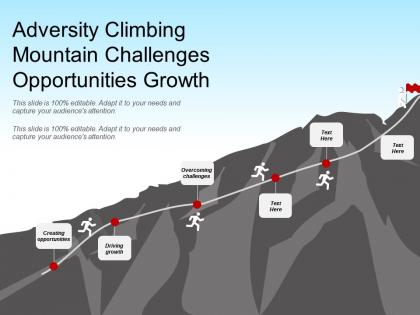
The image is a PowerPoint slide titled "Adversity Climbing Mountain Challenges Opportunities Growth." The slide features a visual metaphor of figures climbing a mountain, representing the journey of overcoming challenges and achieving growth.
The mountain climb is a common metaphor for the path to success, with various stages marked along the way:
1. At the base of the mountain, a caption reads "Creating opportunities," suggesting the starting point involves identifying or creating growth potential.
2. As the climb progresses, another caption "Driving growth" appears, indicating the phase where the strategies to leverage opportunities are implemented to achieve growth.
3. Further up the mountain, "Overcoming challenges" is marked, symbolizing the obstacles that must be navigated to continue the ascent.
At the top of the mountain, there is a flag with "Text Here" boxes, which can be customized to represent the achievement of goals or the pinnacle of success.
Each stage of the climb is marked with a red dot, to which customizable text boxes are connected, allowing presenters to describe each phase of the journey in detail.
Use Cases:
The mountain metaphor in the slide is ideal for illustrating goal-oriented strategies and the journey of overcoming obstacles across diverse sectors.
1. Entrepreneurship:
Use: Motivating startups on the journey from concept to market leader.
Presenter: Business Coach
Audience: Entrepreneurs, Startup Incubator Attendees
2. Sales:
Use: Demonstrating the sales funnel and target achievement process.
Presenter: Sales Director
Audience: Sales Representatives, Account Managers
3. Education:
Use: Showcasing the educational milestones for personal development.
Presenter: Educational Consultant
Audience: Students, Educators
4. Health and Wellness:
Use: Explaining steps toward achieving health and wellness goals.
Presenter: Health Coach
Audience: Clients, Health Enthusiasts
5. Environmental Conservation:
Use: Outlining the progression of conservation projects and initiatives.
Presenter: Conservation Specialist
Audience: NGO Members, Community Leaders
6. Project Management:
Use: Visualizing project milestones and the path to successful completion.
Presenter: Project Manager
Audience: Project Teams, Stakeholders
7. Personal Finance:
Use: Educating on financial planning and achieving financial independence.
Presenter: Financial Advisor
Audience: Clients, Personal Finance Seminar Attendees
Adversity climbing mountain challenges opportunities growth with all 5 slides:
Initiate crowd funding with our Adversity Climbing Mountain Challenges Opportunities Growth. Bring your business acumen to the fore.



FAQs for Adversity climbing mountain
Ugh, I know it sucks in the moment, but tough times really do make you stronger. You end up discovering parts of yourself you didn't even know existed. It's weird how pressure brings out problem-solving skills you never had to use before. Think of it like working out - nobody wants to feel that muscle burn, but that's literally when you're getting stronger. Going through hard stuff teaches you patience and how to actually bounce back when life hits you. Honestly? Without challenges, we'd all just stay comfortable and never grow. Try thinking of rough patches as training instead of the universe being mean to you.
So basically do the three-act thing - setup, struggle, breakthrough. But here's the key: get super specific about the messy parts. Don't just say "it was hard." Show me the 3am panic sessions, the fifth failed attempt, whatever. Those details are what make people actually feel it. The breakthrough has to feel earned too, not like they just got lucky. I honestly think the best adversity stories make you go "damn, if they survived that..." you know? Your audience should walk away feeling like maybe their own problems aren't impossible after all.
Honestly, the biggest game-changer for me has been reframing situations - like actively hunting for different angles when everything feels awful. Your support system is clutch too; don't isolate yourself (I always forget this one). Mindfulness stuff helps you sit with crappy feelings without spiraling. Oh, and there's problem-focused coping for things you can actually fix versus emotion-focused for when you're just stuck dealing with it. Pick whatever clicks with you first and stick with it for a while. Sometimes the simple stuff works better than you'd think.
So first thing - ask your team what they actually need instead of assuming. Nobody wants another mandatory wellness webinar, you know? Create spaces where people can admit they're struggling without getting side-eyed. Mental health resources are huge. Counseling, peer groups, maybe some resilience workshops. But here's the thing - ditch the toxic positivity. That "everything's awesome!" attitude makes people feel like crap when they're having a rough time. Flexible support works way better than one-size-fits-all solutions. Be proactive about it rather than scrambling when someone's already burned out.
Oh nice topic! Start with a real story - someone's actual journey from mess to success works way better than generic advice. Those rock bottom moments? Honestly they're what people remember most. Include the actual strategies they used: mindset shifts, getting support, tackling problems piece by piece. Give your audience tools they can actually use right away. Don't forget to flip the script on failure - show how it's just data, not defeat. Wrap up with something concrete they can try this week, not some vague "be resilient" nonsense.
Your family and cultural background totally influence how you deal with crap life throws at you. Like, some cultures see hardship as building character - so you're more likely to bounce back. Others treat struggles like personal failures, which honestly just makes everything worse. Then you've got cultures that rally around you during tough times versus the "pull yourself up by your bootstraps" mentality. Both work, I guess, but in different ways. The thing is, once you recognize which lens you're looking through, you can figure out if it's actually helping you or just making you feel stuck.
Honestly, visuals are a game-changer for adversity stories. Before/after photos hit different than just describing the transformation. Progress charts show that slow climb out of whatever mess you were in - people eat that stuff up. I'm partial to video timelines myself because they catch those raw moments when you're actually struggling, not just the polished end result. Infographics work too if you're not camera-shy. The trick is matching each visual to where you are in the story. Don't just slap random photos everywhere. Each image should move your narrative forward, you know?
Honestly, the worst thing you can do is just dump all your trauma without showing what you actually learned from it. Nobody wants to hear you complain for five minutes, you know? Don't be super vague either - saying "I faced challenges" tells me nothing. But also don't overshare the really heavy stuff that makes everyone squirm. I've seen people do that and it's awkward for everyone. Focus on how you bounced back instead. What did you figure out? How'd you solve it? End with the win or the lesson - that's what sticks with people anyway.
Mix hard numbers with real stories about people who made it through tough stuff. Honestly, the context matters way more than just throwing stats around. Longitudinal studies are gold - they show actual progress over time. Recovery rates, success rates for different programs, demographic patterns. But here's the thing: explain WHY those numbers happened. What made the difference? Your audience needs to see both how big the problem is AND that there are real ways to beat it. Start with one stat that hits hard, then back it up with evidence showing how people actually won.
Dude, crisis moments teach you stuff no MBA ever could. When everything's falling apart, you discover your real leadership style and figure out who on your team actually has your back. Plus you develop genuine empathy - not the fake corporate kind. Some of my sharpest strategic ideas honestly came when I was scrambling to solve problems creatively. The resilience you build is legit too, like actual muscle memory for stress. I know it sounds cheesy but next time things get rough, just notice what it's showing you about yourself and how your team really works together.
Look, adversity hits differently based on your field. Business deals with market crashes and competition eating profits. Schools struggle with budget cuts and kids checking out. Healthcare's drowning in staffing issues and resource problems - honestly they're getting hammered worse than anyone right now. But every industry's figured out ways to survive their particular brand of chaos. Short bursts of crisis, longer recovery periods. What's cool is you can totally steal strategies from other fields. Like, how restaurants pivoted during COVID might help your situation even if you're in tech or whatever.
Honestly, real stories with actual struggle hit way harder than any generic advice. Share the messy stuff - specific failures, those "holy crap" breakthrough moments, times when people wanted to quit. Your own vulnerability works best if you're comfortable with it (or get permission if it's someone else's story). Pause when you drop the emotional bombs so it actually lands. Before/after photos are gold too. I always think the best part is connecting each story to something concrete they can actually try. Makes it feel less like inspiration porn and more like a roadmap, you know?
Honestly, multimedia just hits different when you're telling tough stories. People don't just read about someone's pain - they actually feel it. Like when you hear someone's voice crack in a video or see their face change. That stuff gets to you way more than words on a page ever could. Visuals work too - infographics can show you patterns in data that make problems feel real and huge. Even background music (I know, sounds cheesy) can make everything feel heavier. But don't go overboard with flashy stuff. Pick one solid piece that actually adds something meaningful to your story, then maybe build from there.
Dude, history's full of this stuff. During the London Blitz, people literally sang together in subway tunnels while bombs dropped above them. Wild, right? Then you've got the Great Depression - whole neighborhoods just started sharing everything, from food to skills. Hurricane Katrina survivors in New Orleans basically rebuilt their own communities from scratch. Even COVID showed it - countries completely flipped their routines overnight. The crazy part is it's always the same pattern: crisis hits, people band together, share resources, form tighter bonds. So when your team's struggling, that pressure might actually unlock something stronger than what you had before.
Honestly, getting feedback on your adversity stories is a game-changer. Other people catch things you miss - like when you're being too vague or oversharing. I used to ramble about my setbacks until friends called me out for burying what actually mattered. They'll help you hit that sweet spot between vulnerable and strong, you know? Plus they can tell which details add to your story versus just cluttering it up. I'd share with maybe 2-3 people you trust and straight up ask what stuck with them most.
-
Design layout is very impressive.
-
Best Representation of topics, really appreciable.