

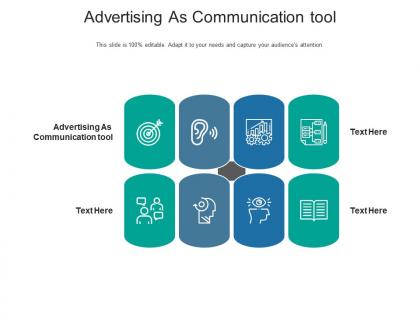
Advertising as communication tool ppt powerpoint presentation file vector cpb




Try Before you Buy Download Free Sample Product
 Impress Your
Audience
 100%
Editable
 Save Hours
of Time


Our Advertising As Communication Tool Ppt Powerpoint Presentation File Vector Cpb are topically designed to provide an attractive backdrop to any subject. Use them to look like a presentation pro.
People who downloaded this PowerPoint presentation also viewed the following :
Advertising as communication tool ppt powerpoint presentation file vector cpb with all 2 slides:
Use our Advertising As Communication Tool Ppt Powerpoint Presentation File Vector Cpb to effectively help you save your valuable time. They are readymade to fit into any presentation structure.

FAQs for Advertising as communication tool ppt powerpoint presentation
Key components of an effective advertising campaign include clear target audience identification, compelling messaging, strategic media selection, consistent brand positioning, and measurable objectives. These elements work together by aligning creative content with audience preferences, optimizing channel selection for maximum reach, and enabling continuous performance tracking, with many organizations finding that integrated campaigns across digital and traditional platforms deliver significantly higher engagement rates and stronger return on investment.
Consumer psychology influences advertising strategies by leveraging emotional triggers, cognitive biases, and decision-making patterns to create compelling messaging and optimal timing. Understanding behaviors like loss aversion, social proof, and brand loyalty enables marketers to craft targeted campaigns that resonate with specific demographics, ultimately delivering higher engagement rates, improved conversion outcomes, and stronger customer relationships across diverse market segments.
Social media platforms serve as comprehensive advertising ecosystems, enabling precise audience targeting, real-time engagement, influencer partnerships, and multi-format content delivery through videos, stories, and interactive ads. These platforms revolutionize brand-customer relationships by facilitating direct communication, user-generated content, and data-driven campaign optimization, ultimately delivering enhanced reach and measurable ROI for businesses.
Businesses can measure advertising ROI by tracking conversion rates, cost per acquisition, customer lifetime value, attribution modeling, and revenue attribution across channels. Through advanced analytics platforms, companies in retail, healthcare, and financial services monitor campaign performance, optimize budget allocation, and demonstrate measurable returns, ultimately delivering improved marketing efficiency and strategic competitive advantage.
Advertisers should prioritize truthfulness, transparency, data privacy protection, respect for vulnerable populations, and environmental responsibility in their campaigns. These ethical practices enhance brand credibility, build consumer trust, and ensure regulatory compliance, with many companies finding that authentic, responsible advertising ultimately delivers stronger customer loyalty and competitive advantage.
Digital advertising has revolutionized traditional marketing by enabling precise audience targeting, real-time campaign optimization, measurable ROI tracking, and personalized customer experiences at scale. Through programmatic platforms and data analytics, businesses across retail, automotive, and financial services can now deliver targeted content instantly, reduce advertising waste by up to 60%, and adapt campaigns dynamically, ultimately achieving significantly higher conversion rates than traditional broadcast methods.
Compelling ad copy techniques include emotional storytelling, benefit-focused headlines, social proof integration, urgency creation, and targeted audience segmentation. These approaches enhance engagement by addressing specific pain points, highlighting competitive advantages, and incorporating testimonials, with many retail and service organizations finding that personalized messaging combined with clear calls-to-action ultimately delivers higher conversion rates and stronger customer responses.
Audience segmentation is crucial for targeted advertising success, enabling marketers to deliver personalized messages, optimize resource allocation, and maximize campaign ROI through precise demographic and behavioral targeting. This strategic approach helps brands like retail companies and financial services providers reduce ad spend waste while significantly improving conversion rates, ultimately delivering higher engagement and competitive advantage in increasingly crowded markets.
Emerging advertising technology trends include programmatic advertising automation, artificial intelligence-powered targeting, augmented reality experiences, connected TV advertising, and privacy-first marketing solutions. These technologies streamline campaign management, enhance audience precision, and deliver personalized experiences, with many brands finding that strategic integration ultimately drives higher engagement rates and competitive advantage in increasingly digital markets.
Businesses can utilize storytelling in advertising by creating emotional connections with audiences, developing relatable character narratives, showcasing customer success journeys, and weaving brand values into compelling plots. This approach enhances brand recall and customer engagement, with companies in retail, automotive, and consumer goods finding that narrative-driven campaigns deliver stronger conversion rates and lasting brand loyalty.
Color psychology significantly enhances advertising effectiveness by influencing consumer emotions, brand perception, purchase decisions, and memory retention through strategic visual communication. Different colors trigger specific psychological responses, with red creating urgency for sales, blue building trust for financial services, and green promoting wellness for health brands, ultimately delivering higher engagement rates and stronger brand recognition across diverse market segments.
Small businesses can leverage social media marketing, local partnerships, email campaigns, content marketing, and referral programs to maximize advertising impact without significant investment. These strategies enable cost-effective customer acquisition through targeted community engagement, organic reach, and word-of-mouth amplification, with many local retailers and service providers finding that consistent digital presence and strategic collaborations ultimately deliver higher conversion rates than traditional expensive advertising methods.
Advertising in a global marketplace presents challenges including cultural sensitivities, language barriers, regulatory differences, varying consumer behaviors, and diverse media landscapes. These complexities require strategic localization, significant resource allocation, and nuanced market research, with many international brands finding that successful campaigns balance global consistency with regional customization, ultimately delivering authentic connections while navigating compliance requirements.
Visual elements drive advertising success by capturing attention, conveying messages instantly, building brand recognition, and evoking emotional responses that influence purchasing decisions. Through strategic use of colors, typography, and imagery, companies across retail, automotive, and consumer goods create memorable campaigns that enhance customer engagement, increase conversion rates, and ultimately deliver stronger market positioning and competitive advantage.
Brand consistency across advertising channels ensures unified messaging, visual identity, and customer experience that reinforces brand recognition, builds trust, and maximizes marketing investment returns. This strategic approach enables companies to create seamless customer journeys from social media to traditional advertising, with many organizations finding that consistent branding increases revenue by up to 23% while strengthening competitive positioning.
-
Really like the color and design of the presentation.
-
Very unique and reliable designs.
-
Presentation Design is very nice, good work with the content as well.
-
Professional and unique presentations.