

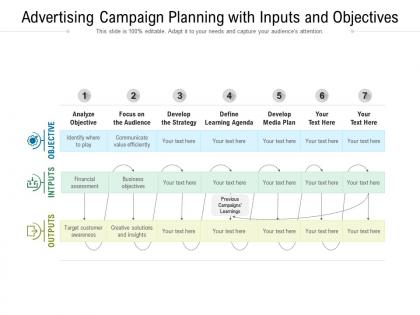
Advertising campaign planning with inputs and objectives




Try Before you Buy Download Free Sample Product
 Impress Your
 Audience
 100%
100% Editable
 Save Hours
 of Time


Our Advertising Campaign Planning With Inputs And Objectives are topically designed to provide an attractive backdrop to any subject. Use them to look like a presentation pro.
People who downloaded this PowerPoint presentation also viewed the following :
Advertising campaign planning with inputs and objectives with all 2 slides:
Use our Advertising Campaign Planning With Inputs And Objectives to effectively help you save your valuable time. They are readymade to fit into any presentation structure.
FAQs for Advertising campaign planning with
Essential advertising campaign components include target audience analysis, clear objectives, compelling messaging, strategic media selection, budget allocation, creative development, and performance metrics. These elements work together by ensuring focused targeting, consistent brand communication, and optimal resource distribution across channels, with many organizations finding that comprehensive planning ultimately delivers higher engagement rates, improved ROI, and stronger market positioning.
Market research informs advertising strategy by identifying target demographics, analyzing competitor approaches, revealing consumer preferences, and determining optimal messaging channels. Through surveys, focus groups, and data analytics, businesses can craft campaigns that resonate with specific audiences, allocate budgets more effectively, and ultimately deliver higher engagement rates and conversion outcomes.
Target audience segmentation enables marketers to create highly personalized campaigns by dividing broader markets into distinct groups based on demographics, behaviors, interests, and purchasing patterns. This strategic approach allows companies to tailor messaging, select optimal channels, and allocate budgets more effectively, with retail brands, financial services, and healthcare organizations finding that segmented campaigns deliver significantly higher engagement rates and conversion outcomes.
Social media platforms, search engines, television, radio, email marketing, and outdoor advertising each excel for different campaign objectives and target demographics. While B2B campaigns often find success through LinkedIn and email marketing, consumer brands leverage Instagram and TikTok for engagement, with many organizations discovering that strategic channel combinations deliver significantly higher ROI than single-platform approaches.
Setting measurable advertising objectives involves defining specific, quantifiable goals like brand awareness percentages, lead generation targets, conversion rates, sales revenue increases, and customer acquisition costs. These metrics should align with broader business goals through SMART criteria, with many companies finding that combining reach metrics with performance indicators like cost-per-acquisition and return-on-ad-spend delivers comprehensive campaign accountability and optimization opportunities.
Key metrics for evaluating campaign success include reach, impressions, click-through rates, conversion rates, cost per acquisition, return on ad spend, and brand awareness lift. These metrics enable organizations to assess performance by tracking audience engagement, measuring financial efficiency, and optimizing resource allocation, with many marketing teams finding that combining multiple metrics delivers comprehensive campaign insights and competitive advantage.
**INPUT**: How can you ensure your messaging aligns with brand identity? **OUTPUT**: Ensuring messaging aligns with brand identity requires establishing clear brand guidelines, conducting regular message audits, and maintaining consistent voice across all channels and touchpoints. Companies like Nike and Apple achieve this alignment by developing comprehensive brand standards that govern tone, visual elements, and core messaging themes, ultimately delivering cohesive customer experiences that strengthen brand recognition and competitive positioning. **Word count: 58 words**
Advertising campaign performance tracking tools include Google Analytics, Facebook Ads Manager, Adobe Analytics, HubSpot, and Hootsuite Insights. These platforms enhance campaign optimization by monitoring real-time metrics, analyzing audience engagement, and measuring conversion rates across multiple channels, with many marketing teams finding that integrated analytics ultimately deliver deeper customer insights and improved ROI.
Effective budget allocation involves analyzing audience demographics, platform performance metrics, campaign objectives, and historical ROI data to distribute resources strategically. Through systematic testing and optimization, advertisers prioritize high-performing channels like social media, search engines, and display networks, while maintaining diversification to minimize risk, ultimately maximizing reach and conversion rates across their target markets.
When selecting a creative team for your campaign, consider expertise in your industry, portfolio alignment with brand aesthetics, collaborative communication skills, budget compatibility, and proven track record with similar project scales. These factors ensure seamless integration with marketing objectives, while many organizations find that teams experienced in their sector deliver more targeted messaging, faster turnaround times, and ultimately stronger campaign performance.
Seasonal trends significantly impact advertising campaign planning by influencing consumer behavior, purchase timing, and market demand patterns throughout the year. Retail brands align holiday promotions with peak shopping seasons, while travel companies optimize summer campaigns, and financial services leverage tax season opportunities, ultimately delivering higher engagement rates and maximized ROI through strategic timing.
Strategies for cross-channel consistency include unified brand guidelines, centralized content management systems, coordinated messaging calendars, standardized visual templates, and integrated campaign workflows. These approaches streamline communication by ensuring consistent tone, timing, and visual identity across platforms, with many retail and financial services organizations finding that coordinated messaging delivers stronger brand recognition and improved customer engagement rates.
Storytelling engages audiences by creating emotional connections, building brand authenticity, and making complex messages memorable through relatable narratives. Through compelling character arcs and conflict resolution, companies like Nike and Dove transform product features into inspiring journeys, ultimately driving deeper customer loyalty and significantly higher engagement rates than traditional advertising approaches.
Common pitfalls include inadequate audience research, unclear messaging, poor budget allocation, insufficient competitive analysis, and lack of measurable objectives. These oversights significantly impact campaign effectiveness, with many marketers finding that strategic planning phases, comprehensive market analysis, and defined success metrics ultimately deliver higher ROI, better audience engagement, and stronger brand positioning across channels.
Incorporating feedback mid-flight involves monitoring real-time performance metrics, analyzing audience engagement data, and conducting stakeholder reviews to identify optimization opportunities. Through agile campaign management, marketers can adjust targeting parameters, reallocate budgets across high-performing channels, and refine creative messaging, with many organizations finding that these strategic pivots significantly enhance ROI and campaign effectiveness.
-
Best way of representation of the topic.
-
Wonderful templates design to use in business meetings.
-
Much better than the original! Thanks for the quick turnaround.
-
Excellent Designs.
-
Excellent Designs.