


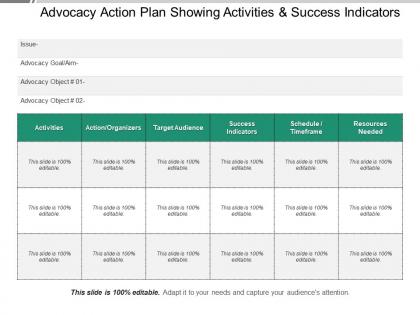
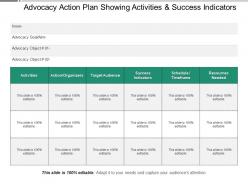
Advocacy action plan showing activities and success indicators




Try Before you Buy Download Free Sample Product
 Impress Your
 Audience
 100%
100% Editable
 Save Hours
 of Time


Facilitate change and development of new areas of policy using Advocacy Action Plan Showing Activities And Success Indicators slide. Mention steps to create an advocacy message for your audience and help to reach the desired goal. Make your presentation informative and reliable by highlighting the principles of advocacy charter using this advocacy plan PPT template. You can plan your advocacy campaign and accomplish your specific goal using this ready to use advocacy campaign plan PowerPoint graphic. Learn how to properly plan for advocacy and increase your chances of success with the help of our strategic framework template. Also, highlight key steps of strategy formulation and include issue selection framework by taking the assistance of our PowerPoint slide. Mention the objectives of advocacy and develop a strategic matrix in order to identify and analyze the issue. Thus download this practical and conceptualized advocacy intervention strategy presentation and help to defend and safeguard the rights of people.
People who downloaded this PowerPoint presentation also viewed the following :
Advocacy action plan showing activities and success indicators with all 5 slides:
Our Advocacy Action Plan Showing Activities And Success Indicators ensure foolish errors don't ever effect you. They help guard against any.

FAQs for Advocacy action plan showing activities
Honestly, relationships come first - can't stress that enough. Figure out what your coworkers and bosses actually care about, then connect your cause to their goals. Executives eat up data, so bring numbers whenever you can. Coffee chats work way better than formal meetings, trust me on this one. Find people internally who'll back you up and spread the word. Document stuff and follow up (but don't be that person who's constantly pestering). Oh, and be ready to compromise - the all-or-nothing approach rarely works in corporate land.
Social media basically acts like a megaphone for your cause. Find out where your people actually hang out first - no point posting on TikTok if your audience is all on Facebook, you know? Hashtags help you jump into bigger conversations that are already happening. Instagram and TikTok are perfect for visual stuff that tells a story, while Twitter's better for quick updates and actually talking to politicians directly. Partner with influencers who genuinely care about your issue. Authenticity matters here - people spot fake advocacy instantly and it backfires. Most importantly, create content that makes people want to hit "share" and encourage supporters to tell their own stories too.
Dude, storytelling is everything in advocacy. People connect with stories way more than boring stats - like they'll remember Maria losing her healthcare but totally forget whatever percentage you threw at them. Abstract issues become real when you put a face on them. Your audience starts thinking "oh shit, that could be me." Data matters, obviously, but emotions drive action. The trick is getting authentic stories from the actual communities you're working with. Don't make stuff up. Then sprinkle those stories throughout your whole campaign - makes everything way more powerful.
Honestly, data transforms your advocacy from just another opinion into something people can't really argue with. Find solid stats that show how big the problem is and track changes over time. Prove your solution worked somewhere else - that's huge. I mean, emotional stories matter too, but numbers grab attention differently. Visual stuff like charts beat boring paragraphs every time. Double-check everything though because one bogus statistic will wreck your whole credibility. Oh, and stick to reputable sources obviously. People notice when you're citing sketchy websites.
Most campaigns crash because people skip the basics, honestly. Your messaging needs to be crystal clear - and I mean speak to what THEY care about, not just what fires you up. Get key players bought in early or you're screwed. I've watched too many good causes die because someone thought they could muscle through without allies. Timing matters huge. Sometimes you gotta wait for the right moment instead of banging your head against a wall. Map out who actually makes decisions. Oh, and practice explaining your cause in like 30 seconds - you'll need it constantly.
Dude, you definitely want to team up with nonprofits - they've got networks and policy connections that would take you forever to build yourself. Politicians actually pay attention when multiple groups are pushing the same agenda instead of just one person. You get access to all their research and data too, which is honestly a huge time-saver. I'd start by figuring out which organizations are already fighting for your cause. Their credibility automatically rubs off on you, and you're not reinventing the wheel trying to become an expert on everything yourself.
Honestly, you need both the hard numbers and the softer stuff to really know if it's working. Before you launch anything, get your baseline measurements down - then watch for policy changes, media coverage, web traffic, petition signatures, social engagement, all that. But don't ignore the qualitative side either. Stakeholder feedback and public opinion shifts are tougher to track but super valuable. Pick maybe 3-5 key things to check monthly instead of drowning in data. Oh, and focus on metrics that actually tie to your goals, not just what looks impressive on paper.
Lead with your best stuff right away - hook them with solid data or a story that hits hard. Map out your argument so it flows, but don't dodge the obvious counterpoints. Hit those head-on instead. Clean visuals help tons, just don't make them text-heavy nightmares. Nobody wants to read paragraphs on slides. You need that emotional punch backed by real facts. Practice until you sound natural, not like you're reading a script. Honestly, this is where most people mess up - they get too formal and lose their audience. Wrap up with super clear action steps. Make it stupid-easy for them to actually do something about it.
Honestly, it all comes down to trust - people won't support your cause if they feel like you don't get them. Listen first before jumping in with solutions. Learn how different communities actually prefer to communicate and organize. I've watched so many campaigns crash and burn because they felt preachy or like outsiders telling people what's best for them. Partner with community members from the start, don't just treat them as the people you're "helping." When you understand cultural values and historical context, your messaging hits different. People can tell when you've done your homework vs. when you're winging it.
Honestly, the key is staying passionate without twisting facts or cherry-picking data to make your point stronger. Listen to opposing views - even when they're infuriating. Demonizing people rarely works anyway. Be upfront about who's funding you and what conflicts you might have. This might sound obvious, but actually listen to the communities you're fighting for instead of talking over them. I've seen too many advocates lose credibility by cutting corners. Do a quick gut check on your current approach - are you building trust or just preaching to the choir? Sustainable change takes time.
Yeah so Boomers are all about the old-school stuff - writing letters, making phone calls, meeting politicians face-to-face. Gen X mixes it up with both digital and offline tactics. Millennials and Gen Z? They're basically living on social media for this stuff. TikTok activism is wild honestly - Gen Z can make literally anything go viral overnight. My cousin started some petition on there last month and it blew up in like 2 days. Anyway, you've gotta figure out where your audience actually hangs out and work with that instead of trying to drag them somewhere they don't wanna be.
Honestly, grassroots stuff is where the real power is. Politicians can brush off lobbyists, but they can't ignore actual voters from their district calling and showing up. Look at basically every major change we've seen - civil rights, environmental laws, marriage equality - it all started with regular people getting pissed off and organizing locally. My friend works in policy and she always says the community groups are way more effective than the fancy DC consultants. Politicians hate when their phones won't stop ringing from constituents. So yeah, if you're trying to change anything, find those local groups and help them get loud about it.
Start by mapping out who actually makes decisions vs who just talks loudly. Coffee chats with 3-5 key people work way better than formal meetings - I learned this the hard way. Relationships matter more than perfect talking points, honestly. Maybe 70/30 split there? Don't wait until you're desperate to start building connections. The person who seems impossible today might totally flip if their district's priorities change. Always bring solutions, not just complaints. Oh, and find common ground with people who don't naturally agree - those wins hit different.
Think of influencers as your message megaphone - they hit audiences you can't reach and bring real credibility. First step? Find people whose values actually match your cause. Don't just ask them to post about you (ugh, so obvious). Offer genuine partnerships instead. Honestly, micro-influencers crush it way harder than celebrities. Their 10K-100K followers actually trust them and engage like crazy. Let them tell your story their way - creative freedom is everything. Oh, and start by stalking who's already talking about similar issues, then slide into those DMs.
Honestly, start with social media for content that spreads itself - way easier than you think. Email automation is clutch for targeted messages, and Change.org type platforms work great for quick signature gathering. Text messages get opened like 90% of the time vs emails, which is insane. You can host virtual events too without worrying about location stuff. But here's the thing - don't try everything at once. Pick maybe 2-3 tools and actually get good at them. I've seen people burn out trying to be everywhere.
-
Commendable slides with attractive designs. Extremely pleased with the fact that they are easy to modify. Great work!
-
Appreciate the research and its presentable format.