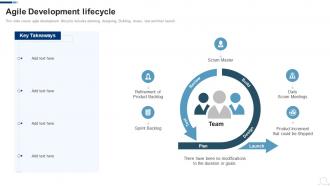
Agile Development Lifecycle Agile Project Management Frameworks
Try Before you Buy Download Free Sample Product
Audience
Editable
of Time
This slide covers agile development lifecycle includes planning, designing, Building, review, test and then launch
People who downloaded this PowerPoint presentation also viewed the following :
Agile Development Lifecycle Agile Project Management Frameworks with all 6 slides:
Use our Agile Development Lifecycle Agile Project Management Frameworks to effectively help you save your valuable time. They are readymade to fit into any presentation structure.
FAQs for Agile Development Lifecycle Agile
So Agile has four main ideas: people matter more than rigid processes, actual working software beats endless documentation, collaborating with customers trumps strict contracts, and adapting to change instead of sticking to inflexible plans. Traditional waterfall is like planning your entire vacation down to the minute - sounds great until everything goes sideways. With Agile, you work in short sprints and get feedback constantly. Build something, test it, adjust. When requirements change (and they always do), you can pivot instead of being stuck. Try starting with daily check-ins and two-week sprints to see how it feels.
Pick whatever framework matches how your team actually works - Scrum's great for structure, Kanban if you want that continuous flow thing. Don't overthink it though. Just start with basic stuff: daily standups, retros, planning sessions. Make a simple board and define what "done" means for your specific work. You can always tweak later, honestly. Most teams I've seen crash and burn because they try to nail everything perfectly right away instead of just... starting somewhere. Focus on being transparent with each other and actually doing something with those retrospective insights. The iteration part comes naturally once you get rolling.
You're the connection point between stakeholders and developers - defining what gets built and keeping priorities straight. Stay tight with your users and write stories they can actually understand. Be around for quick decisions during sprints. Please don't vanish for three weeks then return demanding everything changes (I've watched that trainwreck too many times). Keep grooming that backlog regularly. Show up to sprint reviews. Focus on outcomes instead of just checking boxes off a list. Trust your devs on the technical stuff - honestly, they know way more about the "how" than you do. Your job is nailing the "what" and "why."
Honestly, agile is pretty good at fixing those communication nightmares. Daily standups get everyone on the same page - developers, designers, testers, product people all actually talking instead of just tossing stuff over the wall. Sprint planning keeps things focused on shared goals. The short cycles mean you can change direction fast when (not if) priorities shift. Plus retrospectives help you figure out what's actually broken. Oh, and those 15-minute daily check-ins? Total game-changer if you're not doing them yet. Way better than finding out someone's been stuck for three days after it's too late.
Track your velocity first - story points per sprint and burndown charts. Cycle time's super helpful too. Customer satisfaction scores matter way more than internal metrics though, honestly. Lead time from idea to deployment shows you the whole pipeline. Team happiness is huge - unhappy devs write crappy code, so don't skip those retrospective action items. Oh, and actually shipping working software obviously. Start with maybe 2-3 metrics that hit your biggest problems right now instead of going overboard with tracking everything.
Honestly, you're gonna live in video calls now - daily standups, sprint planning, the whole thing. Get cozy with Jira or Trello for tracking everything. Miss those random desk chats already, don't you? Since you can't just walk over and ask questions, document way more than you think you need. Async communication works great for retros. I'd suggest shorter sprints at first to keep everyone engaged. Set some overlap hours for when the team really needs to collaborate together. Oh, and update your Definition of Done - handoffs need way better docs now.
Honestly, most of the headaches come from people, not process. Cultural resistance hits hard - everyone freaks out when you change how they've always worked. Your teams suddenly need to talk way more than before, which sounds simple but isn't. Management struggles to stop micromanaging every deadline (old habits die hard, I guess). Plus departments hate the constant feedback loops if they're used to just throwing stuff over the fence. The actual technical parts? Usually pretty straightforward. My advice: pick one small team first, nail a few wins, then slowly expand. Don't go full company transformation right away - that's a disaster waiting to happen.
Make retrospectives actually matter - pick ONE thing to fix each sprint instead of just complaining about everything. Most teams talk but never act on anything, which is honestly why retros get such a bad rap. After your next one, block off 30 minutes right then and there to implement whatever you decided on. Track if your experiments work. Mix in some lunch-and-learns or send people to conferences when you can. The trick is weaving learning into regular work instead of treating it like this separate thing you'll "get to eventually." Short bursts work better than big initiatives anyway.
Dude, agile is such a breath of fresh air for customer feedback. You're not stuck waiting months to find out what people actually think - you get input every sprint and can fix things right away. Every 2-4 weeks you're shipping working software, so customers see real stuff and give you feedback that matters. Way better than waterfall where you'd disappear for a year only to find out customers hated everything (been there, it sucks). The constant iteration lets you pivot fast when feedback shows you're going the wrong direction. Seriously, start doing customer demos after every sprint - that's where you'll see the real value.
Honestly, Agile's biggest win is catching problems early before they spiral. You're shipping working stuff every few weeks, so issues surface when they're still cheap to fix. Daily standups help spot blockers fast. The whole iterative thing means you're getting real user feedback instead of building something nobody actually wants - learned that lesson the hard way! Sprint reviews and retros keep you adapting as you go. My advice? Put your scariest risks right in the backlog and tackle them first. Way better than discovering deal-breakers at the end.
For project management, grab something like Jira or even just Trello if you're starting simple. Slack's basically essential for staying in touch between meetings. Git with GitHub is a must-have - seriously, there's no way around version control anymore. CI/CD stuff like Jenkins will save you tons of headaches later, though honestly we didn't set that up until month three and survived. The real trick isn't picking the perfect tools though. It's getting everyone to actually stick with whatever you choose instead of going rogue.
Yeah totally! Marketing teams love this stuff - they'll do 2-week campaign sprints instead of coding ones. Manufacturing uses it too, which honestly surprised me at first. The daily standup thing works everywhere... just becomes "what's blocking you today" instead of tech jargon. HR departments are crushing it with agile retrospectives. Short cycles, quick feedback, cross-team collaboration - same principles, different context. I'd say start with one small project, maybe weekly check-ins, and you'll see how much easier it gets to change direction when things aren't clicking.
Honestly, DevOps is a game changer for Agile teams. It automates deployments so you're not manually pushing code every sprint - which, let's be real, nobody has time for. Your dev and ops people actually start talking to each other instead of throwing things over the fence. Issues get caught way earlier too. The feedback loops get so much faster, and isn't that what Agile's supposed to be about anyway? With CI/CD, your sprint work can go live immediately instead of rotting in some queue. You'll iterate based on real user feedback instead of guessing. My advice? Start with automating your tests first. See how much time that saves before diving into the fancy stuff.
So agile works with changing requirements by using these short sprints - like 1-2 weeks each. You can pivot fast when stuff changes. The backlog stays flexible, so stakeholders can shuffle priorities between sprints based on whatever new info comes up. Those sprint reviews are clutch - you're showing actual working software and getting feedback constantly. Way better than finding out you built the wrong thing months later, right? Don't plan everything upfront (spoiler: it never works anyway). Instead of treating requirements like they're set in stone, think of them more like educated guesses. Short cycles mean you're always course-correcting.
Start with psychological safety - people need to feel okay screwing up and speaking their minds. Those daily standups? Turn them into actual conversations instead of robotic status updates (god, we've all suffered through those). Get your team doing pair programming so knowledge spreads naturally. Celebrate wins AND failures as learning moments. Actually fix real problems in retrospectives, not just surface fluff. Here's the key though - you gotta go first. Admit when you're lost or messed something up. Your team will follow suit once they see you're human too.
-
I joined SlideTeam last month and there’s no doubt that I tend to find our bond only strengthening over time. Best place to find world-class themes, templates, and icons.
-
Great quality product.