

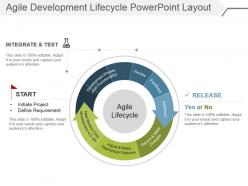
Agile development lifecycle powerpoint layout





Try Before you Buy Download Free Sample Product
 Impress Your
 Audience
 100%
100% Editable
 Save Hours
 of Time


Our Agile Development Lifecycle Powerpoint Layout are topically designed to provide an attractive backdrop to any subject. Use them to look like a presentation pro.
People who downloaded this PowerPoint presentation also viewed the following :
Agile development lifecycle powerpoint layout with all 5 slides:
Use our Agile Development Lifecycle Powerpoint Layout to effectively help you save your valuable time. They are readymade to fit into any presentation structure.

FAQs for Agile development
Agile development lifecycle phases include planning, design, development, testing, deployment, and review, executed in iterative sprints rather than sequential stages. Unlike traditional waterfall methodologies, Agile enables continuous collaboration, frequent feedback loops, and adaptive responses to changing requirements, with many software teams finding that this iterative approach delivers faster time-to-market and enhanced customer satisfaction.
Iterative development enhances the Agile lifecycle by enabling continuous refinement through repeated cycles, incorporating feedback loops, and delivering working software incrementally rather than in one final release. This approach allows teams to adapt quickly to changing requirements, reduce project risks, and maintain stakeholder engagement throughout development, with many software companies finding that iterative cycles ultimately deliver higher-quality products and improved customer satisfaction.
Agile ceremonies like daily stand-ups, sprint planning, retrospectives, and sprint reviews serve as structured communication touchpoints that maintain team alignment, identify blockers, and drive continuous improvement throughout the development lifecycle. These ceremonies enable teams to adapt quickly to changing requirements, enhance collaboration between developers and stakeholders, and ultimately deliver higher-quality software faster, with many organizations finding that consistent ceremony practices significantly reduce project risks and improve delivery predictability.
Teams effectively prioritize their backlog through value-based ranking, stakeholder collaboration, MoSCoW method classification, story point estimation, and regular refinement sessions. These approaches enable product owners and development teams to focus on high-impact features first, while customer feedback and sprint retrospectives ensure continuous alignment with business objectives, ultimately delivering maximum value.
Agile collaboration techniques include daily stand-ups, pair programming, cross-functional team structures, sprint retrospectives, and shared digital workspaces. These approaches streamline communication by fostering transparency, encouraging knowledge sharing, and maintaining continuous feedback loops, with many software development teams finding that regular face-to-face interactions and collaborative planning sessions ultimately deliver faster project completion and enhanced product quality.
Agile handles changing requirements through iterative sprints, continuous stakeholder feedback, and adaptive planning that embraces modifications rather than resisting them. This flexibility enables development teams to pivot quickly based on user insights, market shifts, and evolving business priorities, ultimately delivering products that better align with actual customer needs and competitive positioning.
Agile metrics like velocity and burndown charts enable project managers to track team productivity, predict delivery timelines, identify bottlenecks early, and maintain stakeholder transparency throughout development cycles. These measurement tools streamline resource allocation and sprint planning by providing data-driven insights, with many software development teams finding that consistent metric tracking ultimately delivers more predictable releases and enhanced client satisfaction.
Common pitfalls include inadequate sprint planning, poor stakeholder communication, scope creep, insufficient testing integration, and lack of retrospective follow-through. These challenges can be avoided by establishing clear definition-of-done criteria, maintaining regular client touchpoints, enforcing strict backlog prioritization, and implementing continuous integration practices, with many development teams finding that structured ceremonies and dedicated product ownership ultimately streamline delivery timelines and enhance product quality.
Stakeholder involvement significantly influences Agile project success by ensuring continuous feedback, aligning deliverables with business needs, and facilitating rapid course corrections throughout development cycles. Through regular sprint reviews, user story validation, and iterative input sessions, organizations achieve higher user adoption rates, reduced rework costs, and faster time-to-market, with many finding that engaged stakeholders ultimately deliver products that better meet market demands.
Tools supporting Agile development include Jira, Azure DevOps, Trello, Slack, Jenkins, and Git, which streamline project management, communication, and code integration. These platforms enhance productivity by automating sprint planning, facilitating real-time collaboration, and enabling continuous integration, with many software teams finding that integrated toolchains reduce development cycles and improve delivery quality.
Agile principles integrate with DevOps through continuous collaboration, automated testing, frequent deployments, and shared responsibility across development and operations teams. This strategic combination streamlines software delivery by enhancing communication, accelerating release cycles, and improving product quality, with many organizations finding that integrated Agile-DevOps approaches deliver faster time-to-market and enhanced operational efficiency.
Quality assurance strategies throughout the Agile lifecycle include continuous integration testing, automated test suites, test-driven development, sprint-based quality reviews, and cross-functional team collaboration. These approaches streamline quality control by embedding testing into each sprint cycle, enabling faster feedback loops, and maintaining consistent standards, with many software organizations finding that this integration ultimately delivers more reliable products and accelerated release timelines.
The Agile development lifecycle accommodates remote teams through digital collaboration tools, structured communication protocols, virtual daily standups, and cloud-based project management platforms. These frameworks enable distributed teams to maintain sprint cadences, conduct effective retrospectives, and ensure continuous integration, with many organizations finding that remote Agile practices enhance flexibility while delivering faster development cycles and improved team coordination.
Continuous feedback serves as the cornerstone of Agile development, enabling teams to validate assumptions, refine requirements, and adapt solutions through regular stakeholder reviews, sprint retrospectives, and user testing sessions. This iterative approach streamlines product development by identifying issues early, reducing costly rework, and ensuring deliverables align with business objectives, with many software teams finding that structured feedback loops ultimately accelerate time-to-market while enhancing user satisfaction.
Agile methodologies can be scaled through frameworks like SAFe, LeSS, and Scrum of Scrums, which coordinate multiple teams while maintaining core Agile principles. These approaches enable larger organizations to streamline delivery cycles, enhance cross-functional collaboration, and accelerate product releases, with many enterprises finding that structured scaling ultimately delivers improved alignment and faster time-to-market across complex initiatives.
-
Editable templates with innovative design and color combination.
-
Attractive design and informative presentation.
-
Perfect template with attractive color combination.