

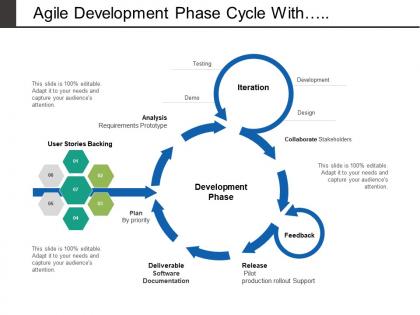
Agile development phase cycle with iteration collaborate and analysis




Try Before you Buy Download Free Sample Product
 Impress Your
 Audience
 100%
100% Editable
 Save Hours
 of Time


Our Agile Development Phase Cycle With Iteration Collaborate And Analysis are topically designed to provide an attractive backdrop to any subject. Use them to look like a presentation pro.
People who downloaded this PowerPoint presentation also viewed the following :
Agile development phase cycle with iteration collaborate and analysis with all 5 slides:
Use our Agile Development Phase Cycle With Iteration Collaborate And Analysis to effectively help you save your valuable time. They are readymade to fit into any presentation structure.


FAQs for Agile development phase cycle with iteration
The key phases of the Agile development cycle include planning, design, development, testing, deployment, and review, operating in iterative sprints with continuous feedback loops. These phases interact seamlessly through daily standups, sprint reviews, and retrospectives, enabling teams to adapt quickly to changing requirements while delivering functional software increments, ultimately enhancing product quality and customer satisfaction.
The Agile Manifesto guides decision-making by prioritizing individuals over processes, working software over documentation, customer collaboration over contracts, and responding to change over rigid plans. These principles enable development teams to make faster, more flexible decisions throughout sprints, with many organizations finding that this approach streamlines project delivery, enhances customer satisfaction, and ultimately delivers competitive advantage in rapidly evolving markets.
User stories serve as the primary communication vehicle in Agile development, translating business requirements into actionable development tasks while maintaining focus on user value and outcomes. These concise, user-focused narratives drive sprint planning, prioritization, and acceptance criteria definition, with development teams across industries like fintech and healthcare finding that well-crafted stories streamline collaboration, reduce miscommunication, and ultimately deliver more targeted solutions.
Teams effectively measure progress during Agile development cycles through sprint burndown charts, velocity tracking, completed story points, and daily standup metrics that provide real-time visibility into workflow bottlenecks and team productivity. These measurement approaches enable project managers and development teams to identify delivery risks early, adjust resource allocation dynamically, and maintain consistent sprint commitments, ultimately delivering faster releases and improved stakeholder confidence.
Incorporating iterative feedback loops in Agile projects delivers enhanced product quality, reduced development risks, faster time-to-market, improved stakeholder alignment, and greater adaptability to changing requirements. These continuous feedback mechanisms enable teams to identify issues early, refine features based on real user input, and maintain strategic focus, with many organizations finding that regular iteration cycles ultimately streamline development while maximizing customer satisfaction.
Agile development addresses changing requirements through iterative sprints, continuous stakeholder feedback, and flexible planning that adapts to evolving business needs. Through regular retrospectives and sprint reviews, development teams can pivot quickly, incorporate new features, and adjust priorities, with many organizations finding that this responsiveness delivers faster time-to-market and enhanced customer satisfaction.
Common Agile development challenges include scope creep, inadequate stakeholder communication, inconsistent sprint planning, team resistance to change, and unclear requirements definition. These obstacles often arise when organizations transition from traditional waterfall methods, with many software teams finding that establishing clear communication protocols, consistent retrospectives, and stakeholder engagement ultimately delivers smoother iterations and improved project outcomes.
Cross-functional teams enhance Agile collaboration by bringing diverse expertise together, eliminating communication silos, accelerating decision-making, and ensuring shared accountability throughout development cycles. These teams streamline feedback loops, reduce handoff delays, and enable real-time problem-solving, with many organizations finding that integrated developers, designers, and stakeholders ultimately deliver higher-quality products faster.
Agile practices improve product quality through continuous testing, iterative feedback loops, regular code reviews, and incremental delivery cycles that catch defects early. These approaches enhance customer satisfaction by enabling rapid response to changing requirements, delivering working features frequently, and maintaining close collaboration throughout development, ultimately ensuring products align with actual user needs and market demands.
Agile development tools include Jira, Azure DevOps, Trello, Slack, and Git for project management, communication, and version control respectively. These technologies streamline sprint planning, backlog management, and team collaboration by automating workflows, enhancing transparency, and enabling real-time tracking, with many software organizations finding that integrated toolsets significantly accelerate delivery cycles while improving code quality.
Scrum differs from other Agile methodologies by using fixed sprints, defined roles like Scrum Master and Product Owner, and specific ceremonies including daily standups and sprint reviews. While Kanban focuses on continuous flow and Extreme Programming emphasizes technical practices, Scrum delivers structured iteration cycles that enhance team accountability and predictable delivery timelines.
Sprint planning and retrospectives serve as critical feedback loops that drive continuous improvement, team alignment, and adaptive project management within Agile frameworks. These ceremonies enable teams to set realistic goals, identify obstacles, and refine processes iteratively, with many software development organizations finding that structured planning and reflection cycles ultimately deliver faster product releases, enhanced team collaboration, and improved stakeholder satisfaction.
Agile methodologies adapt to remote teams through enhanced digital communication tools, virtual daily standups, cloud-based collaboration platforms, and structured online retrospectives. Distributed teams leverage video conferencing for sprint planning, digital kanban boards for transparency, and asynchronous communication channels, with many organizations finding that remote Agile actually improves documentation and cross-timezone collaboration.
Effective product backlog prioritization strategies include value-based ranking, MoSCoW method, story mapping, risk assessment, and stakeholder feedback integration. These approaches streamline development by focusing on high-impact features, minimizing technical debt, and aligning sprint goals with business objectives, with many agile teams finding that strategic prioritization ultimately delivers faster time-to-market and enhanced customer satisfaction.
Agile principles can be integrated with Waterfall through hybrid approaches like Water-Scrum-Fall, staged implementation, and selective methodology application based on project phases or components. Organizations in sectors like banking and healthcare successfully combine Waterfall's structured planning for regulatory requirements with Agile's iterative development cycles, ultimately delivering enhanced flexibility while maintaining necessary documentation and compliance standards.
-
Graphics are very appealing to eyes.
-
Awesomely designed templates, Easy to understand.
-
Understandable and informative presentation.
-
Use of icon with content is very relateable, informative and appealing.
-
Out of the box and creative design.