


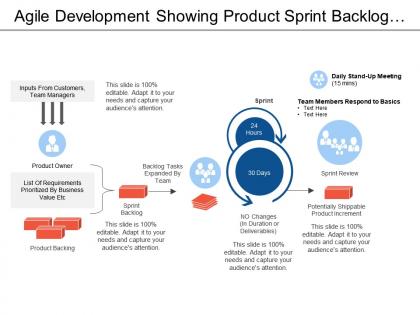
Agile development showing product sprint backlog with sprint review





Try Before you Buy Download Free Sample Product
 Impress Your
 Audience
 100%
100% Editable
 Save Hours
 of Time


Handle the dialogue with our Agile Development Showing Product Sprint Backlog With Sprint Review. Control the flow of any conversation.
People who downloaded this PowerPoint presentation also viewed the following :
Agile development showing product sprint backlog with sprint review with all 5 slides:
Get the benefit of acquiring the best available with our Agile Development Showing Product Sprint Backlog With Sprint Review. Be able to import expertise.




FAQs for Agile development showing product sprint backlog
The sprint backlog serves as a detailed, actionable plan that guides development teams through specific tasks needed to achieve sprint goals, ensuring focused execution and transparent progress tracking. It enables teams to break down user stories into manageable work items, facilitating daily coordination and adaptive planning, while ultimately delivering incremental value and maintaining alignment with broader project objectives.
A sprint backlog contains specific items selected from the product backlog for completion during a single sprint, typically 2-4 weeks, with detailed tasks and acceptance criteria defined by the development team. While product backlogs maintain the entire project's prioritized features and requirements, sprint backlogs focus on immediate deliverables, enabling teams to streamline development cycles, enhance sprint planning accuracy, and ultimately deliver incremental value more efficiently.
A sprint backlog should include prioritized user stories with clear acceptance criteria, task breakdowns with time estimates, definition of done standards, dependencies between tasks, and identified risks or blockers. These elements enable development teams to maintain focus, track progress effectively, and deliver value incrementally, with many agile organizations finding that well-structured backlogs significantly enhance sprint predictability and team accountability.
Teams effectively prioritize sprint backlog tasks by considering business value, technical dependencies, risk factors, effort estimation, and stakeholder urgency. Through collaborative discussions during sprint planning, teams assess each task's impact on sprint goals, identify blocking relationships, and sequence work to maximize delivery value, while maintaining flexibility to adjust priorities as new information emerges throughout the sprint cycle.
The Definition of Done serves as a quality benchmark that determines when sprint backlog items are truly complete, ensuring consistent standards across development teams, reducing rework, and preventing incomplete features from being considered finished. This shared understanding streamlines sprint planning, enhances team accountability, and ultimately delivers higher-quality products while minimizing technical debt accumulation.
Sprint backlogs should be reviewed daily during stand-up meetings and updated whenever new information emerges, task progress changes, or impediments arise. Through continuous monitoring and transparent communication, agile teams can quickly adjust priorities, reallocate resources, and address blockers, ultimately ensuring sprint goals remain achievable while maintaining team alignment and delivery momentum.
Effort estimation techniques for sprint backlog tasks include story points, planning poker, T-shirt sizing, ideal hours, and relative sizing methods. These approaches enable teams to assess task complexity, duration, and resource requirements through collaborative discussion, historical data analysis, and comparative evaluation, with many agile teams finding that combining multiple techniques delivers more accurate estimates and improved sprint planning outcomes.
Teams ensure realistic sprint backlogs through accurate story point estimation, velocity-based capacity planning, and breaking down large user stories into manageable tasks during sprint planning. Regular retrospectives and daily standups enable continuous adjustment, while buffer time allocation and stakeholder collaboration help teams maintain achievable commitments, ultimately delivering consistent value and building sustainable development momentum.
A sprint backlog facilitates team collaboration by providing shared visibility into task ownership, progress tracking, and daily priorities through centralized documentation and regular updates. This transparency enables seamless coordination between developers, testers, and product owners, with many agile teams finding that real-time backlog management streamlines communication, reduces bottlenecks, and ultimately delivers faster project completion and enhanced team accountability.
Sprint backlogs enable teams to identify risks through regular story assessment, dependency mapping, and velocity tracking during daily standups and sprint planning sessions. By breaking down complex features into smaller tasks, teams can spot technical dependencies, resource constraints, and scope creep early, allowing for proactive mitigation strategies that maintain sprint goals and delivery timelines.
Teams face challenges including unclear user stories, scope creep mid-sprint, inaccurate effort estimation, poor stakeholder communication, and inadequate backlog refinement processes. These obstacles can derail sprint planning by creating unrealistic commitments, shifting priorities, and resource allocation issues, with many agile teams finding that proactive backlog grooming and stakeholder alignment ultimately delivers more predictable sprint outcomes.
**INPUT**: How do changes in scope impact the sprint backlog during an ongoing sprint? **OUTPUT**: Changes in scope typically require careful evaluation during ongoing sprints, as they can disrupt team velocity, compromise planned deliverables, and affect resource allocation. Teams generally assess whether new requirements align with sprint goals, often deferring non-critical changes to future sprints while accommodating urgent adjustments through collaborative discussion, ultimately maintaining delivery predictability and team focus.
Popular sprint backlog management tools include Jira, Azure DevOps, Trello, Asana, and Monday.com, each offering features like task tracking, burndown charts, and team collaboration capabilities. These platforms streamline sprint planning by enabling real-time updates, automated workflow management, and comprehensive reporting, with many development teams finding that integrated tools significantly enhance transparency and delivery speed.
Teams should handle unfinished tasks by reviewing them during the sprint retrospective, analyzing why they weren't completed, and deciding whether to return them to the product backlog or carry them forward. Through careful evaluation of scope, complexity, and priorities, organizations can refine their estimation processes, adjust capacity planning, and improve sprint planning accuracy, ultimately delivering more predictable outcomes and enhanced team performance in future iterations.
**INPUT**: What strategies can enhance the visibility and transparency of the sprint backlog for stakeholders? **OUTPUT**: Strategies include digital dashboards, real-time burndown charts, automated progress tracking, regular stakeholder reviews, and collaborative sprint planning sessions. These approaches streamline communication by centralizing backlog status, enabling immediate progress visibility, and facilitating continuous stakeholder engagement, with many organizations finding that enhanced transparency ultimately delivers improved project alignment and faster decision-making across teams.
-
Innovative and Colorful designs.
-
Professional and unique presentations.