


Agile estimation priority improvement evaluate prototype development migration




Try Before you Buy Download Free Sample Product
 Impress Your
 Audience
 100%
100% Editable
 Save Hours
 of Time


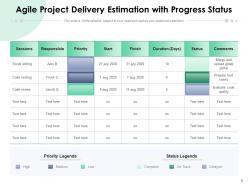
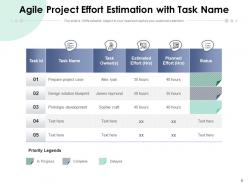
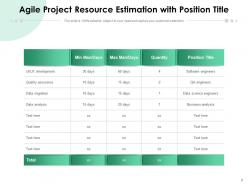
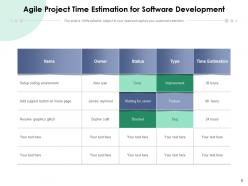
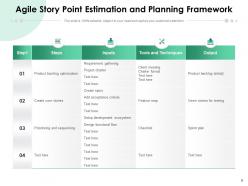
The technique of estimating the effort necessary to perform a priority item in the product backlog is known as agile estimate. This effort is typically assessed in terms of the time required to finish the work, which leads to proper sprint planning. Agile teams also create estimates based on narrative points. In Agile Development projects, a story point is used to quantify the complexity of implementing a specific user story. This is quantified in relative units given to various user stories requiring estimate. Agile project estimating also aids in the development of good coordination. Agile project estimate offers an overview of the wait time if project X is reliant on project Y. SlideTeam’s agile technology PowerPoint templates can help you evaluate prototype development migration and improve Agile estimation priority. Available for download now, our templates provide an extensive set of tools to help you create beautiful, professional presentations. With our templates, you can communicate your ideas clearly and effectively, making it easier to get your team on board with agile methodology. Don’t miss out – download our templates today.
People who downloaded this PowerPoint presentation also viewed the following :
Agile estimation priority improvement evaluate prototype development migration with all 12 slides:
Use our Agile Estimation Priority Improvement Evaluate Prototype Development Migration to effectively help you save your valuable time. They are readymade to fit into any presentation structure.


FAQs for Agile estimation priority improvement evaluate
Agile estimation principles include collaborative team-based estimation, relative sizing over absolute time predictions, iterative refinement through retrospectives, embracing uncertainty with ranges, and focusing on delivering value rather than meeting fixed deadlines. These approaches streamline project planning by leveraging collective team knowledge, adapting estimates based on actual delivery data, and maintaining flexibility in an increasingly dynamic business environment, ultimately delivering more accurate forecasts and enhanced project outcomes.
User stories serve as the fundamental units of estimation in Agile by providing detailed requirements that teams can evaluate for complexity, effort, and time needed. These stories enable teams to apply techniques like story points, planning poker, and relative sizing, with many development organizations finding that well-written user stories significantly streamline sprint planning and enhance delivery predictability.
Common Agile estimation techniques include Planning Poker, T-shirt sizing, Story Points, the Fibonacci sequence, Dot Voting, and Affinity Estimation. These methodologies streamline sprint planning by enabling collaborative consensus, reducing estimation bias, and accommodating uncertainty inherent in software development, with many teams finding that relative sizing delivers more accurate forecasts than traditional time-based approaches.
Teams ensure consistent, reliable estimates by establishing standardized estimation techniques like story points or t-shirt sizing, conducting regular retrospectives to analyze estimate accuracy, and maintaining historical data for reference. Through collaborative estimation sessions, velocity tracking, and continuous refinement of their estimation process, teams develop improved forecasting capabilities, ultimately delivering more predictable project timelines and enhanced stakeholder confidence.
Team velocity significantly impacts Agile estimation by providing historical data for sprint planning, enabling more accurate story point allocation, and helping teams calibrate their capacity forecasting. Through consistent velocity tracking, teams can better predict deliverable scope, adjust estimation techniques based on performance patterns, and communicate realistic timelines to stakeholders, ultimately delivering more reliable project commitments and improved planning accuracy.
Technical debt and external dependencies significantly impact Agile estimation accuracy by introducing unpredictable variables that teams cannot fully control or quantify upfront. Technical debt creates hidden complexity requiring additional refactoring time, while external dependencies introduce delays and coordination overhead that vary based on third-party responsiveness, with many development teams finding that buffer allocation and frequent re-estimation help maintain project momentum despite these uncertainties.
Stakeholder involvement in Agile estimation ensures accurate requirements understanding, realistic expectation setting, and enhanced buy-in through collaborative prioritization and feedback sessions. Through regular sprint reviews and planning meetings, stakeholders provide crucial business context, validate feature priorities, and help teams balance technical complexity with business value, ultimately delivering more aligned outcomes and reducing scope creep risks.
Agile teams incorporate feedback loops by regularly comparing actual versus estimated effort, conducting retrospectives after each sprint, and adjusting estimation techniques based on velocity trends. Through continuous refinement sessions, story point calibration meetings, and post-delivery reviews, teams enhance accuracy progressively, ultimately delivering more predictable timelines and improved project outcomes while building organizational confidence in their delivery capabilities.
Common Agile estimation pitfalls include over-engineering estimates, confusing effort with time, individual rather than team-based estimates, and estimating tasks too granularly. Teams frequently struggle by treating estimates as commitments rather than forecasts, with many organizations finding that focusing on relative sizing instead of precise predictions, embracing uncertainty, and regularly retrospecting on estimation accuracy delivers more reliable sprint planning and stakeholder confidence.
Agile estimation techniques adapt in distributed teams through digital planning poker tools, asynchronous estimation rounds, and virtual collaboration platforms that replicate in-person dynamics. Remote teams leverage video conferencing for real-time discussions, shared digital boards for transparency, and structured time-boxed sessions, ultimately maintaining estimation accuracy while enhancing global team participation and flexibility.
Strategies to improve estimation accuracy include implementing rolling wave planning, using story point relativization, conducting regular retrospective calibration sessions, maintaining detailed estimation tracking metrics, and establishing cross-functional team estimation workshops. These approaches enable teams to adapt quickly through iterative refinement, historical data analysis, and collaborative consensus building, with many organizations finding that combining multiple estimation techniques ultimately delivers more reliable project timelines and resource allocation in dynamic environments.
Teams can leverage historical data to enhance estimation processes through velocity tracking, story point analysis, cycle time measurements, and sprint retrospective insights. By analyzing past sprint performances, similar feature complexities, and team productivity patterns, organizations streamline planning accuracy, reduce estimation variability, and ultimately deliver more predictable project timelines and resource allocation.
Revisiting and revising estimates is absolutely critical in Agile development, as it enables teams to adapt to changing requirements, incorporate new insights, and maintain realistic project timelines throughout iterative cycles. This continuous refinement process enhances delivery predictability, improves resource allocation accuracy, and builds stakeholder confidence, with many development teams finding that regular estimate updates significantly reduce project overruns and deliver more successful outcomes.
Relative estimation in Agile compares task complexity rather than predicting absolute time, using techniques like story points, t-shirt sizing, and planning poker to reduce cognitive bias and improve accuracy. This approach enables teams to streamline sprint planning, enhance velocity tracking, and deliver more predictable project timelines, with many organizations finding that relative sizing ultimately provides greater flexibility and strategic insight than traditional time-based estimates.
Agile estimation scales through techniques like story point normalization across teams, planning poker sessions with team representatives, and t-shirt sizing for epic-level estimates. Large organizations implement estimation standards, cross-team calibration workshops, and portfolio-level planning approaches, with many finding that consistent velocity tracking and regular retrospectives enable better predictability and resource allocation across multiple development streams.
-
Slideteam has every design we’ll need for our work. Meetings feel less tedious now.
-
Enough space for editing and adding your own content.
-
Great experience, I would definitely use your services further.
-
Amazing product with appealing content and design.
-
Top Quality presentations that are easily editable.