

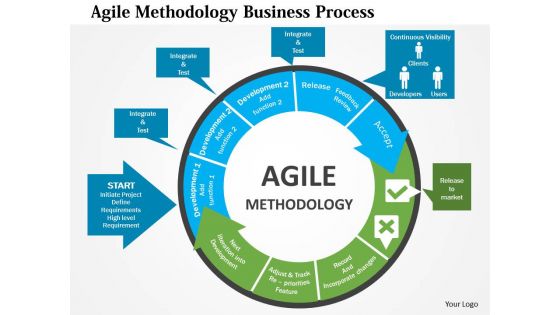
Agile methodology business process flat powerpoint design




Try Before you Buy Download Free Sample Product
 Impress Your
 Audience
 100%
100% Editable
 Save Hours
 of Time


Incorporate feedback actively in the process of designing software and development of other services by deploying agile methodology in the business processes that guide your operations and lay it out for the benefit of every person working in the organization and for the knowledge of new recruits through our elegant and very informative PowerPoint design. You would never have to worry about having to overhaul the entire framework guiding the design of apps, mobile technology products and software when you do course correction based on inputs from customers themselves and other teams working on the project- delineate the progressive and incremental nature of your design process through this PPT slide template, which is crafted specially to make your task of articulation of agility easy, as it can showcase all the key stakeholders involved, their position in the flow of information, responsibilities of various teams in the entire scheme of things and how the ultimate product will be eventually realized. Create exuberance with our Agile Methodology Business Process Flat Powerpoint Design. Give cause for great celebration.
People who downloaded this PowerPoint presentation also viewed the following :
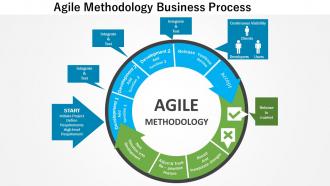
Agile methodology business process flat powerpoint design with all 5 slides:
Our Agile Methodology Business Process Flat Powerpoint Designare likethe dawn. Rays of knowledge will flood the hall.


FAQs for Agile methodology business process
Agile methodology emphasizes iterative development, customer collaboration, responding to change, and working software over comprehensive documentation, contrasting traditional project management's rigid planning and sequential phases. These principles enable teams to deliver value incrementally, adapt quickly to market feedback, and maintain continuous stakeholder engagement, with many organizations finding that this flexibility accelerates product delivery while reducing project risks.
Agile methodology enhances collaboration through daily stand-ups, sprint planning, retrospectives, and shared accountability across all team members. These practices streamline communication, eliminate silos, and enable real-time problem-solving, with many organizations finding that cross-functional teams deliver products faster and respond more effectively to changing requirements.
Agile prioritizes customer feedback through iterative sprints, regular reviews, continuous user testing, and direct stakeholder involvement in development cycles. These approaches enable teams to adapt quickly to changing requirements, incorporate real-time insights, and deliver products that better meet customer needs, with many organizations finding significantly improved customer satisfaction and faster time-to-market.
The most common Agile frameworks include Scrum, Kanban, Lean, Extreme Programming (XP), and SAFe (Scaled Agile Framework). These methodologies differ in their approach to sprint planning, team structure, and delivery cycles, with Scrum emphasizing fixed sprints and defined roles, while Kanban focuses on continuous flow and visual management, ultimately enabling organizations to choose frameworks that best align with their project complexity and team dynamics.
Sprints enhance project timelines by breaking work into focused 1-4 week cycles with clear deliverables, daily standups, and regular retrospectives, creating predictable rhythm and continuous improvement opportunities. This structured approach enables teams to deliver working software incrementally, respond quickly to changes, and maintain higher productivity through enhanced collaboration, with many software development organizations finding that sprint-based workflows reduce project risks while accelerating time-to-market significantly.
The Product Owner maximizes deliverable value by defining product vision, prioritizing the backlog based on business value, writing clear user stories, and making crucial decisions about feature trade-offs. Through continuous stakeholder collaboration and sprint review feedback, they ensure development efforts align with customer needs and market demands, ultimately delivering higher ROI and competitive advantage for organizations.
Organizations transition effectively by implementing gradual pilot programs, investing in comprehensive team training, restructuring workflows around iterative sprints, and establishing cross-functional collaboration frameworks. Through phased adoption, companies in sectors like software development, manufacturing, and financial services achieve faster delivery cycles, improved stakeholder feedback integration, and enhanced adaptability, ultimately delivering competitive advantage in increasingly dynamic markets.
Common Agile implementation challenges include resistance to cultural change, inadequate training, poor communication between teams, unrealistic sprint planning, and lack of stakeholder buy-in. These obstacles can be overcome through comprehensive team training, regular retrospectives, clear communication protocols, and gradual transition phases, with many organizations finding that dedicated Agile coaches and consistent leadership support ultimately deliver smoother adoption and improved project outcomes.
Agile methodology supports continuous improvement through regular retrospectives, iterative development cycles, and frequent feedback loops that enable teams to identify inefficiencies and adapt processes quickly. Through sprint reviews, daily standups, and collaborative planning sessions, teams in software development, marketing, and product management continuously refine their approaches, ultimately delivering higher quality outcomes and enhanced team performance.
**INPUT**: What metrics can be used to measure the success of Agile projects? **OUTPUT**: Agile project success metrics include velocity, sprint burndown rates, lead time, customer satisfaction scores, and defect rates. These measurements enable teams to track productivity, identify bottlenecks, and enhance delivery quality, with many organizations finding that combining quantitative data with qualitative feedback ultimately delivers improved project outcomes and competitive advantage. **Word count: 52 words**
Remote teams can successfully implement Agile practices through regular video standups, collaborative digital tools like Jira or Trello, and structured sprint planning sessions that accommodate different time zones. By establishing clear communication protocols, maintaining shared digital workspaces, and conducting virtual retrospectives, distributed teams enhance transparency and coordination, ultimately delivering faster project outcomes and stronger team cohesion across geographical boundaries.
User stories serve as fundamental building blocks in Agile development, capturing requirements from the user's perspective while defining functional needs, acceptance criteria, and business value. These narratives follow the "As a [user type], I want [functionality] so that [benefit]" format, enabling development teams to prioritize features effectively, facilitate clearer communication between stakeholders, and maintain focus on delivering meaningful outcomes that enhance user experiences and drive project success.
Agile methodology addresses risk management through continuous monitoring, iterative feedback loops, and adaptive planning, enabling early detection and mitigation of potential issues. Through regular sprints and stakeholder reviews, organizations can identify risks incrementally rather than discovering major problems late in development cycles, ultimately delivering more predictable outcomes and reducing project failure rates compared to traditional waterfall approaches.
Popular Agile project management tools include Jira, Trello, Azure DevOps, Asana, and Scrum-specific platforms like Rally and VersionOne. These technologies streamline sprint planning, backlog management, and team collaboration by automating workflow tracking, enhancing transparency across development cycles, and enabling real-time progress monitoring, ultimately delivering faster project completion and improved team productivity.
Team autonomy in Agile environments enhances project success by enabling faster decision-making, increasing ownership and accountability, and fostering creative problem-solving without bureaucratic delays. This approach streamlines development cycles, reduces bottlenecks, and improves team morale, with many software companies and product teams finding that autonomous teams deliver higher-quality results and adapt more quickly to changing requirements.
-
Informative design.
-
Illustrative design with editable content. Exceptional value for money. Highly pleased with the product.