

Agile Project Management Timeline For Software Development




Try Before you Buy Download Free Sample Product
 Impress Your
 Audience
 100%
100% Editable
 Save Hours
 of Time


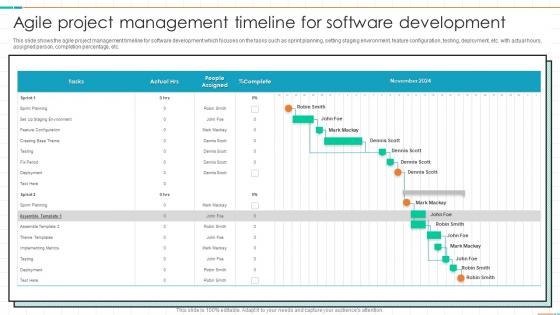
This slide shows the agile project management timeline for software development which focuses on the tasks such as sprint planning, setting staging environment, feature configuration, testing, deployment, etc. with actual hours, assigned person, completion percentage, etc.
People who downloaded this PowerPoint presentation also viewed the following :
Agile Project Management Timeline For Software Development with all 6 slides:
Use our Agile Project Management Timeline For Software Development to effectively help you save your valuable time. They are readymade to fit into any presentation structure.





FAQs for Agile Project Management Timeline
The key phases of Agile project management timeline include project initiation, sprint planning, daily standups, sprint execution, sprint review, and sprint retrospective. These phases streamline delivery by enabling continuous collaboration, iterative development, and regular feedback cycles, with many organizations finding that this structured yet flexible approach ultimately delivers faster time-to-market and enhanced customer satisfaction.
Agile timelines use iterative sprints typically lasting 1-4 weeks with continuous delivery, while traditional timelines follow sequential phases with fixed milestones and final delivery. Through shorter cycles, Agile enables faster feedback incorporation, reduced risk exposure, and enhanced adaptability to changing requirements, with many organizations finding that this approach ultimately delivers greater customer satisfaction and competitive responsiveness.
Sprints serve as time-boxed iterations that structure Agile project timelines, typically lasting one to four weeks, where teams focus on delivering specific increments of working software or features. These structured cycles enable teams to maintain consistent delivery momentum, adapt quickly to changing requirements, and provide regular stakeholder feedback opportunities, ultimately delivering predictable progress and enhanced project transparency across organizations.
Teams effectively estimate sprint time through story points, planning poker, historical velocity data, task breakdown structures, and team capacity planning. These estimation techniques streamline by incorporating past performance metrics, accounting for team availability and skill levels, and breaking complex features into manageable tasks, with many agile organizations finding that combining multiple methods delivers more accurate timelines and improved sprint predictability.
Critical Agile milestones include sprint planning sessions, sprint reviews, retrospectives, product backlog refinements, and release checkpoints. These milestones enable teams to maintain project momentum, assess deliverable quality, and adapt to changing requirements, with many organizations finding that consistent milestone tracking enhances stakeholder communication and ultimately delivers faster time-to-market advantage.
Backlog refinement occurs continuously throughout Agile sprints, typically consuming 10% of the team's capacity through ongoing story breakdown, estimation, and prioritization activities. This iterative process enables teams to maintain well-prepared sprint backlogs, reduce planning meeting duration, and adapt quickly to changing requirements, with many organizations finding that consistent refinement significantly improves sprint predictability and delivery outcomes.
Tools for visualizing Agile project management timelines include Gantt charts, Kanban boards, sprint burndown charts, release roadmaps, and velocity tracking dashboards. These visualization methods streamline project transparency by displaying sprint progress, identifying bottlenecks, and tracking deliverable timelines, with many development teams finding that comprehensive visual dashboards ultimately enhance stakeholder communication and delivery predictability.
Stakeholders can be engaged through regular sprint reviews, daily standups participation, continuous feedback loops, user story validation sessions, and retrospective meetings throughout the Agile timeline. These touchpoints enable organizations to maintain transparency, gather real-time input, and adapt project direction quickly, with many companies finding that consistent stakeholder involvement reduces project risks while delivering solutions that better meet business objectives.
Common pitfalls include overcommitting to unrealistic sprint goals, neglecting regular backlog refinement, inadequate stakeholder communication, and failing to account for technical debt or dependencies. These challenges often arise when teams prioritize speed over sustainable practices, with many organizations finding that maintaining flexible scope boundaries, conducting thorough retrospectives, and ensuring cross-functional collaboration ultimately delivers more predictable timelines and higher-quality outcomes.
Team velocity directly influences project timeline by determining sprint capacity, predicting delivery dates, and enabling accurate scope adjustments throughout development cycles. Higher velocity teams complete more story points per sprint, accelerating milestone achievements, while consistent velocity tracking helps project managers recalibrate timelines, manage stakeholder expectations, and optimize resource allocation for competitive delivery schedules.
Key metrics for Agile project timeline health include velocity, sprint burndown rates, cycle time, lead time, and cumulative flow diagrams. These measurements enable project managers to identify bottlenecks, predict delivery dates, and optimize team performance, with many organizations finding that consistent tracking ultimately delivers improved predictability and enhanced stakeholder confidence.
Changes in project scope can significantly impact Agile timelines by requiring sprint replanning, resource reallocation, and priority reassessments across development cycles. While Agile methodologies are designed to accommodate scope changes through iterative sprints and regular stakeholder feedback, teams must carefully balance new requirements with existing commitments, ultimately enabling more responsive project delivery and enhanced stakeholder satisfaction.
Strategies include sprint planning with realistic velocity estimates, daily standups for obstacle identification, continuous stakeholder feedback loops, scope prioritization through product backlogs, and regular retrospectives for process optimization. These approaches streamline delivery by maintaining team alignment, preventing scope creep, and enabling rapid course corrections, with many organizations finding that disciplined sprint cadences and stakeholder engagement ultimately deliver projects faster than traditional methods.
Retrospective meetings enhance future Agile timelines by identifying process inefficiencies, communication gaps, and workflow bottlenecks that impact sprint velocity and delivery predictability. Through structured reflection and team feedback, organizations streamline task estimation, improve collaboration patterns, and eliminate recurring obstacles, with many development teams finding that consistent retrospectives ultimately deliver more accurate timeline forecasting and enhanced project outcomes.
The product increment represents a working, potentially shippable version of the product delivered at the end of each sprint, serving as the primary measure of progress in Agile timelines. These increments enable continuous value delivery, stakeholder feedback integration, and risk mitigation through early detection of issues, with many organizations finding that regular increments accelerate time-to-market while maintaining quality standards.
-
Unique design & color.
-
The design is clean-cut, modern, and sleek, keeping the users' needs in mind. The multiple uses make this product worth every penny!