

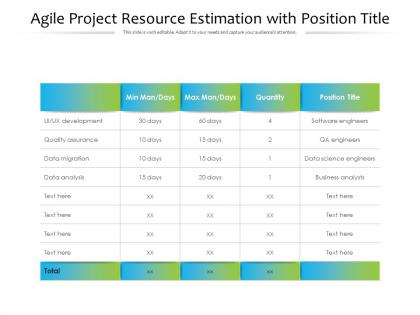
Agile project resource estimation with position title




Try Before you Buy Download Free Sample Product
 Impress Your
 Audience
 100%
100% Editable
 Save Hours
 of Time


Our Agile Project Resource Estimation With Position Title are topically designed to provide an attractive backdrop to any subject. Use them to look like a presentation pro.
People who downloaded this PowerPoint presentation also viewed the following :
Agile project resource estimation with position title with all 2 slides:
Use our Agile Project Resource Estimation With Position Title to effectively help you save your valuable time. They are readymade to fit into any presentation structure.
FAQs for Agile project resource estimation
Agile resource estimation principles include iterative planning, collaborative team involvement, story point sizing, velocity tracking, and continuous refinement based on actual delivery data. These approaches streamline project planning by emphasizing relative estimation over absolute predictions, incorporating team expertise, and adapting to changing requirements, ultimately delivering more accurate forecasts and enhanced project outcomes.
Agile methodologies enhance resource estimation accuracy through iterative planning, continuous feedback loops, and adaptive scope management, while traditional approaches often rely on upfront predictions with limited flexibility. Through sprint-based cycles and regular retrospectives, Agile teams refine estimates based on actual velocity and changing requirements, ultimately delivering more realistic project timelines and budget forecasts than waterfall methods.
Velocity and story points serve as foundational metrics for Agile resource estimation, with velocity measuring team delivery capacity over sprints and story points quantifying task complexity relative to effort required. These metrics enable project managers to predict sprint capacity, allocate resources strategically, and establish realistic timelines, with many development teams finding that consistent velocity tracking ultimately delivers more accurate project forecasting and improved resource optimization.
Teams improve estimation accuracy by tracking velocity patterns, conducting thorough retrospectives after each sprint, refining story points through team consensus, and maintaining detailed estimation records. Through consistent calibration sessions and honest post-sprint analysis, many development teams find that their estimation precision increases significantly over time, ultimately delivering more predictable sprint outcomes and enhanced project planning reliability.
Agile teams can use story point re-calibration, velocity trend analysis, burndown chart reviews, capacity planning adjustments, and retrospective-driven estimation updates for dynamic resource re-estimation. These techniques enable teams to adapt resource allocation by reassessing sprint capacity, adjusting team member availability, and incorporating lessons learned from completed iterations, ultimately delivering more accurate project timelines and enhanced team productivity across evolving project requirements.
Collaboration among team members significantly enhances resource estimation accuracy in Agile environments by leveraging collective expertise, reducing individual biases, and incorporating diverse perspectives from development, testing, and design roles. Through collaborative techniques like planning poker and team discussions, organizations achieve more realistic sprint commitments, better workload distribution, and improved delivery predictability, ultimately strengthening project outcomes.
Relative estimation compares story sizes to each other using points or t-shirt sizes, while absolute estimation assigns specific time or effort values to tasks. Relative estimation proves more effective in Agile environments, as it reduces planning overhead, accommodates uncertainty better, and enables teams to establish consistent velocity patterns, ultimately delivering more predictable sprint outcomes.
Historical data enhances Agile resource estimation by analyzing velocity trends, story point accuracy, team capacity patterns, and sprint completion rates from previous projects. These insights enable project managers to create more realistic forecasts, identify potential bottlenecks, and optimize resource allocation, with many organizations finding that data-driven estimation reduces project overruns by 20-30% while improving delivery predictability.
Effective Agile resource estimation tools include Jira, Azure DevOps, VersionOne, Rally, and Planning Poker apps like PlanITpoker. These platforms streamline estimation by enabling story point tracking, sprint capacity planning, and team velocity analysis, with many development teams finding that integrated dashboards and real-time collaboration features ultimately deliver more accurate forecasting and improved project outcomes.
Agile coaches assist teams by introducing proven estimation techniques like story points, planning poker, and velocity tracking, while facilitating retrospectives to identify estimation gaps and biases. Through hands-on coaching sessions, teams learn to break down complex tasks, leverage historical data, and continuously calibrate their estimates, ultimately delivering more predictable sprint outcomes and enhanced project reliability.
Common pitfalls in Agile resource estimation include underestimating story complexity, ignoring technical debt, failing to account for dependencies, overcommitting team capacity, and neglecting buffer time for unforeseen issues. These challenges often stem from inadequate historical data analysis and insufficient stakeholder communication, with many development teams finding that iterative refinement and cross-functional collaboration significantly enhance estimation accuracy.
**INPUT**: How does the concept of a "Minimum Viable Product" impact resource estimation strategies? **OUTPUT**: Minimum Viable Product fundamentally shifts resource estimation from comprehensive planning to iterative, focused allocation strategies that prioritize core functionality delivery. This approach enables organizations to minimize initial investment, accelerate time-to-market, and gather real user feedback early, with many development teams finding that MVP-driven estimation delivers faster validation and reduces overall project risk. **Word count: 54 words**
Stakeholder input enhances Agile resource estimation accuracy by providing domain expertise, identifying hidden dependencies, clarifying feature complexity, and offering realistic timeline expectations based on business priorities. Through collaborative estimation sessions, stakeholders help teams understand user requirements more deeply, validate technical assumptions, and anticipate potential bottlenecks, ultimately delivering more reliable project forecasts and improved resource allocation across development cycles.
Risk assessment integrates into Agile resource estimation through story point adjustments, buffer allocation, risk-weighted velocity calculations, and uncertainty factor incorporation during sprint planning. Teams increasingly use probabilistic estimation techniques, risk registers, and contingency planning to account for technical debt, dependency issues, and scope changes, ultimately delivering more predictable project outcomes and enhanced resource allocation accuracy.
Key metrics include story point velocity, estimation accuracy variance, sprint commitment reliability, resource utilization rates, and cycle time consistency. These measurements enable teams to refine their forecasting precision, optimize capacity planning, and enhance delivery predictability, with many organizations finding that tracking these indicators significantly improves project outcomes and stakeholder confidence.
-
Illustrative design with editable content. Exceptional value for money. Highly pleased with the product.
-
Commendable slides with attractive designs. Extremely pleased with the fact that they are easy to modify. Great work!