


Agile proposal for effective project management it powerpoint presentation slides




Try Before you Buy Download Free Sample Product
 Impress Your
 Audience
 100%
100% Editable
 Save Hours
 of Time


Agile is utilised by teams in almost every major software and product firm on the planet. However, it is crucial to understand that this is not the only software development approach available. Agile may be a significant change from how your firm or coworkers are accustomed to working. It entails moving swiftly, which implies that not everything will be set out or prepared ahead of time. As a result, you must determine if your environment is capable of coping with such a shift. If you're looking for an Agile proposal template to help manage your next IT project, look no further. SlideTeam's library of agile technology PowerPoint templates provides all the tools you need to get started quickly and easily. And best of all, our templates are completely customizable so that you can make them fit your specific needs. So download our agile technology ppt templates now and start planning your next successful project.
People who downloaded this PowerPoint presentation also viewed the following :
Content of this Powerpoint Presentation
Slide 1: The slide is titled “Agile Proposal for Effective Project Management (IT)”. State your company name at the bottom of the slide.
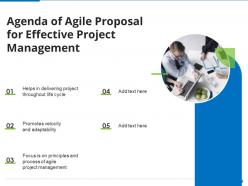
Slide 2: The slide is titled “Agenda of Agile Proposal for Effective Project Management”. It covers the topics: Helps in delivering projects throughout the life cycle, Promotes velocity, and adaptability.
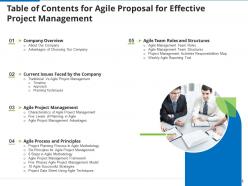
Slide 3: The slide is titled “Table of Contents for Agile Proposal for Effective”. It covers Agile Project Management, Agile Team Roles, etc.
Slide 4: The slide is titled “Company Overview”. It covers About Our Company, Advantages of Choosing Our Company.
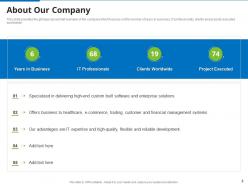
Slide 5: The slide is titled “About Our Company”. It provides a glimpse of a brief overview of the company which focuses on the number of years in business, IT professionals, clients, and projects executed worldwide.
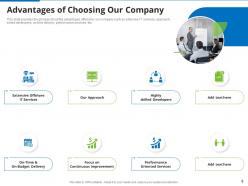
Slide 6: The slide is titled “Advantages of Choosing Our Company”. It provides a glimpse of the advantages offered by our company such as extensive IT services, approach, skilled developers, on-time delivery, performance services, etc.
Slide 7: The slide is titled “Table of Contents for Agile Proposal for Effective Project Management”. It covers Current Issues Faced by the Company, Traditional Vs Agile Project Management Timeline, Approach, Planning Techniques.
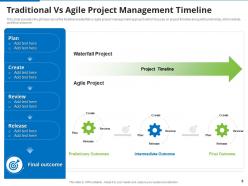
Slide 8: The slide is titled “Traditional Vs Agile Project Management Timeline”. It provides a glimpse about the traditional waterfall vs agile project management approach which focuses on project timeline along with the preliminary, intermediate, and final outcome.
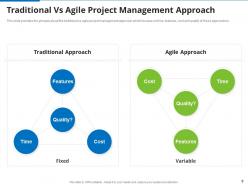
Slide 9: The slide is titled “Traditional Vs Agile Project Management Approach”. It provides a glimpse about the traditional vs agile project management approach which focuses on the time, features, cost, and quality of these approaches.
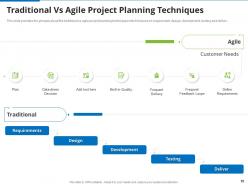
Slide 10: The slide is titled “Traditional Vs Agile Project Management Approach”. It provides a glimpse about the traditional vs agile project planning techniques which focuses on the requirement, design, development, testing, and delivery.
Slide 11: The slide is titled “Table of Contents for Agile Proposal for Effective Project Management”
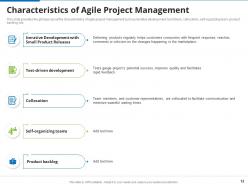
Slide 12: The slide is titled “Characteristics of Agile Project Management”. It provides delivery about the characteristics of agile project management such as iterative development, test-driven, collocation, self-organizing team, product backlog, etc.
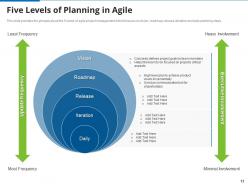
Slide 13: The slide is titled “Five Levels of Planning in Agile”. It provides a glimpse about the 5 levels of agile project management which focuses on vision, roadmap, release, iteration, and daily planning steps.
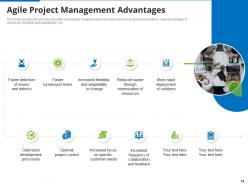
Slide 14: The slide is titled “Agile Project Management Advantages”. It provides a glimpse of the advantages of agile project management such as deployed solutions, reduced wastage of resources, flexibility and adaptability, etc.
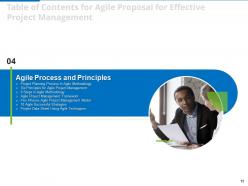
Slide 15: The slide is titled “Table of Contents for Agile Proposal for Effective”. It provides information about Agile Process and Principles, Project Planning Process in Agile Methodology, Six Principles for Agile Project Management, etc.
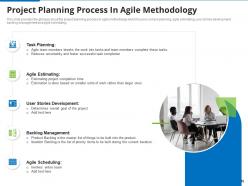
Slide 16: The slide is titled “Project Planning Process In Agile Methodology”. It provides a glimpse about the project planning process in agile methodology which focuses on task planning, agile estimating, user stories development, backlog management, and agile scheduling.
Slide 17: This slide is titled “Six Principles for Agile Project Management”. It provides a glimpse about the 6 principles for agile project management such as close interaction, delayed decision making, adaptive leadership, etc.
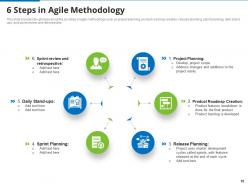
Slide 18: The slide is titled “6 Steps in Agile Methodology”. It provides a glimpse about the six steps in agile methodology such as project planning, product roadmap creation, release planning, etc.
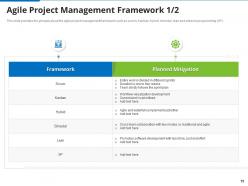
Slide 19: This slide is titled “Agile Project Management Framework”. It provides a glimpse about the agile project management framework such as Scrum, Kanban, hybrid, bimodal, lean, and extreme programming (XP).
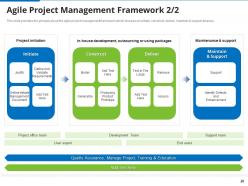
Slide 20: The slide is titled “Agile Project Management Framework”. It provides a glimpse about the agile project management framework which focuses on initiating, constructing, delivering, maintaining & support phases.
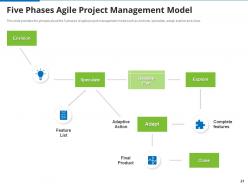
Slide 21: The slide is titled “Five Phases Agile Project Management Model”. It provides a glimpse about the 5 phases of the agile project management model such as envision, speculate, adapt, explore and close.
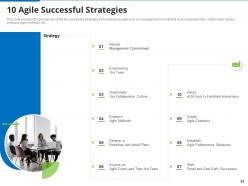
Slide 22: The slide is titled “10 Agile Successful Strategies”. It provides a glimpse about the ten successful strategies for transitioning agile such as management commitment, team empowerment, collaborative culture, embracing agile methods, etc.
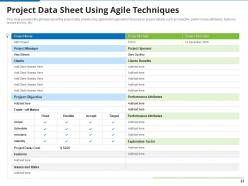
Slide 23: The slide is titled “Project Data Sheet Using Agile Techniques”. It provides a glimpse about the project data sheet using agile techniques which focuses on project details such as the objective, performance attributes, features, issues & risks, etc.
Slide 24: The slide is titled “Table of Contents for Agile Proposal for Effective”. It provides an overview of Agile Team Roles and Structures.
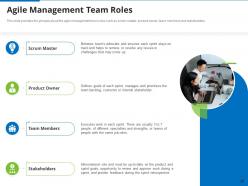
Slide 25: The slide is titled “Agile Management Team Roles”. It provides a glimpse about the agile management team roles such as scrum master, product owner, team members, and stakeholders.
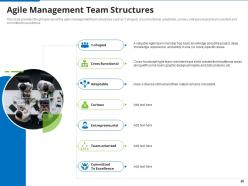
Slide 26: The slide is titled “Agile Management Team Structures”. It provides a glimpse about the agile management team structures such as T-shaped, cross-functional, adaptable, curious, entrepreneurial, team-oriented, and committed to excellence.
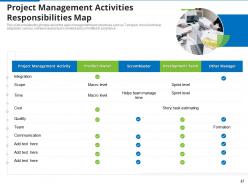
Slide 27: The slide is titled “Project Management Activities Responsibilities Map”. It provides a glimpse of the responsibility map used in a company that focuses on different project management activities and ownership given to different managers.
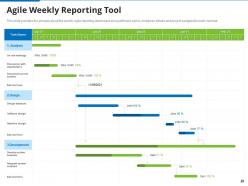
Slide 28: The slide is titled “Agile Weekly Reporting Tool”. It provides a glimpse of the weekly agile reporting dashboard along with task name, employee details, and project assigned to each member.
Slide 29: The slide is titled “Agile Proposal for Effective Project Management (IT)”.
Slide 30: The slide is titled “Additional Slides”.
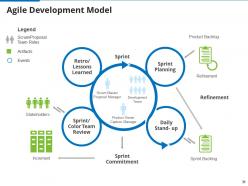
Slide 31: The slide is titled “Agile Development Model”. It gives you an overview of Legend, Events, Artifacts, etc.
Slide 32: The slide is titled “Our Vision Mission Values”. It talks about your vision, mission, and values.
Slide 33: The slide is titled “Linear Diagram”.
Slide 34: The slide is titled “Idea or Bulb”.
Slide 35: The slide is titled “About Us”. Feel free to add valued clients, target audience delivery
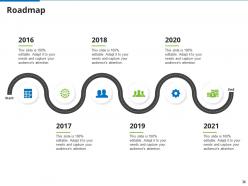
Slide 36: The slide is titled “Roadmap”.
Slide 37: The slide is titled “Our Team”. Feel free to add relevant and factual details.
Slide 38: This is a Thank You slide where details such as the address, contact number, email address are added.
Agile proposal for effective project management it powerpoint presentation slides with all 38 slides:
Use our Agile Proposal For Effective Project Management IT Powerpoint Presentation Slides to effectively help you save your valuable time. They are readymade to fit into any presentation structure.


FAQs for Agile proposal for effective project management it
So Agile breaks down to four big ideas: people matter more than processes, actually ship working stuff instead of writing docs forever, work WITH customers (not against them), and pivot when things change. Which they will, trust me. Short sprints work way better than those massive waterfall projects that take forever. Get feedback early and often. Let your team actually make calls instead of micromanaging everything. The whole point is staying nimble - requirements always shift midstream anyway, so you might as well build that into your workflow from day one.
So basically, Agile chops everything into these short 2-4 week chunks called sprints. Way different from the old school waterfall method where you plan EVERYTHING upfront - which honestly never works out anyway because stuff always changes. With Agile you're rolling with those changes instead of fighting them. Your team ships working pieces regularly so people can actually see what's happening and give feedback. Traditional project management tries to map it all out from day one, but that's kinda unrealistic? If you're dealing with anything that might shift or evolve, definitely go Agile.
So the main ones you'll run into are Scrum, Kanban, and SAFe. Most places use Scrum - it's the whole 2-week sprint thing with daily standups and retrospectives. Kanban uses those visual boards where you move tasks around (weirdly addictive watching stuff go from "doing" to "done"). For big companies trying to coordinate tons of teams, there's SAFe, but honestly it can get pretty heavy. Lean and XP exist too but aren't as common anymore. I'd definitely learn Scrum first since even companies that say they do "agile" usually mean some version of Scrum anyway.
Honestly, just nail the basics first - get your Product Owner, Scrum Master, and dev team roles sorted out. Pick a sprint length that works (we do 2 weeks but whatever). Set up your ceremonies: planning, standups, reviews, and retros. Retros are seriously underrated - that's where you actually fix what's broken. Your Product Owner needs real decision-making power, not just someone who takes orders from above. Keep user stories bite-sized. Oh, and don't stress about doing everything perfectly right away. The whole point is you'll figure out what works through trial and error each sprint.
Stakeholder feedback is huge in Agile - honestly, it's what keeps you from building something nobody wants. Sprint reviews and regular demos let you course-correct before you've wasted weeks going down the wrong path. Way better than waterfall where teams would vanish for months then surface with... well, usually disappointment. When priorities shift (and they always do), that constant feedback loop saves your ass. Don't make the mistake of waiting until sprint end though - check in early and often. Multiple touchpoints per sprint will save you so much headache later.
Honestly, don't get too caught up in all the fancy metrics at first. Yeah, track your sprint velocity and burn-downs - that stuff matters. But the real question is whether customers actually like what you're building. Are they using it? Giving good feedback? Your team's happiness is huge too - if retrospectives aren't fixing real problems, something's off. Pick maybe 2-3 things that actually matter for your project. I made the mistake early on of tracking everything and it was just noise. Focus on what tells you if you're solving actual problems, not just hitting arbitrary numbers.
You'll definitely get faster delivery and way better collaboration between teams. Plus when requirements inevitably change halfway through (they always do), you can actually pivot without everything falling apart. Stakeholders eat up those regular check-ins too. Fair warning though - the transition's pretty brutal at first. Management usually freaks out about not having those detailed upfront timelines, and teams get weird about planning in smaller chunks instead of mapping out everything on giant Gantt charts. Cultural shift's the hardest part honestly. I'd say pick one small pilot project first, see how it goes, then expand from there.
So here's the thing about Agile - it's basically designed around constantly getting better. Every sprint ends with a retrospective where your team talks through what sucked and what didn't. Then you actually use that stuff in the next sprint instead of just filing it away somewhere. The short cycles are clutch because when something's not working, you don't have to wait months to fix it. Daily standups help too since problems come up fast. Honestly, if you're not doing retros every two weeks yet, start there. That's where teams actually level up instead of just spinning their wheels on the same issues forever.
There are a few ways to tackle backlog prioritization that actually work. MoSCoW is probably the easiest starting point - just bucket everything into Must, Should, Could, Won't have. Value vs. effort matrices are clutch because you can literally see the quick wins (though honestly, sometimes the "low effort" stuff ends up being way harder than expected). Kano analysis gets into the weeds of customer satisfaction if you need that level of detail. Weighted scoring works when you're juggling multiple factors like risk and dependencies. The trick is sticking with whatever method you pick instead of constantly switching approaches. I'd go with MoSCoW first - it gets everyone on the same page without overthinking it.
Honestly, you're gonna need really solid digital tools and way more check-ins than feels normal. Miro and Figma are lifesavers for brainstorming sessions. Daily standups should actually be daily - I know it sounds obvious but teams slack on this constantly. Video calls work better than chat for anything complicated, even though we're all burnt out on Zoom. Keep your sprint boards visible all the time with Jira or Trello. Better to over-communicate than have someone confused for days. Set up dedicated Slack channels for each sprint and don't hesitate to jump on quick calls when things get messy.
Stick with velocity, burndown charts, and cycle time - those are your bread and butter. Velocity shows how much your team actually gets done each sprint. Burndown charts track if you're hitting sprint goals. Cycle time is huge though - it measures start to finish on tasks and you'll spot bottlenecks like crazy. Oh, and definitely track your sprint goal success rate plus team happiness during retros. I've seen teams drown in metrics before, so don't go nuts. These basics will tell you what you need to know, then add more later if something specific is bugging you.
Agile's great for innovation because you're doing these short sprints, right? So teams feel way safer experimenting - worst case, you pivot in two weeks instead of being stuck for months. Daily standups actually spark creativity too (who knew?). But honestly, the biggest thing is just removing all that bureaucratic nonsense. When people aren't drowning in documentation and waiting forever for approvals, their brains work differently. They get weird ideas and actually try them. My advice? Tell your team it's totally fine to fail fast next sprint. You'll be shocked how much creative stuff happens when the pressure's off.
Team autonomy is huge for Agile - honestly, it's what makes or breaks most teams. Give them real control over their daily work, tools, and problem-solving approaches. You'll see engagement skyrocket. But here's the thing - you can't just throw them in the deep end. They need clear boundaries about what decisions are theirs versus what goes upstairs. Psychological safety matters too, obviously. Start small with process decisions, then expand as trust grows. I've watched teams completely flip once they got that freedom. It's pretty incredible actually.
Honestly, the Agile Manifesto completely flipped project management on its head. Instead of drowning in documentation and rigid plans, it puts people and collaboration first. Way more practical, right? Teams now work in short sprints, adapt quickly to changes, and actually talk to each other. It started in software but now everyone's using it - marketing teams, HR, you name it. The original manifesto is super short (like a page?) but those four values still drive how most teams operate today. Definitely worth reading if you're stuck in old-school project hell.
Absolutely! Just focus on the main ideas instead of all the software stuff. My friend's marketing team does this and honestly it works way better than their old approach. Break everything into short sprints - like two weeks max. Daily check-ins keep everyone on track. Don't wait months to show results; get feedback constantly from whoever's paying for it. Make a list of tasks, then shuffle priorities weekly based on what you learn. The whole point is staying flexible rather than sticking to some rigid plan that's probably wrong anyway. Start small and you'll see what I mean.
-
Informative presentations that are easily editable.
-
Great designs, Easily Editable.
-
Nice and innovative design.
-
Excellent template with unique design.