

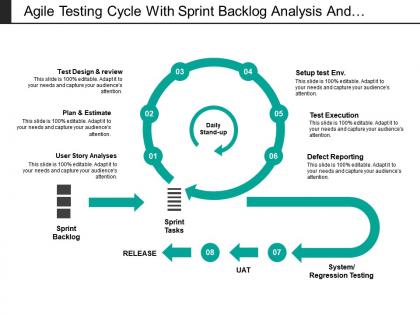
Agile testing cycle with sprint backlog analysis and text execution




Try Before you Buy Download Free Sample Product
 Impress Your
 Audience
 100%
100% Editable
 Save Hours
 of Time


Applaud insistence on adhering to facts with our Agile Testing Cycle With Sprint Backlog Analysis And Text Execution. Appreciate faithful journalism.
People who downloaded this PowerPoint presentation also viewed the following :
Agile testing cycle with sprint backlog analysis and text execution with all 5 slides:
Put out your advice for all to see. Boldly display it on our Agile Testing Cycle With Sprint Backlog Analysis And Text Execution.


FAQs for Agile testing cycle with sprint backlog analysis
Agile Testing principles include continuous testing throughout development cycles, collaborative cross-functional team integration, early defect detection, customer feedback incorporation, and adaptive test planning based on evolving requirements. These approaches streamline quality assurance by eliminating lengthy testing phases, enabling faster releases, and maintaining product quality, with many software development teams finding that this integration ultimately delivers more reliable products and enhanced customer satisfaction.
Agile Testing facilitates better collaboration by integrating developers and testers throughout the development cycle, encouraging shared responsibility for quality, and promoting continuous communication through daily standups and sprint planning. This collaborative approach streamlines feedback loops, reduces defect resolution time, and enhances product quality, with many software teams finding that cross-functional integration ultimately delivers faster releases and improved customer satisfaction.
Automated testing enhances Agile Testing by enabling continuous integration, faster feedback loops, regression testing at scale, and consistent test execution across development cycles. Through automated frameworks, teams streamline repetitive testing tasks, minimize human error, and accelerate release cycles, with many software organizations finding that automation delivers improved code quality and competitive time-to-market advantages.
Common Agile Testing tools include Selenium for automated web testing, JIRA for defect tracking and project management, Jenkins for continuous integration, TestNG for unit testing frameworks, and Cucumber for behavior-driven development. These tools streamline testing cycles by enabling faster feedback loops, seamless integration with development workflows, and comprehensive test coverage, with many development teams finding that strategic tool combinations significantly reduce time-to-market while maintaining quality standards.
Teams ensure continuous testing by integrating automated test suites into CI/CD pipelines, implementing test-driven development practices, conducting regular sprint reviews, and maintaining collaborative communication between developers and testers. Through these approaches, organizations streamline quality assurance, accelerate release cycles, and minimize defects in production, with many software teams finding that embedded testing delivers faster deployment and enhanced product reliability.
User stories serve as the foundation for Agile Testing by defining acceptance criteria, guiding test case creation, and ensuring testing aligns with customer requirements and business value. These narratives enable testing teams to validate functionality from the user's perspective, streamline communication between developers and testers, and prioritize testing efforts based on user needs, ultimately delivering higher quality software that meets actual business objectives.
Agile Testing metrics focus on velocity, sprint burndown, defect density per iteration, and customer satisfaction scores, while traditional methodologies emphasize milestone-based metrics like defect removal efficiency and phase-gate completion rates. These agile approaches enable real-time course corrections, faster feedback loops, and continuous quality improvement, with many development teams finding that sprint-focused metrics deliver better visibility and stakeholder alignment than waterfall measurements.
Agile Testing challenges include coordinating continuous testing cycles with rapid development sprints, maintaining comprehensive test coverage across frequent releases, adapting traditional testing processes to iterative workflows, and ensuring effective communication between cross-functional team members. These implementation hurdles often require teams to restructure their testing strategies, invest in automation tools, and develop new collaboration frameworks, with many organizations finding that overcoming initial resistance ultimately delivers faster delivery cycles and improved software quality.
Exploratory testing integrates into Agile frameworks through sprint-based testing sessions, collaborative test charters with development teams, and continuous feedback loops during daily standups. This approach enables testers to uncover unexpected issues, validate user stories in real-time, and adapt testing strategies based on emerging requirements, ultimately delivering higher software quality and faster release cycles.
Strategies include continuous stakeholder communication, maintaining flexible test documentation, implementing risk-based testing prioritization, utilizing automated regression suites, and conducting regular sprint retrospectives. These approaches streamline requirement changes by enabling rapid test case updates, ensuring critical functionality remains protected, and facilitating seamless collaboration between development teams, ultimately delivering faster releases while maintaining quality standards across evolving project scopes.
Agile Testing practices accelerate delivery by enabling continuous feedback loops, automated regression testing, early defect detection, and parallel development-testing cycles. Through test-driven development and integrated quality assurance, teams streamline release processes, reduce post-deployment issues, and enhance customer satisfaction, with many software organizations finding that embedded testing delivers competitive advantages in increasingly dynamic markets.
The Definition of Done establishes clear, shared criteria for when testing activities and user stories are truly complete, ensuring consistent quality standards across development cycles. This framework enhances transparency between developers and testers, streamlines release processes, and minimizes defects reaching production, with many agile teams finding that well-defined completion criteria significantly accelerate delivery timelines.
Feedback loops in Agile Testing can be optimized through continuous integration, automated testing at multiple levels, real-time collaboration between developers and testers, frequent stakeholder reviews, and immediate defect reporting. These practices enable teams to identify issues earlier, reduce debugging time, and accelerate delivery cycles, with many software organizations finding that streamlined feedback ultimately delivers higher quality products and faster time-to-market.
Testing-focused retrospectives should include reviewing test coverage gaps, analyzing defect trends, evaluating automation effectiveness, assessing team collaboration between testers and developers, and examining feedback loops with stakeholders. These practices enhance quality assurance by identifying process bottlenecks, streamlining test execution workflows, and fostering continuous improvement cultures, with many agile teams finding that structured retrospectives significantly reduce testing cycle times while improving overall product reliability.
Agile Testing supports DevOps and continuous delivery by enabling frequent feedback loops, automated testing integration, and collaborative quality assurance throughout development cycles. Through continuous integration pipelines, organizations streamline deployment processes, minimize production defects, and accelerate time-to-market, with many software teams finding that integrated testing ultimately delivers faster releases and enhanced customer experiences.
-
Very unique, user-friendly presentation interface.
-
Great designs, really helpful.